
Business News
India's livelihood journey since Independence, told through 10 sectors and an extraordinary shift

5 min read | Updated on August 14, 2026, 07:09 IST


SUMMARY
When seen together, the numbers since 1951 reveal more than just a larger workforce. They narrate the story of how the Indian economy has steadily broadened its employment base.

Salaried employment has increased 10x from 1.48 crore in 1951.
The story of livelihood in India since Independence is not merely about jobs. Rather, I believe, it is the story of an extraordinary shift in scale across multiple sectors.
While documenting every sector's journey would require more than a single article, a quick comparison of 10 sectors offers a snapshot of how India earns its living in 2026 compared with 1951.
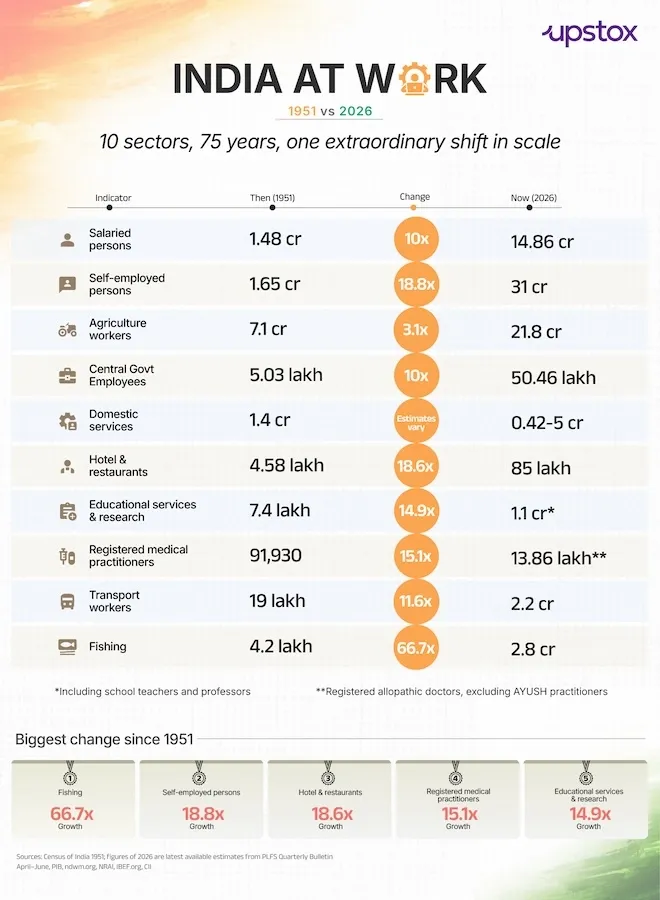
The numbers narrate the story of growth in livelihood options (see infographics below), showing how India's workforce has expanded much beyond agriculture since Independence.
Agriculture remains massive, but no longer alone
There isn't much official data to talk about the year of Independence, 1947. The earliest reliable data on India's quest for livelihood that I could find is the Census of India 1951, which shows nearly 20% of people, or 7.1 crore of the then 36 crore population between January 1950 and March 1951, had agriculture as their main source of livelihood.
The Census classified the people dependent on agriculture for livelihood as "agriculturists", defining them as "anyone whose income is derived from the cultivation of land (whether this be in the form of net profits of cultivation, or of wages for employment as cultivating labourer, or of rent received by virtue of vested rights by a non-cultivating land-holder)."
While the 21.8 crore workers in the agriculture sector are still massive, there has been just a three-fold increase in their absolute numbers since 1951, which is modest compared with many other sectors.
The livelihood story today is being shaped far beyond the farm.
Rise of self-employment and salaried
There has been nearly 18.8 times increase in the number of self-employed workers since 1951. While the Census of 1951 classified 1.65 crore persons as self-employed, noting, "self-employed persons (other than employers) are... more numerous than employers and employees combined," this number has grown to nearly 31 crore as per the latest PLFS bulletin.
Salaried employment has increased 10x from 1.48 crore in 1951 to nearly 15 crore in 2026.
Services revolution
Livelihood opportunities through education and medical services have also grown manifold since Independence.
Nearly 7.4 lakh people were working in the educational services and research in 1951. At present, the government's estimate suggests school and university/college teachers alone account for nearly 1.1 crore workers.
Rising medical professionals
The number of registered medical professionals has grown nearly 15.1x since 1951.
The Census of 1951 captured separate data for registered medical practitioners, nurses, compounders, vaccinators, and unregistered vaids, hakims as follows:
| Category | Count |
|---|---|
| Registered medical practitioners | 91,930 |
| Vaids, hakims and other persons practicing medicine without being registered | 96,147 |
| Compounders | 38,407 |
| Nurses | 31,517 |
| Midwives | 23,938 |
| Vaccinators | 5,928 |
| Dentists | 3,283 |
Source: Census of India 1951
According to the [Ministry of Health and Family Welfare](Ministry of Health and Family Welfare), there are now 13.86 lakh registered allopathic doctors as well as 7,51,768 registered AYUSH practitioners. Not only this, there are 42.94 lakh registered nursing personnel, supported by 5,253 nursing institutions producing nearly 3.87 lakh nurses annually.
Moving people and goods & growing government's footprint
The growing economic footprint of the country since Independence has created a massive source of livelihood in the transport sector. Data shows the number of transport workers has risen from just 19 lakh in 1951 to around 2.2 crore, an 11.6-fold jump.
Surprise leap in fishing
While going through the Census of 1951, one piece of data that I could not resist comparing with the present times was of people engaged in fishing in 1951 and now. There were 4.2 lakh fishing workers in 1951, which grew nearly 66.7 times to 2.8 crore.
When seen together, the numbers reveal more than just a larger workforce. They narrate the story of how the Indian economy has steadily broadened its base of employment.
Related News



About The Author
Next Story

