
Business News
India’s journey to the world’s most populous nation and a $4 trillion economy

4 min read | Updated on August 13, 2026, 19:59 IST


SUMMARY
On the occasion of India's 80th Independence Day on August 15, let's take a look at how India's journey was to become the world’s most populous nation with a $4 trillion economy.
India will celebrate 80th Independence Day on Saturday, August 15, 2026. | Image: Shutterstock
People of India are all set to celebrate their 80th Independence Day on Saturday, August 15, 2026, as the country now aims big towards its ‘Viksit Bharat 2047’ goal with key focus on the youth powering the nation to transform into a developed country.
After around 200 years of British colonial rule, India achieved independence on the evening of August 15, 1947, emerging into the independent nation which over the years have successfully become a home of a $4 trillion economy.
With India becoming the fourth-largest economy in the world, surpassing Japan in 2025, the country has also emerged as the world's most populous nation with an estimated population of more than 147 crore as of 2026.
India’s vis-à-vis growth of population and gross domestic product (GDP) is the main structure of the country’s overall growth story which started from the year of independence.
On account of this historically significant event of August 15, let's take a look at India’s journey to become the world's most populous nation and a $4 trillion economy in terms of GDP growth.
How has population grown since 1947?
India’s first post-independence Census count was carried out in the year 1951, which showed that there were 36.10 crore people in the country which back then had a GDP of approximately $22 billion.
The country’s national population census is a scheduled event which is supposed to be carried out on every 10 year interval and is managed by the Ministry of Home Affairs’ Office of the Registrar General & Census Commissioner.
So far since 1947, India has carried out seven (7) official census counts till the year 2011, after which the 2021 census was postponed due to the unexpected global pandemic COVID-19.
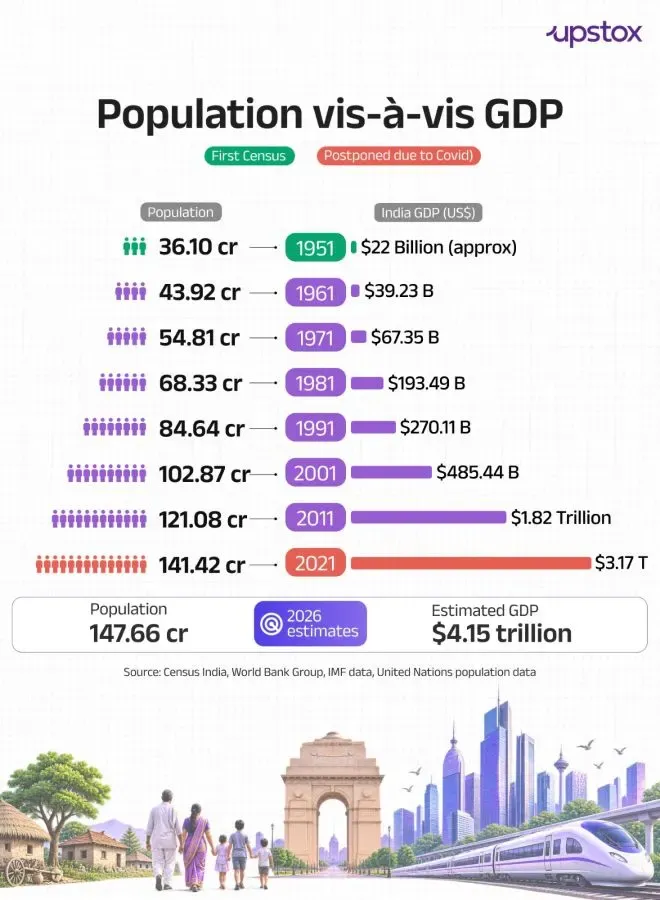
The official Census Bureau data showed that India’s population for 1961 was at 43.92 crore, followed by 54.81 crore in 1971, 68.33 crore in 1981, 84.64 crore in 1991, 102.87 crore in 2001, and the last data of 121.08 crore people in 2011.
However, United Nations Population Division data projects that in 2026, India’s total population is estimated to range around 147.66 crore as the country is expected to touch $4.15 trillion in GDP.
India’s GDP growth over the years
While the population is estimated to cross 147 crore by the end of the calendar year 2026, India’s GDP growth since Independence also shows how the country has achieved its position as the fourth-largest economy of the world.
India’s GDP in value terms was approximately around $22 billion back in the first Census year of 1951, which later surged to $39.23 billion in 1961, $67.35 billion in 1971, $193.49 billion in 1981, and $270.11 billion in 1991.
With the turn of the century, India’s GDP extended its gains to $485.44 billion in 2001 and later to $1.82 trillion in the last official census year of 2011.
Although the 2021 data was not released, World Bank data showed that India’s GDP growth in US$ value terms extended to $3.17 trillion.
Looking ahead, the estimates are pegged around a $4.15 trillion economy by the end of the current calendar year.
India’s 2036 growth projections
In the next 10 years or by the year 2036, India’s population is expected to reach around 158.83 crore, according to United Nation Population Division estimates.
As per Niti Aayog data, India’s GDP per capita projections for the year 2036-37 is projected at ₹2.7 lakh under baseline and ₹3.5 lakh under an aspirational scenario. The report also mentioned that in a pessimistic situation, the GDP per capita projections is estimated to be at ₹1.9 lakh per person in the same period.
Data collected from People's Archive of Rural India (PARI) suggest that in the next 10 years, India’s population density is expected to reach 463 people per square kilometres (km) by 2036, in comparison with 368 people per sq. km back in 2011, the last Census year.
The report also mentioned that while the population is expected to surpass over 150 crore by 2036, the urban population is estimated to occupy 38.2% of the total market share, compared to a 31.8% share back in 2011.
The Asian country which was colonised for over 200 years, is now focused on driving growth to become an Atmanirbhar Bharat (Independent India) with key focus on boosting domestic manufacturing, services and agricultural sector along with powering exports to world nations.
Related News

About The Author
Next Story

