
Business News
How two-wheelers outpaced cars on Indian roads since Independence

3 min read | Updated on August 13, 2026, 18:13 IST


SUMMARY
While car ownership expanded rapidly after Independence, the growth of two-wheelers was even more explosive, reflecting the country's economic development, urbanisation, and increasing demand for affordable personal mobility.
The fastest expansion of two-wheelers occurred between the 1970s and 1990s.
India had more registered cars than two-wheelers at the time of Independence. Surprising, but true. Cut to 2026, India's registered two-wheeler fleet is over 5x larger than the number of registered cars on its roads. The automotive landscape in the country has literally undergone a dramatic transformation over the last seven decades.
Data from the Ministry of Road Transport and Highways (MORTH) shows that while car ownership expanded rapidly, the growth of two-wheelers was even more explosive, reflecting the country's economic development, urbanisation, and increasing demand for affordable personal mobility.
While the exact figures for cars and bikes on Indian roads in 1947 are not available, vehicle registration data from 1951 show there were 1.59 lakh cars and just 27,000 two-wheelers at that time.
When India got Independence in 1947, there was hardly any automobile industry in India. Cars were imported from England in a knocked-down condition, reassembled and served to a very small market comprising the ruling British and some Indian elites. Later, this led to the emergence of an indigenous spare parts industry, according to a report by the Ministry of Statistics and Programme Implementation (MoSPI).
Not just the cars, there was hardly any industry for two-wheelers. A research paper by the World Intellectual Property Organization (WIPO) says the two-wheeler industry in India grew between the 1950s and 1980s, a period which was marked by very few Indian brands, limited access for foreign companies, and limited vehicle options.
"One of the early players in the scooter market was Bajaj, which began trading imported Vespa scooters in 1948. Later, in 1959, Bajaj started manufacturing these scooters under license from Piaggio. This agreement expired in 1971," says the paper titled, "The Evolution of the Two-Wheeler Industry: A Comparative Study of Italy, Japan, and India".
However, the picture changed dramatically as India's growth picked up.
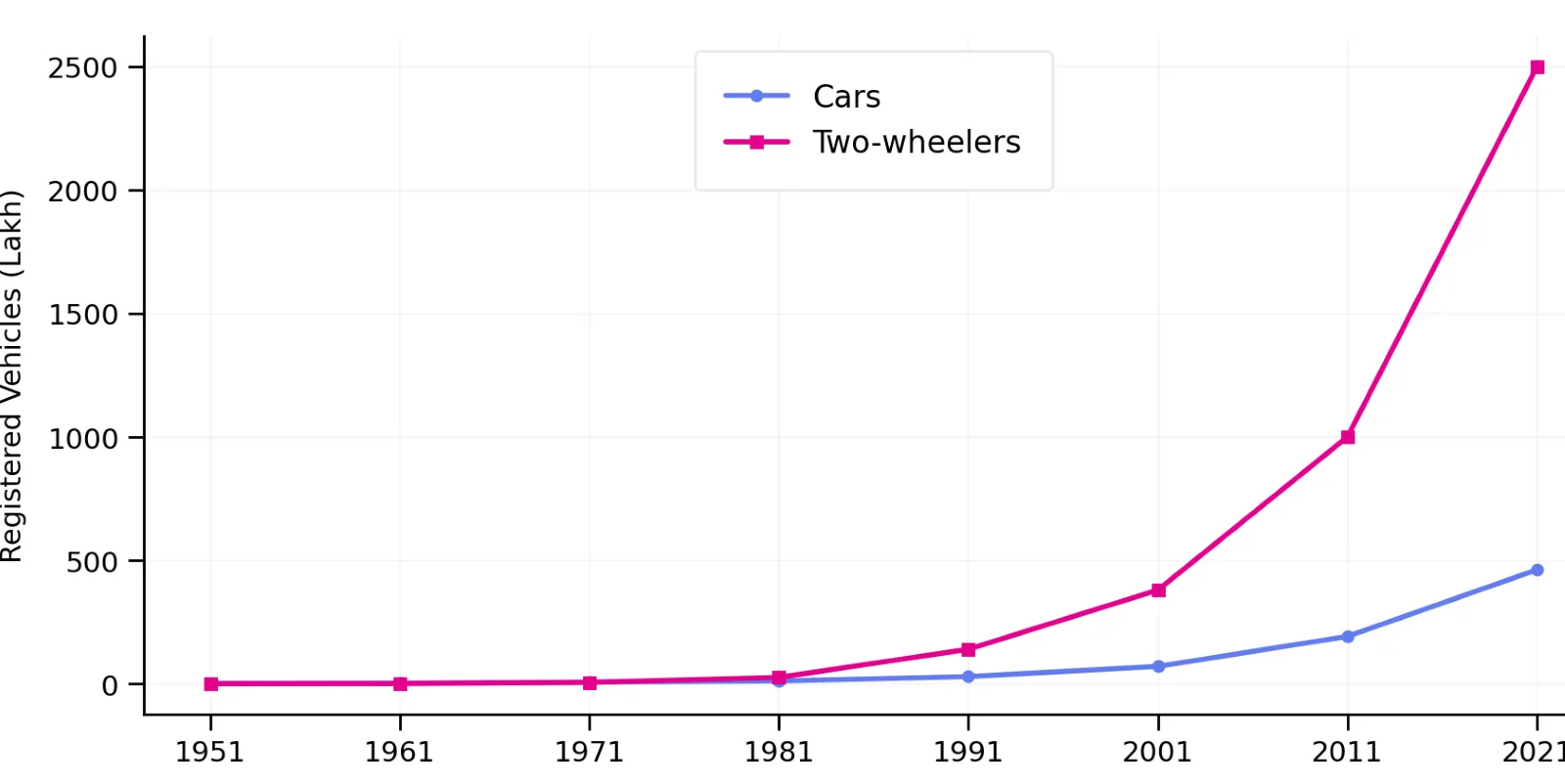
By 2021, there were 4.62 crore registered cars, including jeeps and taxis, and 25 crore registered two-wheelers, recording 290x growth in registered cars and 9,259x jump in registered two-wheelers since 1951.
The numbers reveal that while car ownership has expanded steadily, two-wheelers have become the dominant mode of private transport for millions of Indians.
As you can see in the above chart, the gap between cars and two-wheelers widened sharply after the 1980s, with two-wheeler registrations accelerating much faster and reaching 25 crore by 2021, compared with 4.62 crore cars.
Decade-wise growth of cars
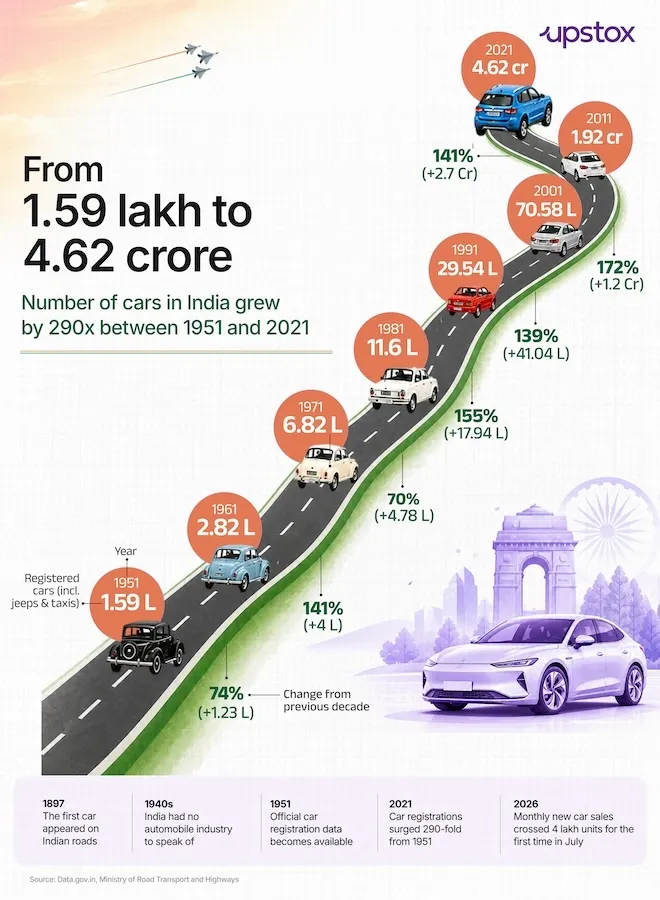
Car growth accelerated after economic liberalisation in the 1990s. Rising incomes, easier financing, expanding highways, and greater vehicle choice pushed registrations sharply higher.
Decade-wise growth of two-wheelers
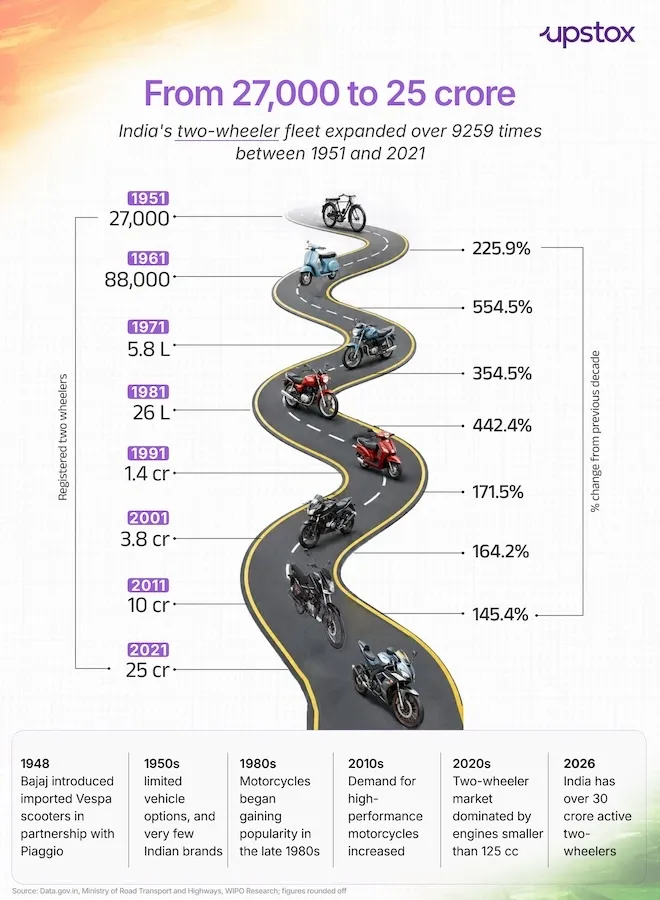
The fastest expansion of two-wheelers occurred between the 1970s and 1990s as motorcycles and scooters emerged as an affordable transport solution for the middle-class households.
As we celebrate the 80th Independence Day, the comparison highlights that economic growth increased demand for all forms of personal transport, but two-wheelers emerged as the backbone of mobility.
Even in 2021, registered two-wheelers outnumbered cars by more than five times, demonstrating their continuing importance to commuters across urban and rural India.
Related News
About The Author
Next Story

