
Upstox Originals
Your next health diagnosis could come years in advance
7 min read | Updated on December 11, 2025, 15:05 IST


SUMMARY
What if illness could be spotted long before it shows up, and your data warned you before your body did? While many have tried doing this in the past, with AI and advanced data processing, this can soon be a reality. That’s the promise of generative AI like Delphi-2M, which claims it can predict the risk of 1,000+ diseases. Let’s unpack what this shift could mean for the future of healthcare.

Healthcare AI is now one of the fastest-growing segments in the global GenAI market, expected to reach $22 billion by 2027
If you want a glimpse of where global healthcare is headed, you might not have to look very far.
Here is one example: Apollo Hospitals already offers a preview. Its AI-led cardiac risk model now predicts outcomes for Indian patients more accurately than global benchmarks like Framingham. Its connected-care network uses IoT, real-time analytics, and the cloud to monitor patients continuously, cutting medical crises by 80%, reducing nurse workload by 70%, and saving doctors 44 hours a month through automated transcription.
It’s one hospital system, true.
But it tells us something bigger: AI in healthcare isn’t theoretical anymore. It’s working. Quietly. Repeatedly. And at scale. Which raises the real question: If this is what a single network can do, what does the global picture look like?
That’s where the data steps in.
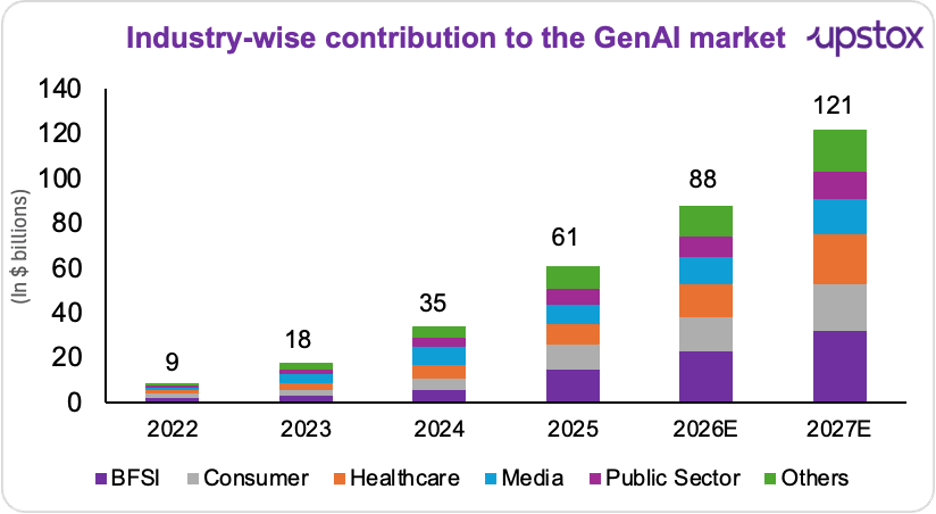
Healthcare is now one of the fastest-growing segments in the global GenAI market. The sector is projected to reach $22 billion by 2027, fuelled by investments in diagnostic models, remote monitoring systems, accessibility tools, population-health engines, and AI-driven drug development.
And the contribution chart makes this shift clearer. BFSI and consumer tech still dominate the market. But from 2024 onward, healthcare’s slice starts widening; slowly, consistently, and unmistakably.
Because AI is solving the exact bottlenecks the sector has struggled with for years: slow diagnosis, high workloads, limited specialists, and mountains of administrative tasks.
Source: World Economic Forum
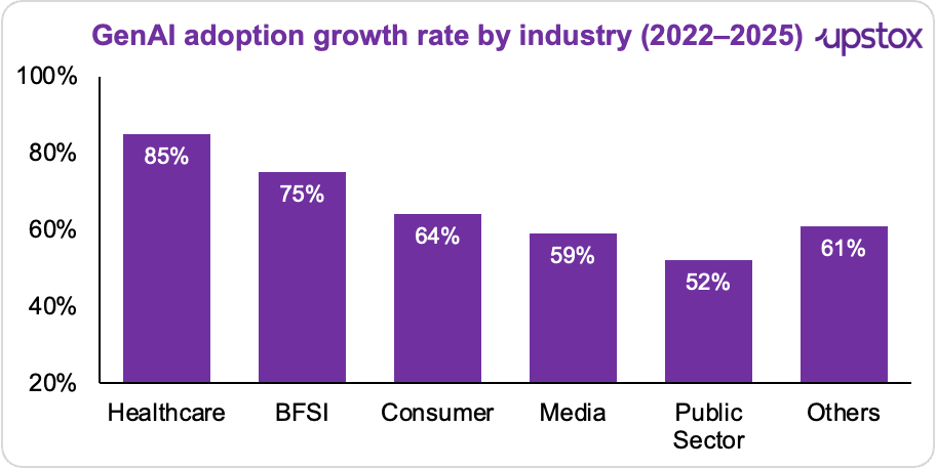
The data below tells us who’s moving. And here, healthcare steals the show. Between 2022 and 2025, healthcare’s GenAI adoption jumps a massive 85% ; the highest across all industries.
Source: World Economic Forum
The age of predictive healthcare
Unlike yesterday’s diagnostic tools, Delphi-2M reads your medical records as a continuous narrative, not isolated snapshots. Powered by transformer deep learning and validated on massive datasets, it predicts the next likely disease and even its timing, across more than 1,200 conditions.
Think of it as a health storyteller, piecing together genetics, lifestyle, and past illnesses to produce a probability map rather than a diagnosis. The result? Doctors, hospitals, and insurers can intervene earlier, plan better, and push care toward the preventive end of life.
And Delphi-2M isn’t alone. There’re others too.
Researchers at Imperial College London have developed AIRE-CHB, an AI tool that reads an ECG and predicts complete heart block, a potentially fatal condition, with 89% accuracy, far ahead of traditional methods. Trained on over 1.1 million ECGs, it identifies high-risk patients up to 12x more likely to develop the condition, even when their ECG looks normal today.
Together, these tools signal a profound shift; diagnosis is no longer about spotting what’s wrong today, but what might go wrong tomorrow.
How far has India come in AI-powered healthcare?
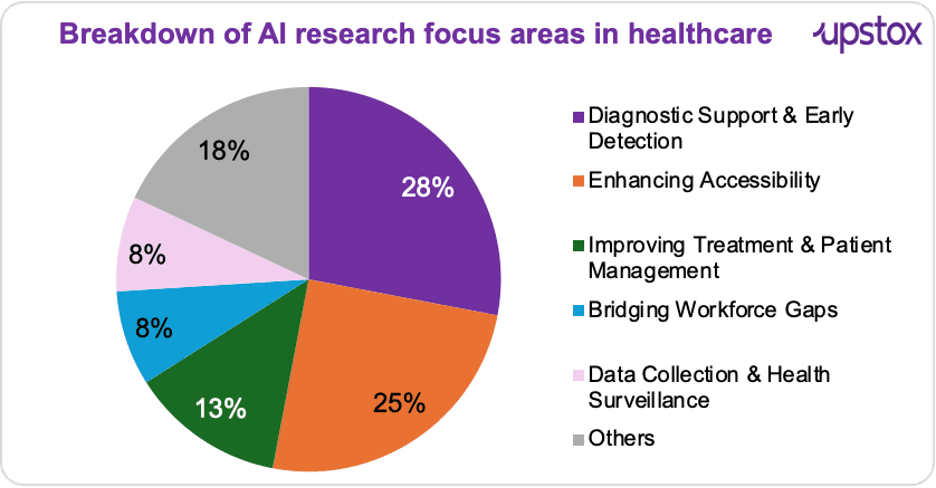
If you look at India’s AI research, the priorities scream loud and clear: 28% is chasing earlier diagnosis, 25% is breaking accessibility barriers, and 13% is sharpening treatment and patient management. Translation? We’re using AI to spot diseases sooner, reach patients faster, and treat them smarter, in that order.
Source: Science Direct
Numerous published studies on conditions like cancer, mental health, diabetes, heart disease, and Alzheimer's dementia support the rapidly growing role of AI in disease diagnosis
Let us understand a few examples:
1) Mental health gets a digital boost
Fortis Healthcare is a good example. Its AI-powered Adayu Mindfulness platform offers multilingual assessments, 24/7 emotional support, automated triage, and therapy guidance. In a field where stigma and staffing shortages slow down care, AI becomes the bridge, helping patients open up, get screened faster, and access support around the clock.
2) AI is plugging gaps across the care chain
It’s not just one company. Innovators such as Lupin, Qure.ai, Tricog, Niramai, and research institutions like AIIMS Delhi are deploying AI across cardiology, cancer screening, radiology, and digital therapeutics. They’re doing what traditional systems struggled with:
-
delivering real-time cardiac analysis
-
detecting cancers earlier
-
supporting doctors with imaging backlogs
-
running mobile health platforms that travel to rural communities
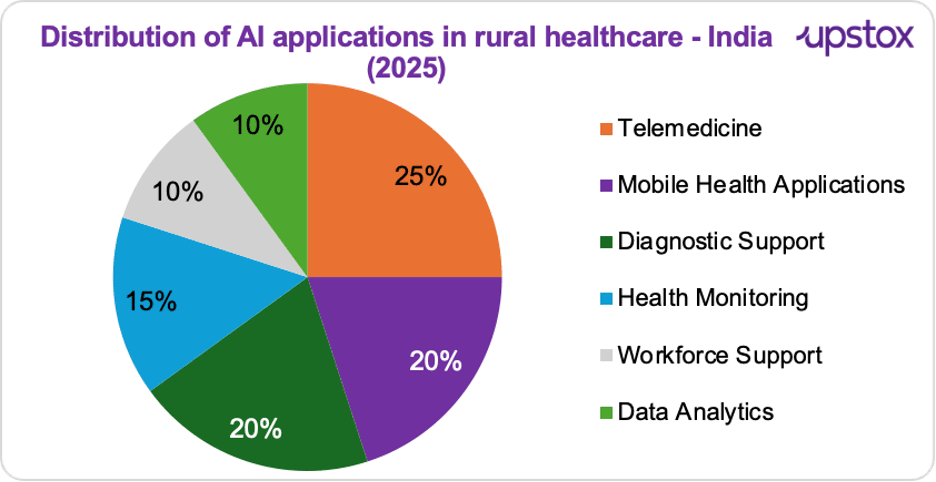
And this shift is not only limited to big hospitals or metro cities. Even in rural India, AI is changing care delivery by filling workforce gaps and making essential health services more accessible.
Here is how AI applications are distributed across rural healthcare today:
Source: Sciencedirect.com
How experts envision the future of AI in health?
Insights from global forums and industry leaders highlight four expert-driven visions defining the future of AI-enabled healthcare:
-
Paradigm shift to well-being: The transition from reactive treatment to prevention is powered by sensors, wearables, and AI, focusing care on well-being and longevity, rather than episodes of illness. Data analytics support continuous assessment and personalised plans for nutrition, physical activity, and mental resilience. For example, AI analyzes real-time data from devices like smartwatches to detect early risks such as irregular heart rhythms, enabling personalized nutrition and activity plans before crises occur.
-
8 billion doctors: With advancements in voice AI, ambient computing, and mobile platforms, every individual could access a virtual AI clinician; offering tailored advice, real-time support, and transcending location and socioeconomic barriers. This demands strong regulatory frameworks and user education to ensure quality care and patient safety. An example is Jivi.ai's MedX, a voice-enabled AI doctor aiming to serve global populations in top languages, providing real-time advice like diabetes management.
-
Operational excellence: AI optimises hospital processes through predictive analytics, document automation, digital twin simulations and ambient listening systems. The result? Fewer administrative burdens and more time for direct patient care, boosting both satisfaction and system efficacy. For instance, machine learning forecasts patient volumes with 90-95% accuracy up to 90 days ahead, optimizing staffing in 15-minute intervals and reducing crises.
-
Health leapfrog: LMICs use AI to leap developmental hurdles in public health, care delivery, and infrastructure, with digital platforms recruiting new patient pathways, reinventing collaborative models, and ensuring sustainable access to advanced medicine even where resources are limited.
These visions are not just theoretical; they reflect the direction of current investments and innovation. Expert groups stress the importance of aligned policies, technological maturity, and strategic partnerships to fully unlock AI’s societal benefits.
Risks you should know about
While AI has definitely made tremendous strides, there are some obvious risks one should be aware of:
-
If the algorithm is inaccurate, it could create larger-than-expected damage and actually even affect a large number of patients.
-
Health providers need to be trained. Incorrect implementation could raise additional security and error issues.
-
These practices are still at the trial stage. Medical authorities and regulators have yet to decisively endorse them. To that extent, one must be careful before relying entirely on them.
Before you go
In the end, AI isn’t trying to replace doctors, it’s trying to give them a head start. The tools we’ve seen, from Delphi-2M to AIRE-CHB, hint at a future where illness doesn’t catch us off guard, and where early warnings become as routine as annual checkups.
The challenge now is less about technology and more about deploying it wisely, building trust, tightening regulation, and ensuring access doesn’t become a privilege. If we get that balance right, predictive healthcare won’t just extend lives. It will change how we live them.
About The Author
Next Story



