
Upstox Originals
Why Maruti chose BYD’s Blade battery for eVitara

5 min read | Updated on March 20, 2026, 16:50 IST


SUMMARY
The eVitara marked Maruti’s EV debut, and it’s all over the headlines! Well, the real story is Maruti leaning on China-assembled BYD LFP packs to power the vehicle. The same chemistry powers 80% of China’s EVs, and it’s safer, cheaper, and longer-lasting. Want to know why this one choice could matter more than the car itself? Read on.

The eVitara comes in at ~₹11 lakh (ex-showroom), while the electric Creta is priced closer to ₹18 lakh | Image: Shutterstock
After years of staying away from electric vehicles, Maruti Suzuki has finally made its move with the Maruti Suzuki eVitara, launched in February 2026.
At ₹10.99 lakh (ex-showroom), the price stands out because it’s significantly lower than most electric SUVs (with similar size and offerings) in India. But that number comes with an important caveat: the battery is not included in the price.
Instead, Maruti has introduced a Battery-as-a-Service (BaaS) model, where users pay ₹3.99 per kilometre for battery usage. The SUV is offered with 49 kWh and 61 kWh battery options, with the larger pack delivering a claimed range of over 500 km. Under the hood, it uses BYD’s full Blade battery pack made from Lithium Iron Phosphate (LFP) battery chemistry.
Is MSIL the first one to offer Battery-as-a-Service?
No, Maruti is not the first to introduce this model.
MG Motor India had already rolled out Battery-as-a-Service (BaaS) with the Windsor EV in September 2024. MG’s BaaS model has seen early traction, with about 15% of its EV buyers opting for it, and adoption is higher in Tier-III markets. As awareness improves, the share is likely to grow further, especially among price-sensitive buyers. What Maruti is doing differently is bringing it to a mass-market SUV like the Maruti Suzuki eVitara.
BaaS separates the cost of the car and the battery. Since the battery makes up 30–40% of an EV’s cost, removing it lowers the upfront price significantly.
That’s why the eVitara starts at ₹10.99 lakh, with battery usage charged at ₹3.99 per kilometre. This directly tackles one of the biggest barriers in India, high initial cost, especially when rivals like the Hyundai Creta Electric are priced around ₹18 lakh with the battery included.
At ₹3.99 per km, driving 12,000 km a year would cost about ₹48,000 annually, or roughly ₹2.4 lakh over five years. So the car isn’t dramatically cheaper, it’s just easier to buy upfront.
At the same time, this model works in Maruti’s favour. Since the battery isn’t sold, it becomes a long-term earning asset.
Now, what does Maruti actually gain from this battery choice?
Other traditional battery types include NMC (nickel manganese cobalt). Both (NMC and LFP) are lithium-ion batteries, meaning they store and release energy through lithium ions. But their focus is different:
The most immediate advantage is cost. Globally, LFP battery packs cost roughly $80–90 per kWh, compared to $100–120 per kWh for NMC batteries used in cars like the Hyundai Creta Electric. On a 60 kWh battery, that translates to savings of around $1,200–1,800 (₹1–1.5 lakh) on the battery pack, which in turn reduces the overall cost of an EV car.
Why the difference? NMC batteries rely heavily on nickel and cobalt, all relatively expensive metals, which makes their prices volatile.
LFP is different. Its cathode is made from lithium iron phosphate; iron and phosphorus, both cheaper and more abundant.
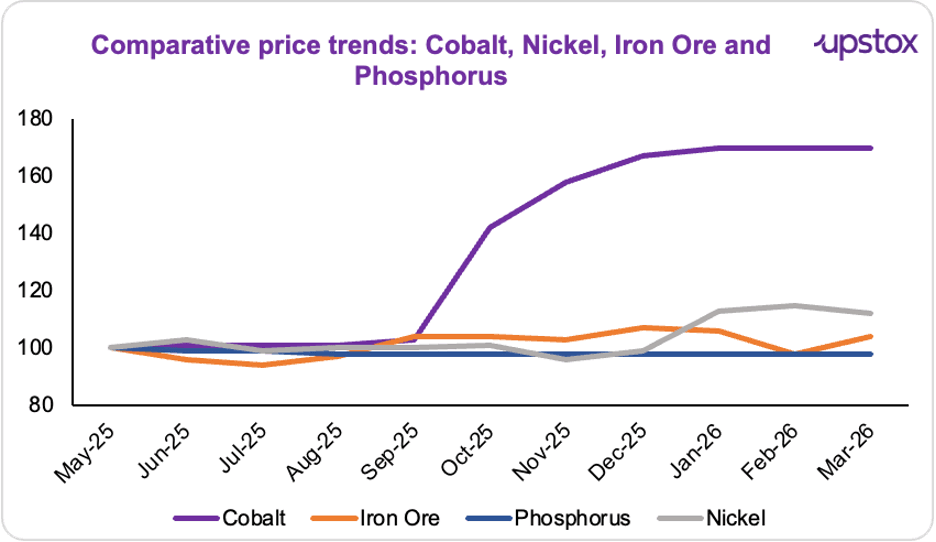
Source: Trading economics Note: Monthly averages have been used for the analysis; values are indexed (May 2025 = 100) for comparability across commodities.
There’s also a safety advantage. The battery system used in the eVitara is far more resistant to overheating. It typically remains stable up to around 270°C, compared to about 210°C for alternative systems. That 60°C gap matters in real-world conditions, especially in a market like India, where high temperatures, fast charging, and heavy usage can put batteries under stress.
Then there’s the environmental and supply-chain advantage. Unlike some rival EVs that rely on materials like cobalt and nickel, Maruti’s setup depends on more abundant materials like iron and phosphate. This reduces exposure to volatile global commodity prices and supply risks. It also avoids some of the environmental concerns linked to cobalt mining.
Is there a trade-off?
By choosing this battery setup, the Maruti Suzuki eVitara does come with one key trade-off, lower energy density.
No battery is perfect, and in this case, the system used here stores less energy for the same weight. Typically, it operates in the range of 160–190 Wh/kg, compared to 200–280 Wh/kg in alternatives used by some rivals.
What this means in practice is simple; different battery chemistries are optimised for different priorities. Some focus on packing more energy into a smaller, lighter battery, while others prioritise safety, longevity, and cost.
In this case, Maruti Suzuki’s choice leans toward a more stable, long-lasting, and cost-efficient setup, which is better suited for everyday use, city driving, and large-scale adoption.
In a nutshell
Battery technology is consistently evolving. LFP batteries are safer, more durable, and cheaper, which is why Maruti Suzuki has chosen them for the eVitara. They also fit well with the Battery-as-a-Service (BaaS) model, given their longer lifespan and lower degradation.
That said, the choice of technology also increases Maruti’s dependence on Chinese imports. While it is just one car right now, Maruti will need to find a way to apply this technology without further increasing its dependence.
About The Author
Next Story



