
Upstox Originals
The agri-tech wishlist Budget 2026 can’t ignore
5 min read | Updated on January 30, 2026, 16:59 IST


SUMMARY
From drones that detect pests early to AI that times harvests with precision, agri-tech could transform Indian agriculture. Yet today, its penetration hovers around 2%. Budget 2026 arrives February 1. If it unleashes the real firepower; precision tools at scale, AI everywhere, and digital muscle; India’s 140 million farmers might finally stop losing battles to weather, water, and yesterday’s methods. Ready to see if the budget actually delivers? Keep reading.
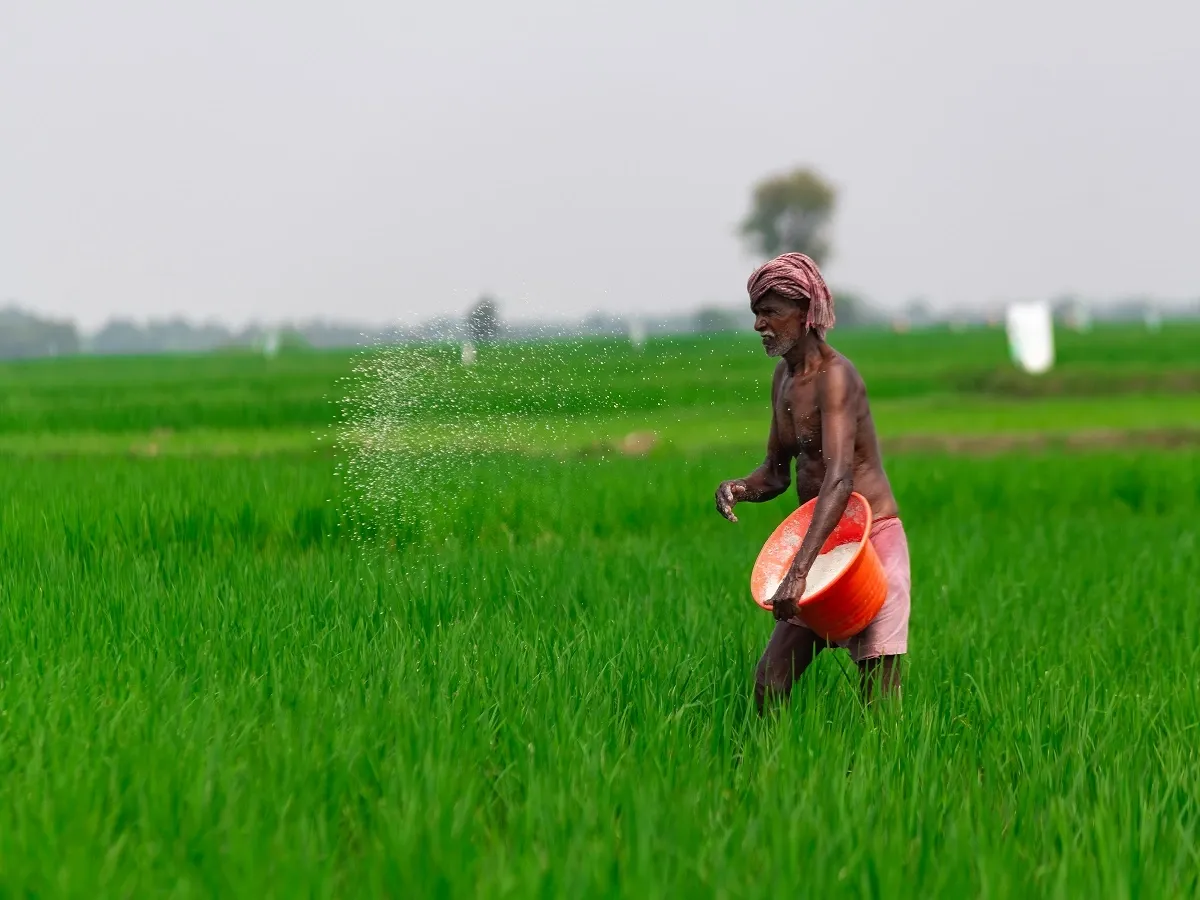
India’s agri-tech market stands at around $9 billion in 2025
A farmer checks his phone. And suddenly..
- A drone flags pest attacks before crops fail
- AI is predicting the best harvest window
- Advisories arrive before the weather turns
Sounds like sci-fi? It’s not.
It’s the promise of agri-tech.. tech that helps farmers cut losses, save water, boost yields, and make better decisions in real time.
According to Inc42, India’s agri-tech market stands at around $9 billion in 2025. By 2030, it’s projected to hit $28 billion, growing at a 25–30% CAGR.
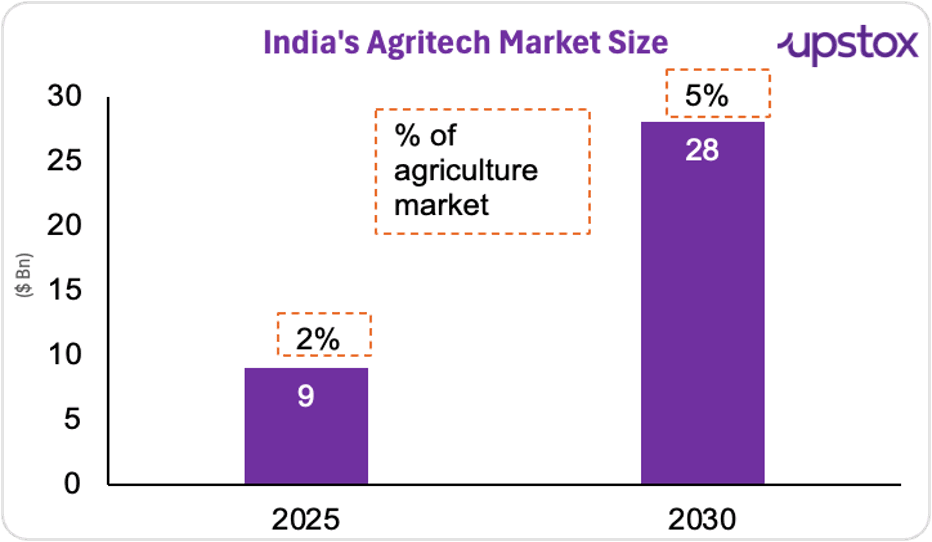
Source: Inc42
But the irony is right there in the numbers. Even at $9 billion in 2025, agri-tech makes up only about 2% of India’s total agriculture market. By 2030, even at $28 billion, penetration rises to just around 5%.
India’s 2026 agritech budget wishlist
Building outcome-driven farm mechanisation
India’s farm mechanisation? Lots of tractors! We’re the world’s biggest tractor market, sales hit around 10-11 lakh units in 2025, almost double from ~6 lakh in 2015. Overall mechanisation level is still ~47%.
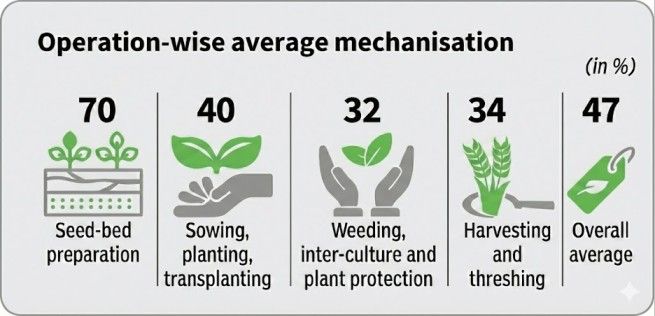
Source: Inc42
Now compared to others; US ~95%, Brazil ~75%, China ~60-76%. We’re behind.
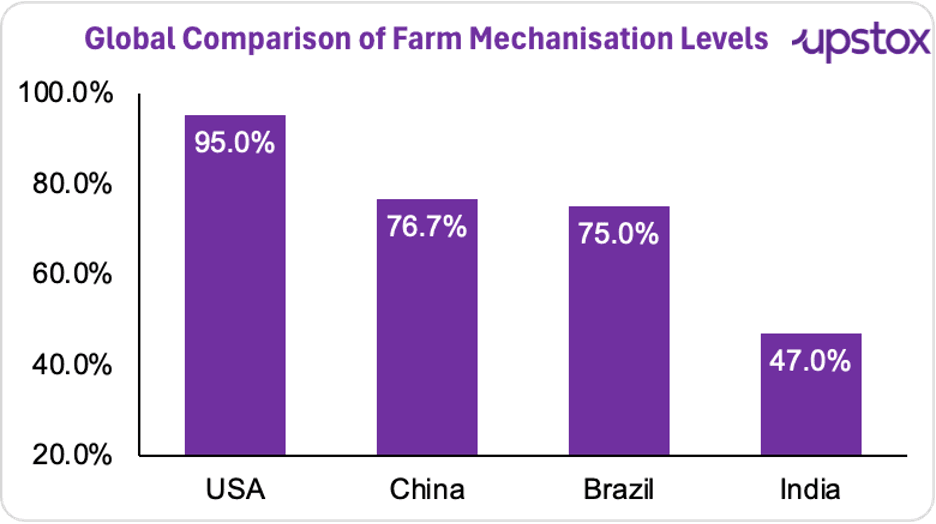
Source: News articles
India’s mechanisation problem isn’t lack of machines. It’s what we use them for. Nearly 70–75% of farm mechanisation is just tractors. Meanwhile, precision tools; laser land levelling, Direct Seeded Rice, AI sprayers; barely get traction.
That’s a miss. These tools can cut water use by ~25%, reduce labour dependence, and improve timing across rice, wheat, and cotton. The catch? They’re sold as standalone gadgets, not as plug-and-play systems. Farmers are left to stitch things together themselves; and most won’t take that risk.
Budget 2026 could change this. Experts say the focus should shift from selling equipment to solving problems:
- Fund solutions for real pain points like water stress, labour shortages, and timing delays using proven methods (zero tillage, raised beds, precision horticulture).
- Scale what already works by bundling tools like DSR, laser levelling, and precision drills into ready systems; backed by field demos and easier access to quality-approved gear.
Addressing climate vulnerability in rain-fed farming
Climate-resilient farming isn’t about hoping for good weather. Nearly 72% of oilseeds and 80% of pulses in India are grown in rain-fed areas. So when rains fail or heat spikes, these crops get hit first; putting food security at risk.
Budget 2026–27 can help fix this. Scaling climate-smart tools like micro-irrigation (uses less water), healthier soils, and drought-tolerant seeds can help farms handle climate stress better.
Add digital tools; crop advisories on phones, satellite crop tracking, and weather-risk support; and farmers get more than subsidies.
They get better, on-time decisions.
Addressing the AI adoption gap
Globally, AI in agriculture is expected to grow from $5.9 Bn to $61 Bn at a 26% CAGR, while in India, AI currently accounts for only 10% of the agritech market, projected to reach 20% by 2030. This indicates strong momentum, but also highlights a significant adoption gap.
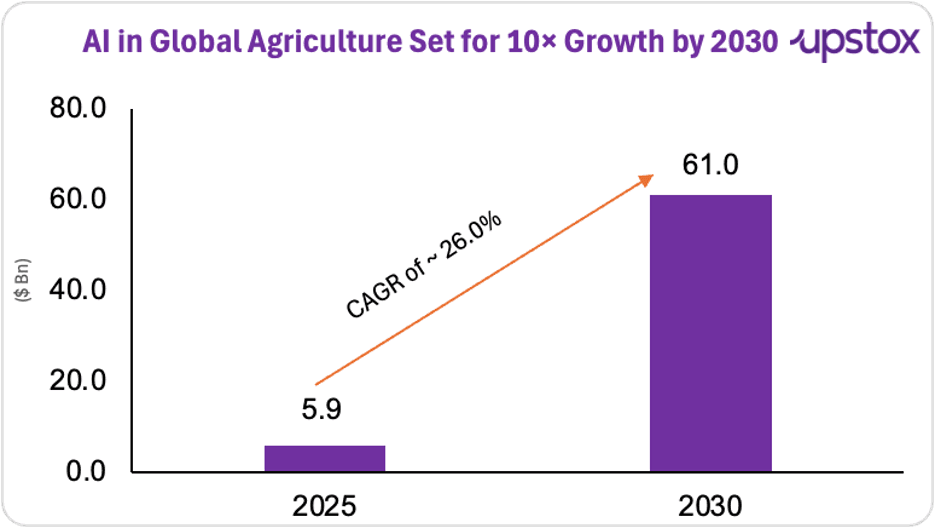
Source: Research Gate
Budget 2026 is expected to bridge this gap by strengthening the Digital Agriculture Mission, which is receiving a major funding push. With ₹2,817 crore allocated, 90M+ Kisan Pehchaan Patra IDs, and the integration of AgriStack and Krishi DSS, the government is laying the foundation for data-driven and AI-enabled agriculture.
By building a single digital source of truth for farmers, Budget 2026 aims to enable faster access to PM-KISAN, crop insurance, credit, subsidies, and smarter crop planning and disaster management; accelerating the role of AI-powered advisory.
India’s low farm R&D intensity
Strengthening agricultural R&D must be a Budget 2026 priority. India currently spends just 0.3–0.4% of agricultural GDP on farm research, a fraction of what global peers invest, Brazil allocates nearly 1.8% of its Ag-GDP, enabling faster innovation and competitiveness.
Highlighting this gap, RG Agarwal, Chairman Emeritus of Dhanuka Agritech, noted that: “if we genuinely want scientific progress and global competitiveness, R&D funding has to increase.”
He also stressed the need to restore incentives for private-sector research, which plays a critical role in translating lab innovation into farm-level solutions.
Import dependence and scale issues in drone manufacturing
India wants to be a global drone hub.
But right now, as we are all aware, key drone parts are still imported, factories are expensive to set up, and incentives arrive after production starts. Result? Scale never really takes off.
Budget 2026 could help here. According to a Moneycontrol report, the government is weighing a ₹10,000-crore incentive under the Drone Shakti mission over five years. Unlike the current PLI scheme, this one helps before and after production; 10–15% capital subsidies to build factories, plus 10–15% output-linked incentives to compete with imports.
The catch? Firms must hit revenue targets, finish investments on time, and ensure 50–60% local value addition. Latecomers can still enter; but with thinner incentives.
Summing it up
The real test for Budget 2026 isn’t how much it spends on agri-tech, but how intelligently it deploys it. Scaling proven tools, closing data and R&D gaps, and aligning incentives with outcomes, not equipment, could finally move agri-tech from pilots to the field. If policy execution matches ambition, Indian farming may shift from coping with uncertainty to actively outsmarting it.
About The Author
Next Story



