
Upstox Originals
How brainrot is turning mindless memes into millions

7 min read | Updated on November 17, 2025, 19:39 IST


SUMMARY
68 million views! And it's not a Taylor Swift video we are talking about, but rather a video of an owl mascot performing a ridiculous rendition of "Cotton Eye Joe”. Welcome to Brainrot: a wave of absurd, low-effort content turning distraction into dollars. But as investors chase the next big thing, is this just another Metaverse moment—or a warning about the price of our shrinking attention spans?

The term brainrot's usage frequency rose by 230% between 2023 and 2024
What happens when memes evolve beyond harmless online jokes and start generating millions of downloads, toy sales, and advertising revenue; despite often being nothing more than repetitive, chaotic, attention-draining content? Welcome to the era of Brainrot, a trend that is profitable for platforms but quietly draining for users.
You might not realise it, but you may already be affected by brainrot in small ways. And that’s exactly why this matters. What looks silly or harmless on the surface; endless loops of absurd videos, nonsensical AI-generated clips, or low-effort meme games; has quietly turned into a trend that feeds on distraction rather than value. Understanding Brainrot is not about celebrating it; it’s about recognising how internet culture is increasingly designed to hijack attention and convert mindlessness into money.
These trends appear funny, but their stickiness comes from the same mechanics that drive doomscrolling; constant stimulation without substance.
- With over 68 million views, Duolingo's TikTok featuring its owl mascot performing a ridiculous rendition of "Cotton Eye Joe" increased app engagement.
- In just 3 months, the hyper-casual game Merge Fellas, which included Brainrot memes, received 2.1 million downloads.
- The only Roblox game to have more than 25 million concurrent players is Steal a Brainrot.
The Origin of “Brain Rot”
The term "brain rot" was initially used to make fun of Gen Z's obsessive doomscrolling. But by 2024, it was a widespread psychological and social problem.
The term's usage frequency rose by 230% between 2023 and 2024, according to the Times of India, suggesting growing concerns over attention spans and excessive use of digital media.
Oxford University Press even chose "Brain Rot" as its 2024 Word of the Year because of how popular it is among students, gamers, and TikTok artists.
From meme to market
The AI startup OpenArt (San Francisco) has turned meme creation into a scalable SaaS business. But beneath its success lies an uncomfortable truth - millions of people are paying for tools that help them generate even more nonsensical content.
It was founded in 2022 by two former Google employees and is the driving force behind the viral AI addiction. With just one click, users can transform bizarre concepts like "a shark wearing sneakers" or "a ballerina with a cappuccino head" into "brainrot" films. OpenArt currently has 6 million monthly active users and uses a credit-based payment scheme, according to TechCrunch:
| Plan | Price | Credits | Output |
|---|---|---|---|
| Basic | $14/month | 4,000 credits | 4 One-Click stories, 40 videos, 4,000 images, 4 characters |
| Pro | $29/month | 12,000 credits | 12 One-Click stories |
| Infinite | $56/month | 24,000 credits | Unlimited story generation |
| Team | $35/month per member | Collaborative features |
Source: OpenArt
The company has raised $5 million in funding from Basis Set Ventures and DCM Ventures, is already cash-flow positive, and projects a $20 million annual revenue run rate in 2025.
Even well - known brands have begun leaning into the trend. Duolingo’s TikTok video of its owl mascot performing a chaotic rendition of “Cotton Eye Joe” crossed 68 million views, largely because viewers kept replaying the absurdity. Nutter Butter followed with a similarly offbeat short video that received 11 million views. These aren’t accidental hits; they’re intentional attempts to stay visible in Gen Z’s hyperactive attention economy, where even the most nonsensical moments can outperform traditional marketing.
The gaming boom - Merge Fellas and beyond
The hyper-casual "merge" game Merge Fellas, which debuted in 2023, is the best example of Brainrot's market dominance.
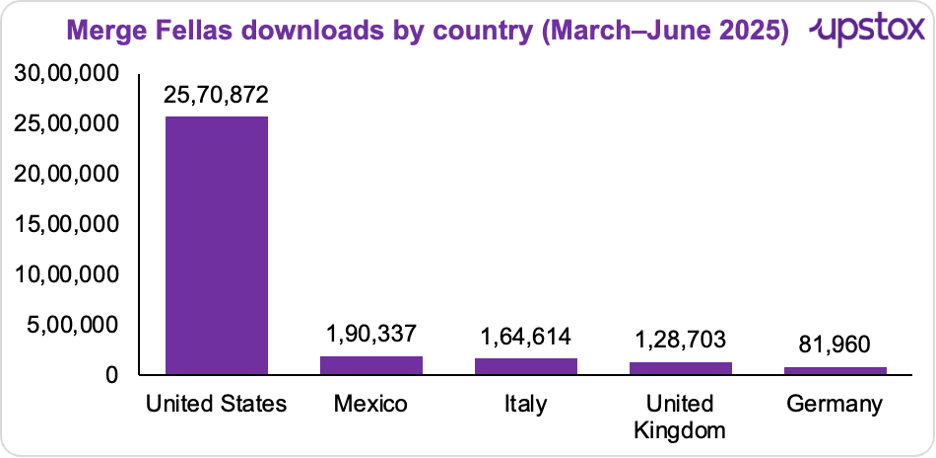
Downloads reached 2.1 million installs in just 3 months (March - June 2025), driven by Brainrot-themed updates that replaced common fruit with popular meme creatures.
The breakdown is as follows:
Source: FoxData
Why the Brainrot + hyper-casual formula “works”
Not because it's smart, but because it's designed for easy consumption. Low-friction play: Users can tap, combine, and repeat. No thought is necessary. Hyper-casual loops thrive because they require little onboarding and keep consumers engaged only long enough to harvest attention.
"Optimised" advertising units: For user-acquisition marketers, Brainrot clips are ideal for the 3-7 second window because they are rapid, noisy, and shallow. They function well not because they are good, but because they hijack reflexes before the brain has a chance to process what it sees.
Cross-cultural humour (lowest common denominator): Music, exaggerated movement, and visual insanity do all the job. It does not require translation because it scarcely says anything. It spreads solely because it is stimulus-rich.
The creator pipeline prioritizes convenience, allowing for quick character creation using subscription AI tools.. It spreads purely because it’s stimulus-heavy.
Global trend, local impact
In India, toy startups and consumer brands are starting to notice. From AI-generated character toys to short-video-inspired figurines, companies are bridging meme culture and retail.
Smaller toy workshops in Delhi and Mumbai are experimenting with 3D-printed Brainrot Animals; a market LiveMint notes could move 15,000 - 20,000 3D printers annually for toy applications alone.
Combine that with India’s digital youth base (over 250 million under-15s), and the potential for meme - fueled toy economies is enormous. And again, that’s the concern; entire micro-industries are forming around attention that isn’t particularly healthy.
Investor perspective
For investors, Brainrot doesn’t represent a great cultural shift as much as it shows how easily the internet can turn fleeting distractions into quick commercial opportunities. Many players are simply capitalising on a momentary wave; packaging chaotic memes, low-effort humour and fast-moving trends into something that can be sold.
These days, viral cycles expire more quickly than before. What is effective this week expires next week. Brainrot is "the dying internet entertaining itself," according to Meer.com. The infrastructure that supports and magnifies memes is more valuable than individual memes.
Risks & regulation to price in
A few years ago, the Metaverse was sold as the next big platform; immersive 3D worlds where people would shop, work, and socialise, straight out of Black Mirror. Big Tech poured in billions, calling it a long-term bet. Today, the buzz has evaporated: hardware is niche, virtual worlds draw tiny audiences, and money has shifted back to AI, gaming, and practical AR. Another hype cycle peaked, and only a few exited on time.
The Brainrot wave mirrors this pattern; aggressively monetised, barely questioned. Fast digital trends burn capital when hype fades, but the psycho-social damage is worse. Parents and psychologists warn about what high-stimulation, low-substance content does to young minds.
Media now highlights how excessive screen exposure affects cognition. In India, the “brain rot” debate reflects wider fears around shrinking attention spans and mental-health strain among Gen Z and Gen Alpha. Heavy social-media use is linked to poor focus, disrupted sleep, and rising anxiety.
As neurologist Daniel Small notes, “Any of the five billion people on social media can get brain rot.” Teenage girls; the heaviest users; spend nearly three hours daily scrolling. The psychological downside is escalating faster; and almost no one is questioning the trade-off.
Before you go
Despite starting out as ridiculous AI content, Brainrot has evolved into a comprehensive commercial case study in 2025. It has fueled successful AI tools, brought back fading mobile gaming categories, and transformed memes into quantifiable growth engines.
Engagement has been transformed into something shorter, louder, and infinitely profitable by the "Brainrot generation." The true conclusion is that, rather than simply applauding in a meme - driven economy where even "Tung Tung Sahur" can seem like a business plan, it's important to retain an open mind.
About The Author
Next Story



