
Upstox Originals
Did US tariffs make Indian exports stronger?

5 min read | Updated on March 05, 2026, 22:26 IST


SUMMARY
US tariffs hit Indian exporters hard. But instead of folding, Indian exporters pivoted. Shipments were rerouted and markets diversified. Between April and November, exports still grew 5.4%, with China, Europe, and several emerging markets stepping in to absorb the shock. What started as a brutal trade setback ended up stress-testing India’s export strategy.
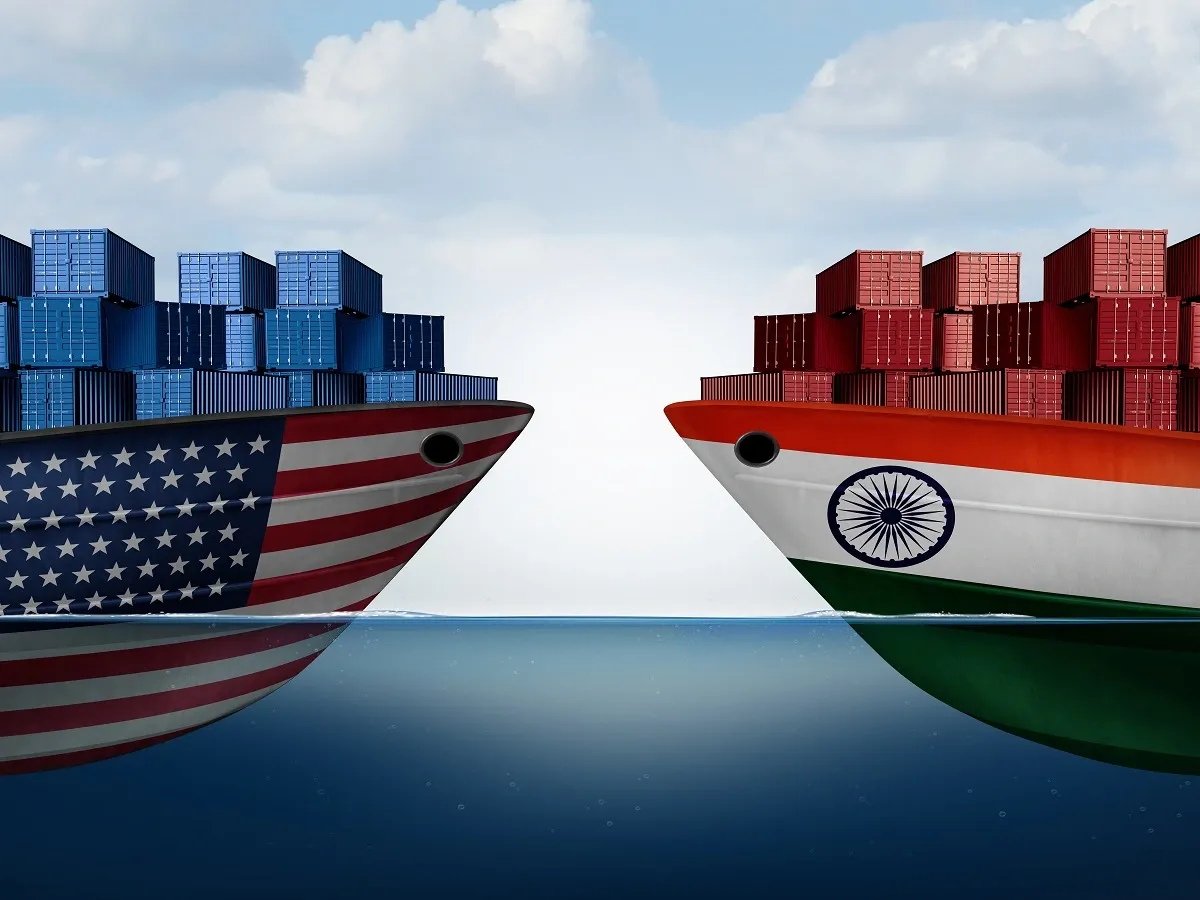
India has increased trade with regions like China, Europe and UAE to offset impact of US tariffs | Image: g
2025 tested India’s exporters like never before. The US just imposed effective tariffs of about 50% on Indian imports.
Textiles, engineering goods, pharma, gems & jewellery; the big US shippers took it hard. Orders dried up and thousands of jobs were impacted (we're talking ~100,000 in Surat's diamond and textile clusters alone).
But well, here's the twist. Instead of collapsing, India's overall exports actually held steady, and in some ways even got stronger.
The US share of India's exports dropped noticeably, from around 22.5% in the pre-tariff days to about 17.8% once the tariffs really bit. That drop didn't kill the numbers; it forced India to diversify across other big markets.
Cumulative exports from April to November 2025 landed at an estimated $562.1 billion, compared to $533.2 billion the year before.
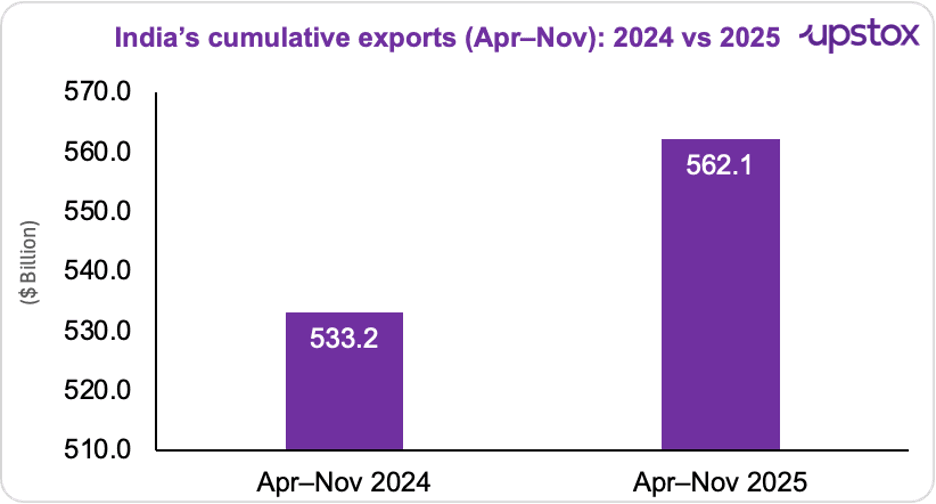
Source: PIB
So how did India actually pull off staying resilient?
Exporters and the government moved to redirect stuff using existing FTAs, PLI incentives, and just plain grit, to grab share in other places. T
China
China stood out clearly during this period. Between April and November, India’s exports to China rose sharply, with cumulative growth estimated in the 32–38% range. In absolute terms, shipments climbed to $12.22 billion, up from $9.20 billion a year earlier. That’s a 33% YoY increase, and notably, the highest level of exports to China in the last four years.
What drove the surge? A mix of old strengths and new demand gaps. China ramped up purchases of iron ore, marine products, telecom instruments, engineering goods, auto components, and petroleum intermediates, as it adjusted its own supply chains amid global trade disruptions.
Some sectoral numbers were eye-catching:
- Marine products: up 1,300%
- Telecom instruments & electronics: up 400%+
- Engineering goods & auto components: solid double-digit growth
The result? China’s share in India’s export basket rose from ~4.8% to nearly 5.8%.
To be clear, India still runs a trade deficit with China and that remains a problem to be addressed. But this increase in exports, could be one among the many required to do so.
| Period | Exports to China ($ Billion) | YoY Growth |
|---|---|---|
| Apr–Nov 2022–23 | 9.89 | — |
| Apr–Nov 2023–24 | 10.28 | +3.9% |
| Apr–Nov 2024–25 | 9.20 | -10.5% |
| Apr–Nov 2025–26 | 12.22 | +33.0% |
Source: TOI
Europe
Spain stole the European spotlight.
Between April–November 2025, India’s exports to Spain surged 56%, jumping from $3 billion last year to $4.7 billion this year.
More telling is what it did to the export mix. Spain’s share in India’s total exports climbed to 2.4%, a gain of 0.5 percentage points, the largest share increase among all European partners during the period. In a 27-nation EU bloc, Spain clearly stood out as the fastest-growing market for Indian goods.
This wasn’t an isolated spike either. It was part of a broader European rebalancing.
Exports to Germany; India’s traditional anchor in Europe, rose a steadier 9.3%, from $6.8 billion to $7.5 billion, keeping its export share at a solid 2.6%. Belgium saw shipments edge up from $4.2 billion to $4.4 billion, while exports to Poland grew 7.6% to $1.82 billion.
UAE
In key months of late 2025, exports to the UAE grew significantly faster than exports to the US or Europe. For instance, specific sectors like Auto Components (+84.5%) and Gems & Jewellery (+34.9%) saw explosive year-on-year growth in late 2025.
Since the India-UAE CEPA came into effect, exports to the United Arab Emirates have surged, making it one of India’s top three export destinations.
Unlike China, India runs a far more balanced trade relationship with the UAE, making this growth strategically cleaner. The UAE also acts as:
- A re-export hub to Africa & Europe
- A financial and logistics gateway
This makes UAE growth structurally different; and arguably more sustainable. Shipments also picked up across the Middle East and Asia; with Saudi Arabia, Oman, Iraq, Vietnam, Thailand, Bangladesh and parts of Africa seeing steady gains during the same period. Together, these markets helped absorb volumes diverted from the US.
So now that the US deal is back - what next?
With India and the US resetting trade ties after the 2025 tariff episode, the US is firmly back as a key export market. It still absorbs the largest share of Indian shipments, especially in pharmaceuticals, electronics and engineering goods.
At the same time, India has committed to significantly higher purchases from the US; estimated at around $500 billion over the coming years. That raises the stakes. To avoid a wider trade imbalance, India will need to grow exports faster and more broadly.
That’s where the 2025 diversification effort matters.
So the path ahead isn’t binary. India could lean back into the US as tariffs ease. Or it could continue spreading export growth across regions; especially as import commitments rise.
What’s clear is this: the export map after 2025 is wider than before.
And that gives India more options.. whichever way trade flows evolve next.
In a nutshell
The 2025 tariff shock didn’t just test India’s exporters; it changed how they operate. By spreading exports across China, Europe, the Middle East and Asia, India reduced its reliance on any single market. With the US back in play but import commitments rising, this diversification now looks less like a detour and more like a long-term strategy.
About The Author
Next Story



