
Personal Finance News
PAN card rules: 17 financial transactions where quoting Permanent Account Number is compulsory

4 min read | Updated on April 21, 2026, 17:40 IST


SUMMARY
As per Rule 114B of the Income-tax Rules, quoting of Permanent Account Number is mandatory for specified high-value financial transactions to ensure transparency and prevent tax evasion.

The income tax department has introduced new application forms for the PAN allotment process. | Image: Shutterstock.
Most people think the Permanent Account Number (PAN) is only for income tax return (ITR)filing, but in reality, it quietly appears at almost every major financial transaction above certain limits.
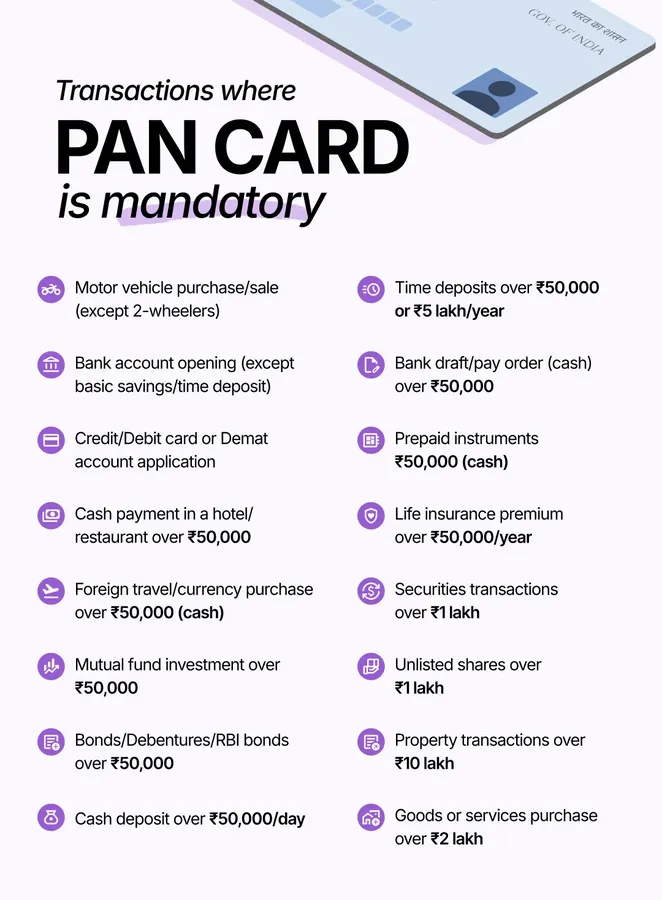
17 financial transactions in which quoting of PAN is mandatory
-
Sale or purchase of a motor vehicle or vehicle other than two-wheeled vehicles.
-
Opening an account (other than a time deposit referred to at point No. 11 and a Basic Savings Bank Deposit Account) with a banking company or a co-operative bank.
-
Making an application for issue of a credit card or debit card, or opening of a demat account with a depository, participant, custodian of securities or any other person registered with SEBI.
-
Payment in cash of an amount exceeding ₹50,000 to a hotel or restaurant against a bill at any one time.
-
Payment in cash of an amount exceeding ₹50,000 in connection with travel to any foreign country or for purchase of any foreign currency at any one time.
-
Payment of an amount exceeding ₹50,000 to a mutual fund for purchase of its units.
-
Payment of an amount exceeding ₹50,000 to a company or institution for acquiring debentures or bonds issued by it.
-
Payment of an amount exceeding ₹50,000 to the Reserve Bank of India for acquiring bonds issued by it.
-
Deposit with a banking company or a co-operative bank:
-
Cash exceeding ₹50,000 during any one day; or
-
Cash deposits aggregating to more than ₹2,50,000 during the period from 9th November, 2016 to 30th December, 2016.
-
Payment in cash exceeding ₹50,000 during any one day for purchase of bank drafts, pay orders or banker’s cheques from a banking company or a co-operative bank.
-
A time deposit exceeding ₹50,000 or aggregating to more than ₹5 lakh during a financial year with:
-
a banking company or a co-operative bank;
-
a Post Office;
-
a Nidhi company referred to in section 406 of the Companies Act, 2013; or
-
a non-banking financial company.
-
Payment in cash or by bank draft or pay order or banker’s cheque aggregating to more than ₹50,000 in a financial year for one or more prepaid payment instruments, as defined under the Payment and Settlement Systems Act, 2007.
-
Payment of an amount aggregating to more than ₹50,000 in a financial year as life insurance premium to an insurer.
-
A contract for sale or purchase of securities (other than shares) for an amount exceeding ₹1 lakh per transaction.
-
Sale or purchase of shares of a company not listed on a recognised stock exchange for an amount exceeding ₹1 lakh per transaction.
-
Sale or purchase of any immovable property for an amount exceeding ₹10 lakh or valued by the stamp valuation authority at an amount exceeding ₹10 lakh.
-
Sale or purchase of goods or services of any nature other than those specified above for an amount exceeding ₹2 lakh per transaction.
How does the income tax department ensure compliance?
"It is the statutory responsibility of the person receiving documents relating to the notified financial or economic transactions to ensure that PAN has been duly quoted wherever required. For example, while opening a bank account, the bank shall ensure that the applicant has furnished their PAN," the tax department said in a FAQ.
What’s changed in PAN applications from April 2026?
-
Birth certificate
-
Voter ID
-
Class 10 certificate
-
Passport
-
Driving licence
Introduction of new PAN application forms
Old PAN application form 49AA has been replaced with new forms 95 and 96.
Form 95: PAN allotment application form filed by an individual not being a citizen of India.
Form 96: PAN allotment application form filed by entities incorporated outside India.
Related News

About The Author
Next Story

