
Personal Finance News
Form 40 explained: How Indians with US, UK and Canadian retirement accounts can opt to defer tax

6 min read | Updated on June 11, 2026, 13:27 IST


SUMMARY
Form 40 explained: How Indians with US 401(k), UK pension and Canadian retirement accounts can opt to defer tax in India under the Income-tax Act, 2025.

Form 40 allows eligible taxpayers to defer taxation in India until the year in which the amount is withdrawn from the retirement account. | Image: Shutterstock.
Indian residents holding retirement accounts in countries such as the US, UK, Canada or Australia may need to take note of Form 40 under the Income-tax Act, 2025.
The form itself is new under the Income-tax Act, 2025. However, the tax relief associated with it is not a new benefit.
Form 40 replaces Form 10EE, which was earlier used to exercise a similar option under Section 89A of the Income-tax Act, 1961. The relief now continues under Section 158 of the Income-tax Act, 2025, read with Rule 74 of the Income-tax Rules, 2026.
Form 40 at a glance
-
Replaces: Form 10EE
-
Earlier provision: Section 89A of the Income-tax Act, 1961
-
Current provision: Section 158 of the Income-tax Act, 2025
-
Applicable countries currently notified: United States, United Kingdom, Canada, and Australia
-
Purpose: To exercise an option for tax relief in respect of income from specified foreign retirement benefit accounts
-
Filing mode: Electronic filing through the Income Tax Department's e-filing portal
Why was this provision introduced?
Many individuals who return to India after working abroad continue to maintain foreign retirement accounts. These accounts may continue to earn income from underlying investments even after the account holder becomes a resident taxpayer in India.
This difference in timing can create practical difficulties for taxpayers.
According to CA Abhishek Soni, CEO and Co-Founder of Tax2win, "Form 40 allows eligible taxpayers to defer taxation in India until the year in which the amount is withdrawn from the retirement account. This aligns the timing of taxation in India with the tax treatment applicable in the foreign country and can help address issues arising from different tax rules in different jurisdictions."
Who is likely to be affected?
The provision is particularly relevant for individuals who have worked overseas and continue to maintain retirement benefit accounts after becoming residents of India.
These may include retirement arrangements such as US 401(k) plans, IRAs, pension schemes in the United Kingdom, and eligible retirement savings plans in Canada, subject to conditions prescribed by law.
The relief is available to a specified person who is resident in India and maintains a retirement benefit account in a notified country, provided the account was opened while the individual was resident in that country and non-resident in India.
Not a new relief, but a continuation of an existing framework
While Form 40 has been introduced under the new tax legislation, the underlying policy objective remains largely unchanged.
Sandeep Bhalla, Partner at Dhruva Advisors, notes that "Section 158 of the Income-tax Act, 2025 substantially continues the framework that existed under Section 89A of the Income-tax Act, 1961. The relief was originally introduced to address cross-border timing differences in the taxation of retirement savings and continues to serve the same purpose."
According to him, without such a mechanism, annual accretions in foreign retirement accounts could potentially be taxed in India on an accrual basis even though the foreign jurisdiction may tax the same income only when withdrawals are made. By aligning the timing of taxation, the provision also facilitates the operation of foreign tax credit mechanisms in appropriate cases.
Retirement accounts often continue to generate investment income for years after an individual returns to India.
Mahesh Nayak, Managing Committee Member of BCAS, says that "this can create a timing mismatch because some countries tax the accumulated income only at the time of withdrawal, whereas India may otherwise seek to tax the income in the year it is earned within the account."
According to him, the option available under Indian tax law allows eligible taxpayers to defer taxation of such income until withdrawal, thereby reducing the timing mismatch and helping facilitate foreign tax credit claims where applicable.
Filing Form 40 is mandatory to claim the relief
The benefit is not available automatically.
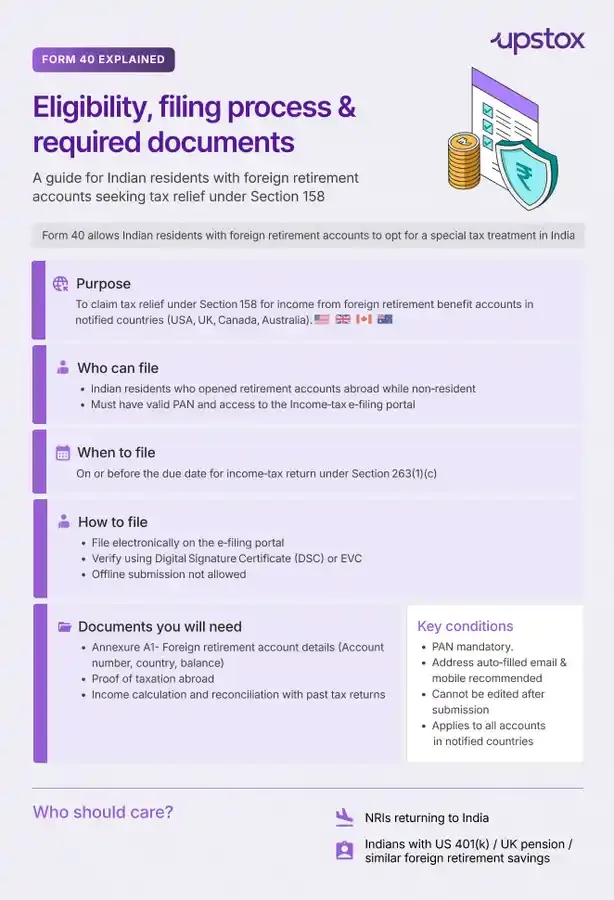
A specified person seeking to exercise the option under Section 158 must file Form 40 electronically on or before the applicable due date for filing the income-tax return.
The form requires details of the specified retirement accounts maintained in the notified country, along with supporting documentation relating to the account and its tax treatment in the foreign jurisdiction.
The prescribed annexures include account statements, evidence regarding taxation of the account in the foreign country, and details of income that may already have been offered to tax in India in earlier years.
No. As per the prescribed conditions, once the option is exercised for a tax year, it cannot be withdrawn for that year. The option continues to apply in subsequent years in accordance with the provisions governing the relief.
The Form 40, for exercise of option for claiming tax relief under section 158 of the ITA’ 2025, is required to be filed electronically on or before such “due date” for filing return of income prescribed under section 263(1)(c) of the ITA’ 2025, as may apply for the specified person claiming the tax relief. This time limit is specified in the relevant rule.
The following documents/details may be required while filing Form 40.
-
Specified Account or Foreign Retirement Account details - Account number(s), Date of account opening, Account balance at the end of the previous tax year.
-
Name of the retirement fund and the notified country.
-
Details of income already taxed in India in earlier years,
-
Copy of statement of the specified account having above details.
-
Document showing how the income from specified account has been taxed or is taxable in the notified country including relevant statutory provision of the notified country or any other relevant document.
-
Computation of income for all the tax years in which the income from specified account has already been included in the total income.
-
A reconciliation statement of the computation of income with the return of income for the said tax years.
Form 40 cannot be submitted without a valid PAN of the specified person exercising the option to claim the tax relief.
No. Form 40 can only be submitted online through the Income Tax e-Filing portal.
Form 40 does not create a new tax benefit. It simply replaces Form 10EE under the Income-tax Act, 2025 and continues the relief available to eligible taxpayers with specified foreign retirement accounts.
Related News



About The Author
Next Story

