
Personal Finance News
FII tax exemption FAQs: Key income-tax changes, impact and rules explained

4 min read | Updated on June 05, 2026, 17:27 IST


SUMMARY
The Income Tax Amendment Ordinance, 2026 exempts FIIs from tax on interest income and capital gains from government securities. Here's what changes, who benefits and when it takes effect.

The new provisions will take effect from April 1, 2026.
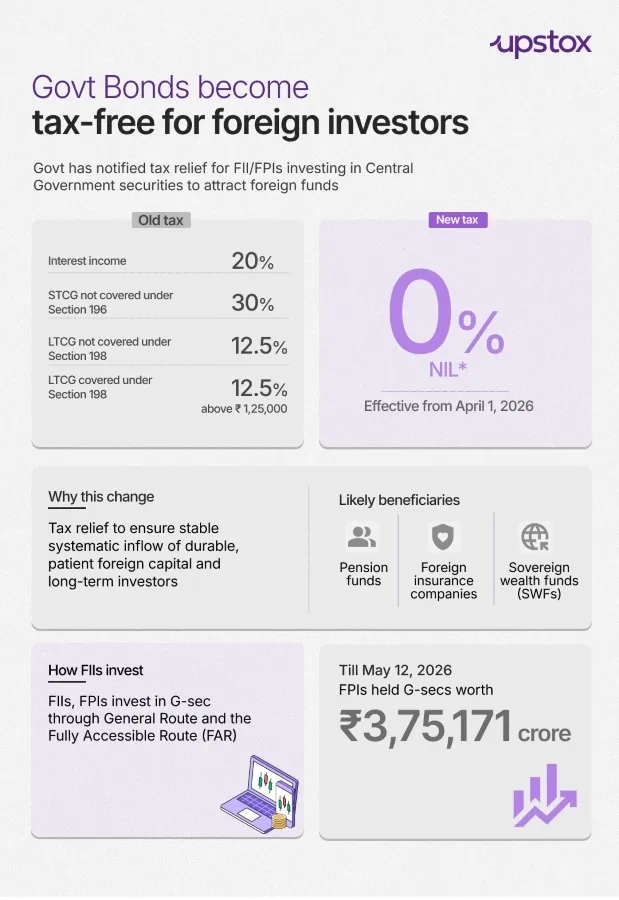
Under the ordinance, foreign institutional investors (FIIs) will be exempt from tax on both interest income and capital gains arising from government securities from April 1, 2026. The Bank for International Settlements (BIS) has also been granted a similar exemption.
The move is part of a broader set of measures announced by the government to make it easier for foreign investors to invest in India's government securities (G-Secs) and equity markets.
The Finance Ministry said the reforms are aimed at strengthening India's position as a global investment destination, attracting long-term foreign capital and improving ease of doing business for Foreign Portfolio Investors (FPIs) and Persons Resident Outside India (PROIs).
"In a welcome move, the Government has announced a complete tax exemption for interest and capital gains on FPI investment in Government securities. This will increase the returns for FPIs from investment in Indian G-Secs by 15-20% and improve the delta between returns on investment in Indian sovereign bonds compared to other countries thereby making India a bit more attractive," said Rajesh H. Gandhi, Partner, Deloitte India.
"This also makes India's inclusion in the global bond indices more meaningful since tax was the key hindrance to the same. FPIs investing only in Government securities will also be free from any tax compliances such as return filing etc. The move should ease pressure on the rupee over the medium to longer term," added Rajesh H. Gandhi.
1. What changes have been introduced under the Income Tax Amendment Ordinance, 2026?
The ordinance grants a complete tax exemption to FIIs on income earned from government securities. This covers both interest income and capital gains arising from the sale, transfer, redemption or maturity of such securities.
2. Who will benefit from the new tax exemption?
The exemption applies to Foreign Institutional Investors (FIIs), including Foreign Portfolio Investors (FPIs) notified as FIIs. The Bank for International Settlements (BIS) has also been granted a similar exemption.
3. When will the tax exemption come into effect?
The new provisions will take effect from April 1, 2026.
4. How were FIIs taxed on government securities before this change?
In the absence of a specific exemption, interest income and capital gains from government securities were taxed under the FII taxation framework. Depending on the nature of income, tax rates could be as high as 20% on interest income, 30% on certain short-term capital gains and 12.5% on long-term capital gains.
5. What taxes are being exempted under the ordinance?
-
Tax on interest earned from government securities
-
Capital gains tax on the sale, transfer or redemption of government securities
6. Through which routes do FIIs invest in government securities?
-
General Route
-
Fully Accessible Route (FAR)
7. What are the current levels of FII investment in government securities?
-
General Route: ₹54,091 crore
-
Fully Accessible Route (FAR): ₹3,21,080 crore
-
Total investment: ₹3,75,171 crore
8. How could the exemption impact foreign investment in Indian bonds?
The exemption is expected to improve post-tax returns for foreign investors, making Indian government bonds more competitive globally. Market experts believe the move could boost foreign participation in G-Secs, support India's inclusion in global bond indices and encourage long-term capital inflows into the country.
Related News


About The Author
Next Story

