
Personal Finance News
Mutual Fund tax rules you can’t ignore in 2026: How your equity, debt & hybrid gains are taxed

4 min read | Updated on May 11, 2026, 16:17 IST


SUMMARY
Whether from debt, equity, or hybrid funds, the way mutual fund gains are taxed can directly affect your final returns, making it important for investors to clearly understand these rules in 2026.

When you invest in mutual funds, the profits you earn when you sell your units are called capital gains. | Image: Shutterstock.
Mutual fund (MF) investment has become a topic of discussion in almost every household today. Even people who are not very familiar with investment products often suggest starting an SIP.
While most investors are more or less aware of mutual funds and how they work, one important aspect is often ignored in financial planning, and that is taxation.
In this article, we will learn about how mutual fund gains are taxed in India
How are gains on mutual funds taxed in India?
When you invest in mutual funds, the profits you earn when you sell your units are called capital gains. How much tax you pay depends mainly on two things: the type of mutual fund you choose (equity, debt, or hybrid) and how long you stay invested.
Different types of funds follow different tax rules, so equity, debt, and hybrid funds are not treated the same.
Another thing investors often hear about is dividends. In mutual funds, dividends are paid only if you choose the Dividend option also called IDCW – Income Distribution cum Capital Withdrawal).
If you select IDCW, mutual funds usually give you two choices:
-
IDCW payout option
-
IDCW reinvestment option
Under current tax rules, any IDCW payout you receive is added to your total income and taxed as per your income tax slab. So your tax rate depends on which slab you fall under.
Equity mutual funds taxation
Equity mutual funds invest mainly in shares of listed companies in India (at least 65% of their portfolio). Because they are linked to the stock market, their value can move up and down, which means higher risk but also higher return potential over the long term.
-
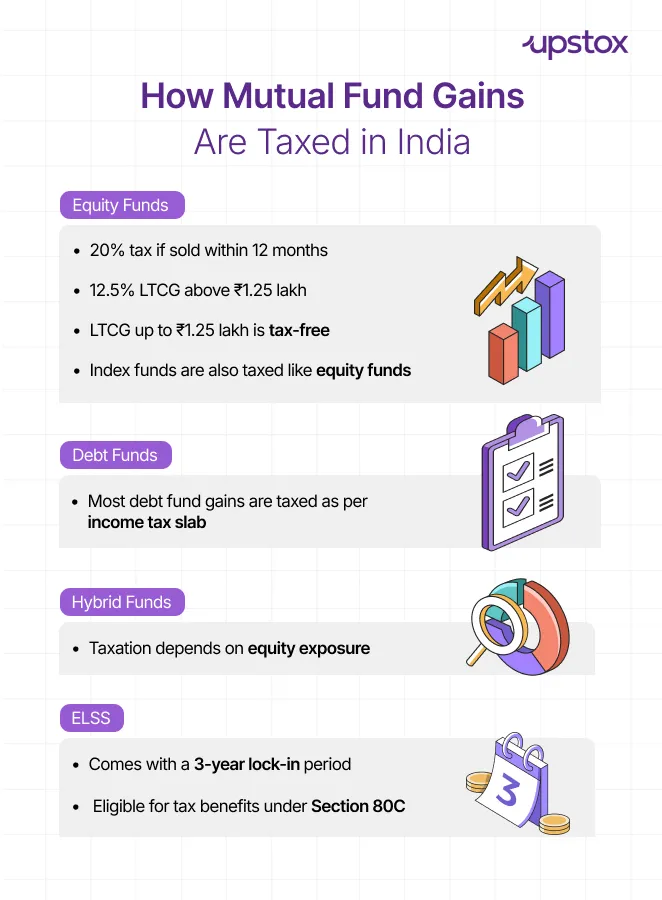
Short-term (≤ 12 months): 20%
-
Long-term (> 12 months): 12.5% on gains above ₹1.25 lakh
-
LTCG up to ₹1.25 lakh per year is tax-free
Index funds, which only track a market index like the Nifty or Sensex, are another type of equity mutual fund. For taxation purposes, these funds are still considered equity-oriented.
Debt mutual funds taxation
Debt funds have seen several tax rule changes in recent years. Earlier, taxation depended on how long you stayed invested, and long-term gains also got indexation benefits.
However, from 1 April 2024, the rules changed significantly. Now, most gains from debt funds are taxed as short-term capital gains, regardless of how long you hold them.
There are some exceptions for older investments made before 1 April 2023, where different long-term rules may still apply based on holding period.
Hybrid mutual funds taxation
-
Taxed at 20% for short-term gains.
-
12.5% for long-term gains above ₹1.25 lakh (no indexation benefit).
ELSS taxation
Equity Linked Savings Schemes (ELSS) come with a 3-year lock-in period. After this period, gains are treated as long-term capital gains and taxed at 12.5% above ₹1.25 lakh.
These investments also qualify for a deduction of up to ₹1.5 lakh under Section 80C of the Income Tax Act, 1961 (only under the old tax regime). All deductions under Section 80C, 80CCC, and 80CCC(1) have been combined under a single Section 123 read with Schedule XV under the Income Tax Act, 2025 effective 1 April 2026.
Taxation of special investment funds
In general, taxation for special investment funds and mutual funds is similar at the investor level.
-
Long-term gains above ₹1.25 lakh are taxed at 12.5% (if held for more than 12 months)
-
Short-term gains are taxed at 20%
Therefore, MFs are more than just picking the best plan or chasing returns; taxes have a significant impact on your actual take-home pay. Whether you invest in debt, equity, or hybrid funds, the manner in which your gains are taxed can subtly alter your final income.
Disclaimer: The information contained in this article is for informational purposes only and does not represent investment advice from Upstox. Investment decisions should be made based on independent research or consultation with a registered financial advisor. Past performance is not indicative of future results.
Related News



About The Author
Next Story

