
Personal Finance News
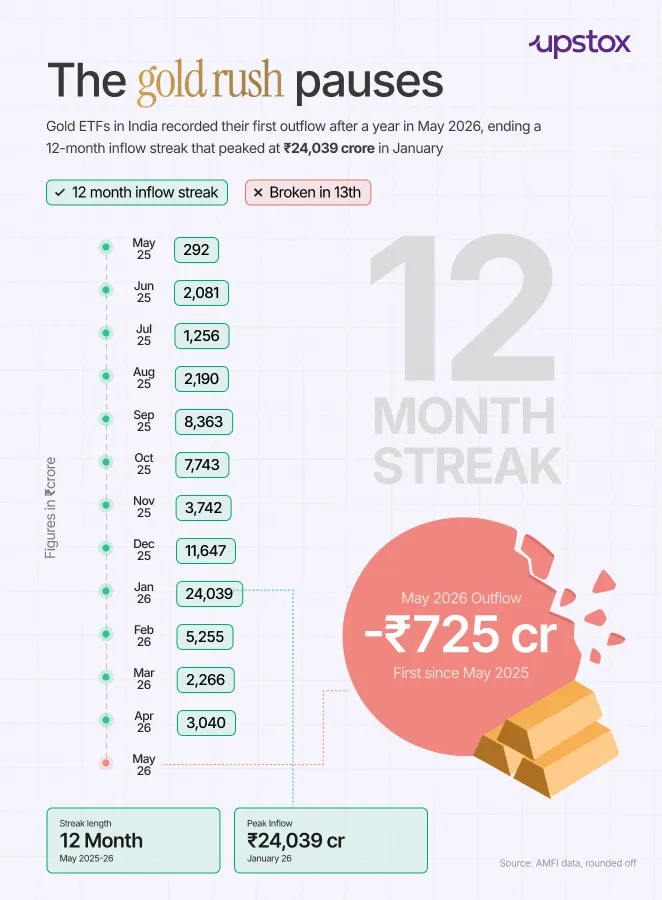
Gold ETFs record first outflow in 13 months: Why investors pulled ₹725 crore in May 2026

5 min read | Updated on June 11, 2026, 13:13 IST


SUMMARY
Profit-booking after gold's rally, a shift toward equities, stable prices, higher import duties and regulatory changes all contributed to the reversal in flows

Gold ETFs, despite their safe-haven appeal, have periodically faced significant outflows driven by a combination of macroeconomic and market-specific factors.
Gold exchange-traded funds (ETFs) ended their 13-month streak of consecutive inflows in May 2026, recording net outflows of around ₹725 crore, a sharp reversal from inflows of about ₹3,040 crore in April, according to data from the Association of Mutual Funds in India (AMFI) released on June 10.
The flow moderation was not a unique domestic phenomenon. According to the World Gold Council, there were also slight withdrawals from physically backed gold ETFs globally in May.
"Gold ETF flows slowed to a trickle in May, with Europe the only region to register inflows. Global gold ETF AUM declined 2% m/m to US$604bn, while holdings eased to 4,121t, just shy of February’s record high. Gold market liquidity remained robust, with trading volumes slightly higher m/m and still above the 2025 average. Net outflows pushed global gold ETF total assets under management (AUM) down 2% m/m to US$604bn. Collective holdings ticked lower 0.4% to 4,121t, remaining just below the record high of 4,176t reached on 27 February 2026," said World Gold Council.
Key reasons behind gold ETF outflows in May
Gold ETFs, despite their safe-haven appeal, have periodically faced significant outflows driven by a combination of macroeconomic and market-specific factors. Experts say the recent outflows are less about a loss of confidence in gold and more about portfolio behaviour.
After a sustained rally where gold prices hit record highs, institutional investors and traders often sell a portion of their holdings to lock in profits.
"Gold ETF flipped to an outflow of ₹725 crore after months of strong inflows—classic profit-booking after a sustained rally," said Suranjana Borthakur, Head of Distribution & Strategic Alliances, Mirae Asset Investment Managers (India).
As CFP Shweta Shastri notes, “Many investors used the recent rally to book profits. This should be seen as a healthy portfolio adjustment rather than a negative signal for gold.”
Echoing a similar view, Pankaj Mathpal, MD & CEO at Optima Money Managers, points out that gold tends to see redemptions after strong cycles, as investors lock in gains once target returns are met.
"Gold is a non-yielding asset. It doesn't pay interest or dividends. When central banks (like the US Federal Reserve or the RBI) hint at or implement higher interest rates, or when government bond yields rise, investors often shift their money from gold into fixed-income assets to get higher guaranteed returns," said Yudhajit Baul, Founder and Managing Director, Yudhajit Financial Services Private Limited.
When gold prices move sideways, investor interest tends to soften. Without a clear upward trend or volatility spike, Gold ETFs often see reduced inflows as investors wait for better entry points.
Another key factor is asset reallocation. With equity markets showing improvement, some investors have rotated money back into growth-oriented assets. Experts say gold’s pause after a strong rally also encouraged short-term investors to diversify elsewhere.
"At the same time, improving sentiment in equity markets encouraged some investors to shift money back into equity for better growth opportunities. Also, after a sharp rally in gold prices also moved into a consolidation phase, leading some short-term investors to look at other asset classes," said CFP Shweta Shastri.
Another factor that may have weighed on gold ETF demand is the recent increase in India's gold import duty from 6% to 15%. Since gold ETFs are backed by physical gold, fund houses need to buy and hold the metal as money flows into the scheme. Higher import costs can make acquiring gold more expensive and may add to concerns about costs and valuations. While this was unlikely to be the main reason behind outflows, it may have prompted some investors to stay on the sidelines.
"This move was intended to stabilise the rupee and manage the current account deficit," said Yudhajit Baul.
Gold ETFs saw a reversal in May 2026 after 13 straight months of inflows, with investors pulling ₹725 crore. The decline appears to be driven by profit-booking, portfolio rotation, and stable gold prices, rather than any long-term weakness in the asset class.
Related News


About The Author
Next Story

