
Personal Finance News
EPF Scheme 2026 allows full withdrawal under 7 circumstances: What has changed from EPF 1952?
4 min read | Updated on July 09, 2026, 19:15 IST


SUMMARY
EPF withdrawal rules 2026: Members can apply for full withdrawal from their accounts on termination of service in the case of mass or individual retrenchments.

EPF members can apply for full withdrawal on termination of service under VRS.
The 2026 scheme allows full withdrawal upon retirement from service after attaining age 55. A member, who has not attained the age of 55 years at the time of termination of his service, can also make a full withdrawal if s/he attains the age of 55 years before the payment is authorised
The Scheme allows full withdrawal on retirement on account of permanent and total incapacity for work due to bodily or mental infirmity. Such infirmity should be certified by the employer's medical officer. In case there is no regular medical officer, the infirmity should be certified by a registered medical practitioner designated by the establishment.
EPF members can apply for full withdrawal immediately before migration from India for permanent settlement abroad or for taking employment abroad.
EPF members can apply for full withdrawal from their accounts on termination of service in the case of mass or individual retrenchments.
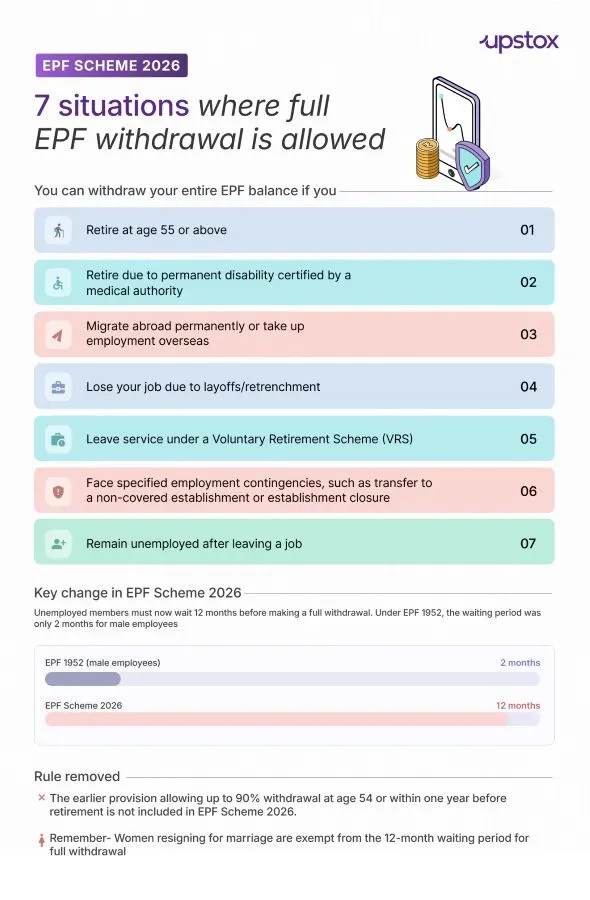
EPF members can apply for full withdrawal on termination of service under a voluntary scheme of retirement (VRS) framed by the employer and the employee under a mutual agreement.
The EPF Scheme 2026 allows full withdrawal in any of the following contingencies:
-
Where a factory or other establishment is closed but certain employees who are not retrenched, are transferred by the employer to other factory or establishment, not covered under the Code.
-
Where a member is transferred from a covered factory or other establishment to another factory or other establishment not covered under the Code, but is under the same employer.
-
Where a member is discharged and is given retrenchment compensation under the Code on Industrial Relations, 2020.
In such cases, however, actual payment can be made only after two months from the date of the application for withdrawal.
The EPF Scheme 2026 allows full withdrawal on "ceasing to be an employee in any establishment" to which the Code of Social Security 2020 applies.
There is a waiting period of 12 months for full withdrawal after losing employment.
As per the EPF Scheme 2026, this withdrawal will not be allowed till the completion of 12 months from ceasing to be an employee.
"Provided that a member shall not be eligible to withdraw unless the member has not been employed in any factory or other establishment to which the Code applies for a continuous period of not less than twelve months immediately preceding the date of application for withdrawal," the scheme says.
However, this waiting period will not apply to women employees resigning to get married.
On re-employment after making the withdrawal under this condition, the person will have to qualify again for membership of the fund, and s/he will be treated as a fresh member.
What has changed from EPF Scheme 1952?
The circumstances under which full withdrawal can be made under EPF 2026 are the same as EPF 1952. However, there are two noticeable changes.
The EPF Scheme 1952 had a waiting period of only two months after losing or leaving a job for male employees. There was no waiting period for women employees resigning for marriage.
Second, Paragraph 68NN of EPF 1952 allowed up to 90% withdrawal after attaining age 54 or within one year before retirement on superannuation, whichever is later. This rule is not present in the EPF Scheme 2026.
Related News


About The Author
Next Story

