
Personal Finance News
The real wealth killer isn’t market crashes, it’s investor behaviour

6 min read | Updated on May 18, 2026, 10:20 IST


SUMMARY
Investor behaviour plays a bigger role than market timing in wealth creation. Learn why panic exits, SIP interruptions, and poor timing decisions can hurt long-term returns, and how staying invested and delaying exits can improve outcomes.

One should avoid trying to time the market based on short-term uncertainty. | Image: Shutterstock.
Market fear often hurts investors more than the market itself, and it is completely natural to feel uncomfortable when markets turn volatile. And right now, with global uncertainties, oil prices, inflation, and currency swings, that feeling is back again.
But history shows something very different: most wealth is not lost in falling markets, but in the decisions investors make during them.
Today’s market environment is making many investors nervous. They are once again questioning whether they should stay invested or exit.
"This phase is not very different from what we saw between March 2024 and 2026, where, on paper, Nifty looked almost stuck near the same levels around 23,300. But emotionally, investors experienced everything like sharp rallies, 10-20% corrections, global uncertainty, interest-rate fears, and nonstop volatility. This is where investor behaviour matters more than market returns, because markets do not damage wealth every time… panic does," said Certified Financial Planner (CFP) Shweta Shastri.
The biggest mistake investors make during market corrections
These reactions may feel rational in the moment, but experts say fear-driven decisions often end up hurting long-term wealth creation more than the correction itself.
For example, exiting during a temporary fall can lock in losses on paper and also mean missing the recovery phase that usually follows, which can significantly reduce long-term wealth creation and potentially cost investors lakhs in future value.
"Selling after a fall turns temporary losses into permanent ones, and later re-entering becomes emotionally difficult because markets usually recover before confidence returns," said CFP Shweta Shastri.
Another common mistake is stopping SIPs or withdrawing early.
"Stopping SIPs during corrections also hurts quietly because lower markets actually help investors buy more units at lower prices. And early withdrawals interrupt compounding, which is one of the biggest wealth destroyers. Missing even ₹1 lakh today can mean losing ₹3-4 lakh of future value over 10 years if money could have compounded at around 12%," added Shastri.
Why timing matters more in some investments than others
Not all investment exits behave the same way. In sectoral and thematic funds, timing plays a far bigger role because these categories move in cycles of strong outperformance followed by periods of underperformance.
"Timing matters the most in the case of sectoral/thematic funds, as there we tend to see a couple of years of outperformance versus broader markets and then a few years of underperformance. But if you are planning to withdraw for some particular goal or milestone, then it is always advisable to exit gradually 6-12 months before your target goal period," said Ronak Morjaria, Partner at ValueCurve Financial Services.
However, experts caution that exiting purely due to panic or geopolitical events can backfire.
"But for someone who is just exiting because of the panic or war happening around, with an intention to protect the possible downside in the market, then it may or may not work in your favour. As re-entering the market is very difficult if the market suddenly starts moving up," added Morjaria.
He pointed out that markets often recover even when uncertainty is high, making timing exits extremely difficult.
This is where time becomes more important than timing
"Sometimes, simply giving investments one extra year can create a surprisingly large difference. Imagine your goal requires ₹1 crore, but because markets are temporarily down, your portfolio falls to ₹90 lakh. If you withdraw immediately, the shortfall becomes permanent. But if markets stabilise over the next year and the portfolio grows 12-15%, the same corpus may comfortably cross the target again," said CFP Shweta.
This is why short-term volatility does not always justify changing a long-term investment plan.
For goals that are still 3-5 years or more away, temporary market movements should not force emotional decisions. Long-term wealth creation often feels uncomfortable, especially during volatile phases.
When protecting capital becomes more important
If money is required within the next year for goals such as a house purchase, wedding, or education, then safety becomes more important than returns.
"If money is needed within 1 year, then gradually shifting toward short-term debt, arbitrage, or low-volatility allocation strategies makes more sense," advises CFP Shastri.
During volatile markets, investors often search for timing strategies or ways to avoid short-term losses. But experts say consistency matters more than prediction.
"A few simple habits help more than complicated strategies that continue SIPs during volatility, review asset allocation calmly, keep emergency money separate, and avoid panic selling," explained Shastri.
Wealth impact example
₹50 lakh growing at 12% for 10 years can become nearly ₹1.55 crore, but a single panic exit during volatility can significantly alter that outcome. Not because markets failed, but because compounding was interrupted.
What history tells us about market recoveries
Market corrections often feel prolonged and uncertain in real time, but history shows that recoveries frequently begin when confidence is still weak.
"After the 2020 COVID crash, markets recovered strongly with a 70% rebound from the lows within 12 months. The SENSEX fell from around 42,000 in January 2020 to nearly 25,900 in March 2020, but later recovered to around 52,000 by early 2021.
During the Russia-Ukraine war in 2022, Nifty corrected nearly 16% from around 18,000 to 15,200, but later recovered and eventually crossed 25,000.
Even in recent geopolitical tensions, markets have seen sharp corrections but also phases of recovery despite uncertainty. Historically, whenever markets have corrected around 10-15% and remained volatile for 12-18 months, the following year has often delivered strong double-digit returns.
This does not mean recovery is immediate, but exiting in panic during uncertainty has historically hurt long-term wealth more than the correction itself. Investors should focus more on asset allocation, discipline, and risk appetite rather than reacting emotionally to short-term fear," said Shastri.
What investors should keep in mind during volatile markets
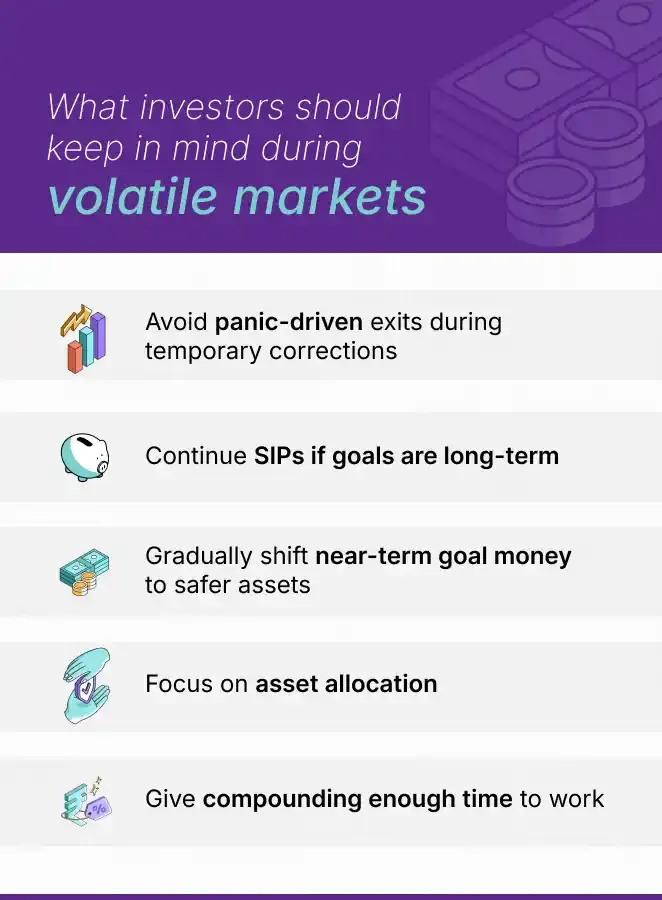
Short-term volatility is part of investing. But long-term outcomes are often decided by behaviour during these phases.
A panic exit can turn temporary losses into permanent setbacks, while patience and discipline often allow compounding to do its work.
So, one should avoid trying to time the market based on short-term uncertainty because, in many cases, waiting just one extra year can make a meaningful difference to long-term wealth.
Related News


About The Author
Next Story

