
Personal Finance News
NPS Sanchay scheme launched: Key rules on withdrawals, investments and eligibility explained

3 min read | Updated on May 07, 2026, 16:32 IST


SUMMARY
The Pension Fund Regulatory and Development Authority (PFRDA) on May 6 announced the launch of “NPS Sanchay”, a simplified NPS variant under the All Citizen Model and Multi Scheme Framework (MSF).
NPS Sanchay has been designed to make retirement savings easier for people who may not have access to financial advisors or may find investment choices complicated. | Image: Shutterstock.
India’s pension regulator has introduced a simplified version of the National Pension System (NPS) aimed at workers in the informal sector. This segment employs nearly 90% of the country’s workforce but remains largely outside formal retirement coverage.
What is NPS Sanchay?
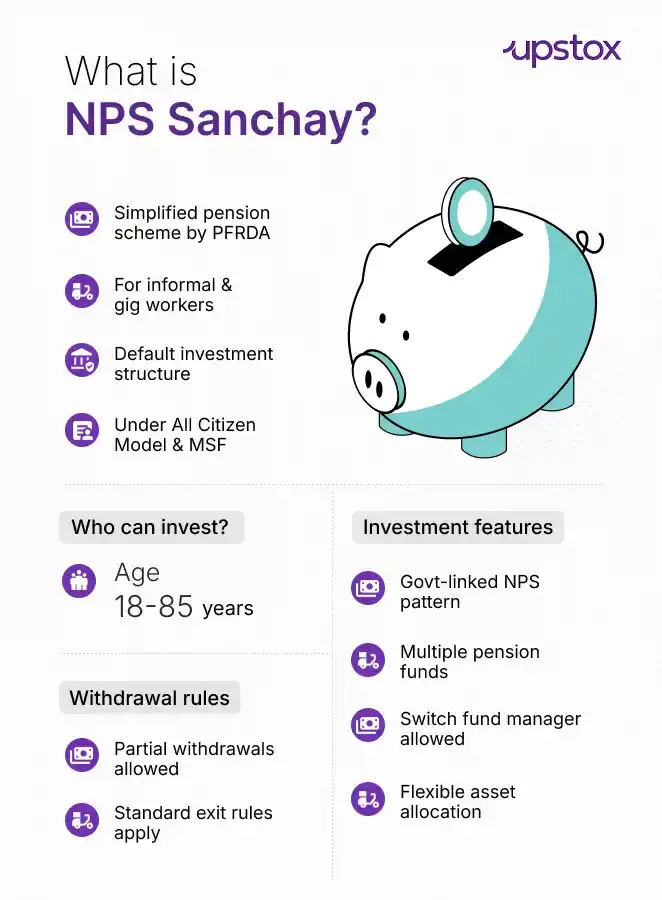
According to the circular, NPS Sanchay has been designed to make retirement savings easier for people who may not have access to financial advisors or may find investment choices complicated.
“The default design of this scheme is intended to reduce complexities associated with the selection of investment options and the determination of asset allocation, while also addressing constraints arising from limited advisory support at the last-mile level,” the regulator said.
In simpler terms, the scheme is meant to offer a more plug-and-play pension option for workers such as gig workers, daily wage earners, self-employed individuals, small traders and others in the unorganised sector.
Who can open an NPS Sanchay account?
Any Indian citizen between 18 and 85 years of age can open an NPS Sanchay account either:
-
Through a Point of Presence (PoP) or PoP-Service Provider
-
Via the online platform
-
Subscribers will have to complete standard KYC formalities and submit required documents under the existing NPS registration rules.
How will investments work?
PFRDA said the investment pattern under NPS Sanchay will follow the same guidelines currently applicable to government-sector-linked NPS and pension schemes, including:
-
UPS/NPS schemes for Central and State Governments
-
Corporate CG
-
NPS Lite
-
Atal Pension Yojana (APY)
-
The scheme will also be available across all pension funds registered with the authority.
Can subscribers change fund managers or allocation?
Yes. Subscribers will be allowed to change:
-
Pension fund managers
-
Asset allocation or investment choices
The flexibility will remain aligned with existing rules applicable under the All Citizen Model of NPS.
Withdrawal and exit rules
PFRDA clarified that all exit and partial withdrawal rules applicable under existing NPS regulations will also apply to NPS Sanchay.
This means subscribers will continue to follow the broader withdrawal framework already prescribed under NPS regulations.
Charges and contribution structure
-
NPS (All Citizen)
-
NPS Vatsalya
-
NPS Lite
Minimum and subsequent contribution requirements will also mirror existing norms unless changed separately by the authority later.
For millions of workers in India’s informal sector, retirement planning has often taken a backseat due to irregular incomes, lack of financial guidance and limited access to formal pension products.
With NPS Sanchay, PFRDA is trying to make that process simpler. By reducing the need to actively choose investment options or decide asset allocation, the new scheme aims to make pension saving easier for first-time investors and workers outside the formal salaried system.
The circular came into effect immediately, with the regulator asking all stakeholders to begin necessary preparatory actions.
Related News
About The Author
Next Story

