
Personal Finance News
₹20 lakh in an FD? Should you choose SBI, HDFC Bank, ICICI Bank or split the money across banks?
.png)
7 min read | Updated on September 09, 2026, 09:39 IST


SUMMARY
If we talk about the FD interest rates. There is no major difference if you split it into smaller term deposits or keep one big fat deposit. If ₹20 lakh is invested at the same rate, for the same period and under the same terms, the overall return will be broadly similar whether it is kept in one FD or divided into smaller deposits.
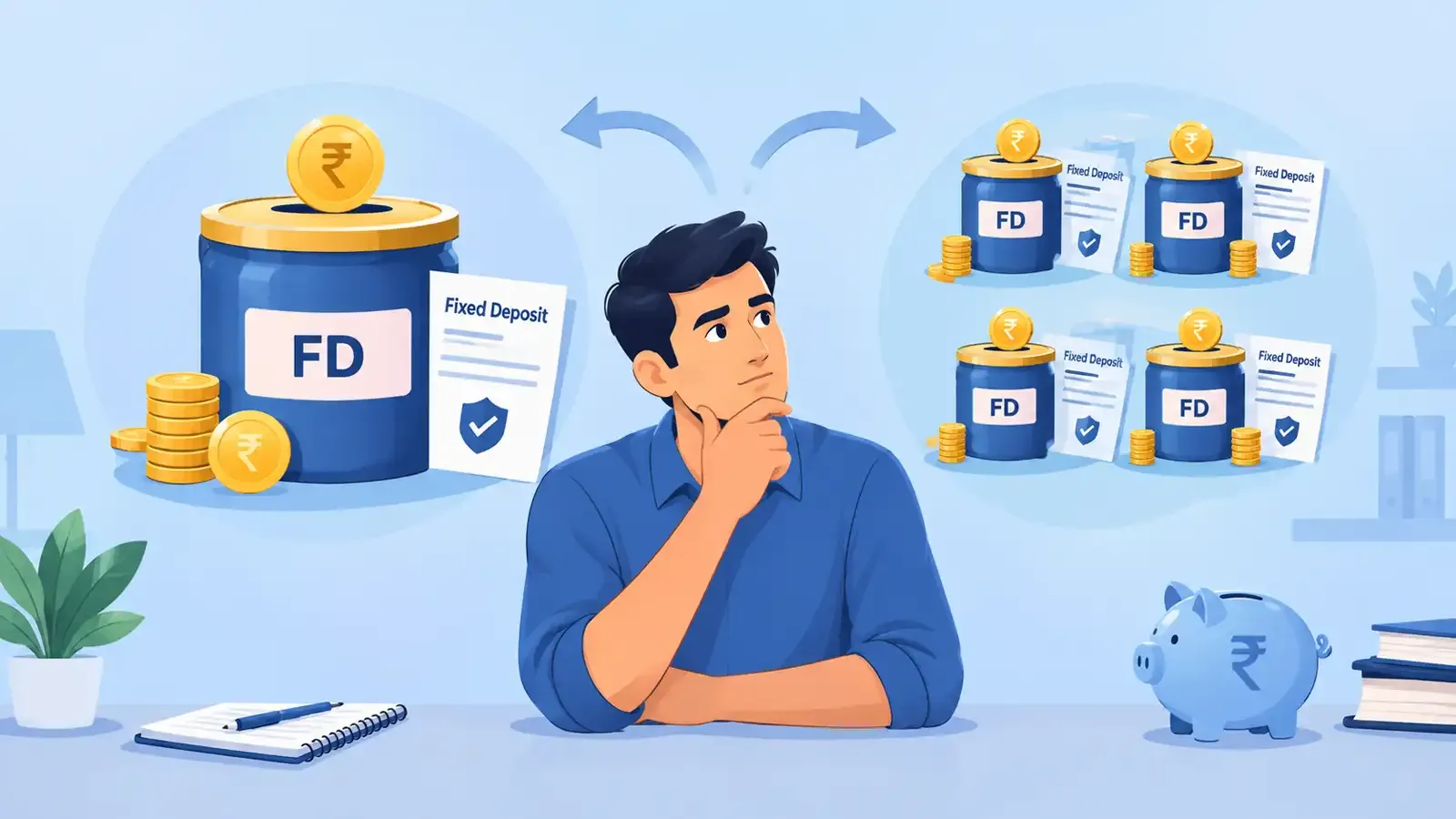
An FD ladder can be another option if you want different portions of the money to mature at different times.
You have ₹20 lakh that you want to keep in a bank fixed deposit (FD). What is the first thing that comes to your mind? It is usually to check the bank which offers the best interest rate. But apart from FD rates you should also think that should you put the entire amount into one FD or split it into several smaller deposits?
If we talk about the FD interest rates. There is no major difference if you split it into smaller term deposits or keep one big fat deposit. If ₹20 lakh is invested at the same rate, for the same period and under the same terms, the overall return will be broadly similar whether it is kept in one FD or divided into smaller deposits.
The difference becomes important when you need some of the money before the FD matures.
If instead you had divided the money into four small FDs of ₹5 lakh each, the picture would have been completely different. You could close one term deposit and do not touch the remaining three. The exact amount you can withdraw and any penalty or revised interest rate would depend on the bank's premature withdrawal rules.
So, splitting the money is less about earning more and more about keeping some flexibility.
FD laddering
There is also the option of spreading the deposits across different tenures. For instance, you could put ₹5 lakh each into one-year, two-year, three-year and four-year FDs. When one deposit matures, you can decide whether to use the money or reinvest it at the prevailing rate.
This approach, often called an FD ladder, can be useful for someone who does not want the entire ₹20 lakh tied up until one maturity date.
How much can ₹20 lakh grow in SBI, HDFC Bank and ICICI Bank?
The interest rate offered by the bank also matters. But it is important to remember that banks generally offer different rates for different FD tenures.
For example, the rates published by SBI, HDFC Bank and ICICI Bank vary depending on whether you choose a one-year, five-year or longer-tenure FD.
Using the respective banks' published rates for the relevant tenure, here is an illustration of what ₹20 lakh could grow to:
| Bank | 1-Year Rate | ₹20 Lakh After 1 Year | 5-Year Rate | ₹20 Lakh After 5 Years | 10-Year Rate | ₹20 Lakh After 10 Years |
|---|---|---|---|---|---|---|
| SBI | 6.25% | ₹21.25 lakh | 6.05% | ₹26.83 lakh | 6.05% | ₹36.11 lakh |
| HDFC Bank | 6.25% | ₹21.25 lakh | 6.40% | ₹27.27 lakh | 6.15% | ₹36.42 lakh |
| ICICI Bank | 6.25% | ₹21.25 lakh | 6.50% | ₹27.41 lakh | 6.50% | ₹37.52 lakh |
The numbers show why the rate matters, particularly over a longer period. In this illustration, ₹20 lakh at 6.50% grows to about ₹37.54 lakh over 10 years, compared with about ₹36.67 lakh at 6.05%.
That is a difference of roughly ₹87,000 before tax.
However, this does not mean that you should simply pick whichever bank has the highest rate. A higher rate may come with a different tenure, and you also need to consider premature withdrawal rules, taxation and how often the interest is compounded.
What if you split ₹20 lakh into four FDs of ₹5 lakh? Suppose you decide to divide the ₹20 lakh into four separate FDs of ₹5 lakh each.
If all four FDs are with the same bank, have the same interest rate and run for the same period, the total return will be broadly the same as putting the entire ₹20 lakh into one FD.
For example, take an ICICI Bank FD at 6.50% for 10 years.
With one ₹20 lakh FD, the illustrative calculation is:
₹20,00,000 × (1.065)¹⁰ = approximately ₹37.54 lakh
Now divide the money into four deposits:
₹5,00,000 × (1.065)¹⁰ = approximately ₹9.39 lakh per FD
Four such deposits would give:
₹9.39 lakh × 4 = approximately ₹37.54 lakh
In other words, splitting the ₹20 lakh into four FDs does not create additional returns when all the other conditions are the same.
The advantage is flexibility. If you need ₹5 lakh before maturity, you may be able to close one FD and keep the other three invested, subject to the bank's premature withdrawal rules.
What if the four FDs are spread across different banks?
This is where the calculation can change.
Suppose you put ₹5 lakh each in SBI, HDFC Bank, ICICI Bank and another bank. If the banks offer different rates for the same tenure, each ₹5 lakh deposit will grow at a different rate.
So the total maturity amount could be higher or lower than keeping the entire ₹20 lakh in one bank.
What does DICGC insurance mean for your ₹20 lakh?
There is also another reason some depositors choose to spread their money across banks: deposit insurance.
This means putting ₹20 lakh into four separate FDs of ₹5 lakh each at the same bank does not give you four separate ₹5 lakh insurance covers. Deposits held with that bank are aggregated for the purpose of deposit insurance, subject to the applicable ownership rules.
If eligible deposits are spread across different banks, the insurance limit applies separately to each bank.
For example, a person with ₹20 lakh could have:
-
₹5 lakh in SBI
-
₹5 lakh in HDFC Bank
-
₹5 lakh in ICICI Bank
-
₹5 lakh in another DICGC-insured bank
In that situation, the deposits are spread across four different banks rather than concentrated in one bank.
That does not mean deposits above ₹5 lakh are automatically unsafe. The ₹5 lakh figure is the deposit-insurance limit, not a statement that any amount above it would disappear if a bank failed.
One FD or multiple FDs: What makes sense?
One large FD may make sense if you value simplicity and are confident that you will not need the money before maturity.
Several smaller FDs may make more sense if you want flexibility. If you need only part of your money, you may be able to close one smaller FD instead of prematurely closing the entire deposit.
Spreading the deposits across different banks can also help diversify your banking exposure and provide separate DICGC insurance limits, subject to the applicable rules.
An FD ladder can be another option if you want different portions of the money to mature at different times.
FD interest rate is taxable. The amount you ultimately keep will depend on your total income and applicable tax rate. TDS deducted by the bank is not the same as your final tax liability.
Related News




About The Author
Next Story

