
Personal Finance News
LIC denied his son's Jeevan Anand death claim over alleged suppression of a heart condition; NCDRC orders full payout with interest
5 min read | Updated on October 15, 2026, 15:11 IST


SUMMARY
For policyholders and their nominees, the ruling highlights an important point: The mere fact that a disease was diagnosed shortly after the proposal was submitted does not, by itself, prove that the insured hid anything.
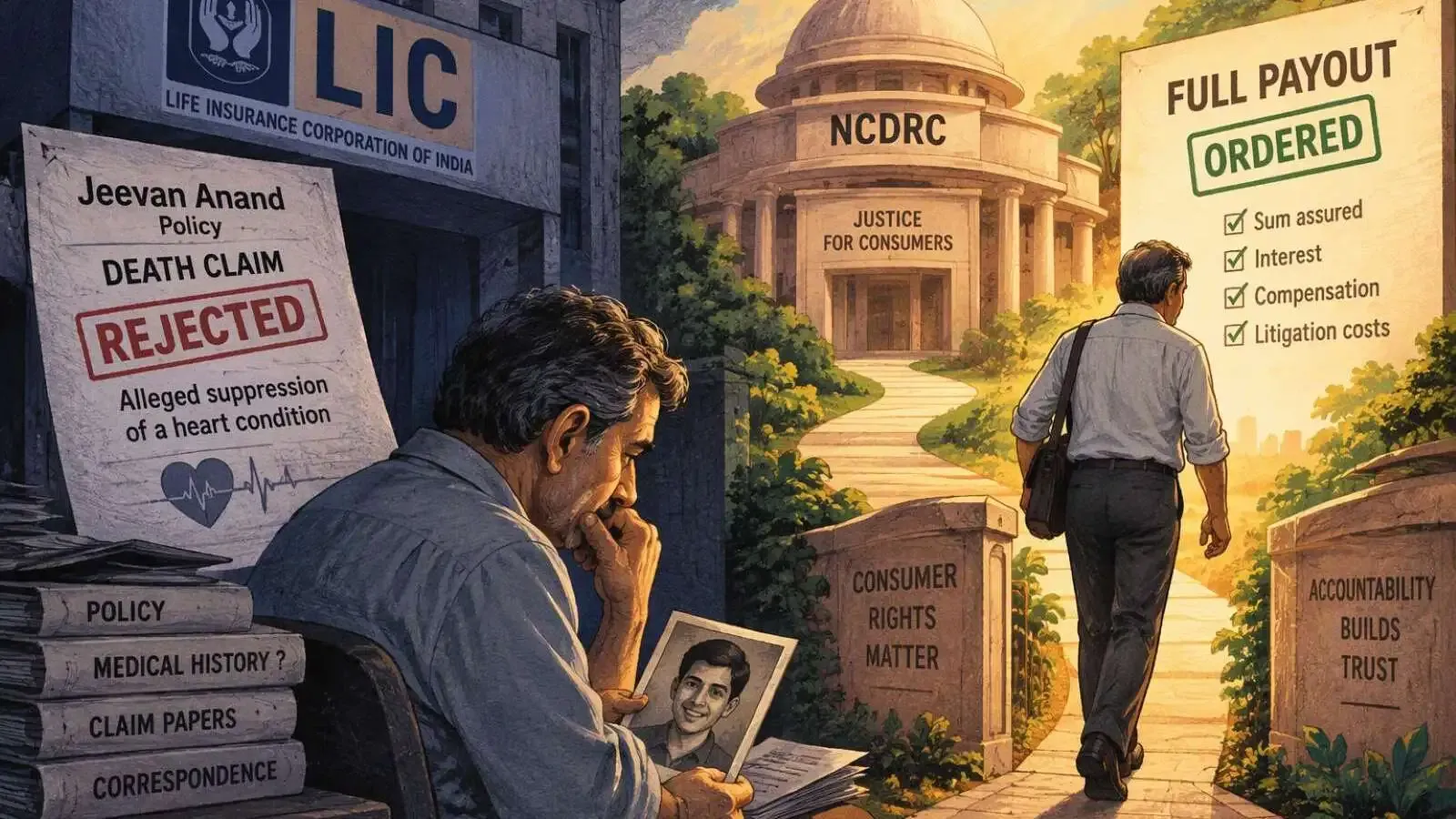
LIC failed to establish that the deceased knew of his cardiac condition and deliberately suppressed it. | Representational image/AI Generated
Based on details in the NCDRC's ordered dated October 1, 2026, this article explains the case history and takeaways for policyholders.
The NCDRC order on October 1 came in Life Insurance Corporation of India v. Prakash Sadhwani.
LIC had challenged an order dated July 29, 2021 of the State Consumer Disputes Redressal Commission (SCDRC), Delhi, which had upheld the order of the District Consumer Disputes Redressal Forum, New Delhi dated November 26, 2012. The district forum had directed the insurer to pay the sum assured of ₹5,00,000 with interest at 9% per annum from the date of repudiation till actual payment, besides ₹1,00,000 towards deficiency.
How the case started
Navitesh Sadhwani, son of complainant Prakash Sadhwani, took a Jeevan Anand policy for a sum assured of ₹5,00,000 with an annual premium of ₹31,818 in 2007, with his father named as nominee. The policy commenced on January 28, 2007. Navitesh also held another policy, for ₹2,50,000, since February 28, 2006. He was hospitalised on October 3, 2008 and died on October 14, 2008 due to hypertrophic cardiomyopathy, congestive heart failure and cardiorespiratory arrest. The family intimated the death on November 5, 2008. LIC investigated and settled the claim under the earlier policy, but repudiated the Jeevan Anand claim, alleging "fraudulent suppression of material facts" about the deceased's health.
What LIC argued
LIC contended that the proposal was actually submitted and inwarded at the branch only on February 7, 2007 under the Green Channel scheme. It relied on Counter Receipt No. 1375523 dated February 7, 2007 generated at 14:52 hours to contend that the first premium was accepted on that date. The risk, therefore, began only after that. The LIC submitted a certificate dated December 18, 2008 by Dr. S. Lahiri, consultant cardiologist at Delhi Heart and Lung Institute, which said that the deceased was diagnosed with hypertrophic cardiomyopathy by 2D echocardiography on February 5, 2007. On that basis LIC argued that the policyholder knew of his cardiac condition before the proposal was submitted on February 7, 2007, but answered the questions on medical consultation, hospitalisation and heart disease in the negative.
The insurer invoked the principle of utmost good faith (uberrima fides) and cases including Satwant Kaur Sandhu v. New India Assurance Co. Ltd., (2009) 8 SCC 316, LIC v. Asha Goel, (2001) 2 SCC 160, and LIC v. Raja Vasireddy Komalavalli Kamba, (1984) 2 SCC 719.
What the respondent argued
The respondent said the proposal was completed and signed on January 31, 2007 and handed over, along with the first premium cheque, to LIC's authorised agent and panel medical examiner the same day. Further, the medical examination was also done on January 31, 2007. Any later inwarding on February 7, 2007 was LIC's internal administrative matter and could not alter the date on the proposal form. The respondent's Counsel also pointed to Dr. Lahiri's certificate, which recorded that the deceased was diagnosed for the first time on February 5, 2007 and had no past history of disease before that.
What the NCDRC said
The apex consumer panel framed the real question as whether LIC had established that the deceased knew of his cardiac condition and deliberately suppressed it.
"The mere fact that the DLA was subsequently diagnosed with hypertrophic cardiomyopathy is not, by itself, sufficient to establish fraudulent suppression," the order said.
On the dates, the NCDRC found that the proposal was filled on January 31, 2007, the medical examination was done the same day, and the first premium cheque was handed over the same day. So the health particulars were entered when the proposal was made.
"Therefore, the DLA has no occasion to make any changes in that proposal form," it said.
The NCDRC also noted the respondent's assertion that "a free look opportunity as mandated under IRDA Rules was not provided to the DLA. Hence, there was no opportunity to the DLA to disclose the disease diagnosed on 05.02.2007."
The bench held that "even assuming that the duty of disclosure continued until acceptance of the proposal, the Petitioner was required to establish that the DLA had occasion to disclose but deliberately failed to disclose the same." It also found no jurisdictional error, illegality or material irregularity in the concurrent findings district and state panels.
The NCDRC, thus, dismissed LIC's petition and directed it to pay the respondent the amount as directed by the district forum within six weeks of the order. If it fails to pay within that period, "the outstanding amount shall carry interest at the rate of 12% per annum till realisation," NCDRC said.
Takeaways for policyholders
For policyholders and their nominees, the ruling highlights an important point: The mere fact that a disease was diagnosed shortly after the proposal was submitted does not, by itself, prove that the insured hid anything.
An insurer that wants to repudiate a claim for non-disclosure needs to show that the policyholder knew of the condition at the relevant time and consciously failed to disclose it. The burden of proving suppression of facts also stays with the insurer.
The NCRDC order also highlights the value of the paper trail — a dated proposal form, a same-day medical examination and the premium receipt — in establishing what a policyholder knew, and when.
Related News


About The Author
Next Story

