Market News
NIFTY50 just 1,000 points shy of record peak: Can Dalal Street end 2026 on a high? 5 factors to watch

8 min read | Updated on November 12, 2026, 14:21 IST

SUMMARY
With NIFTY50 1,000 points away from a fresh record high as of November 12, investors are now looking at the potential on whether or not the November rally can sustain in the upcoming period. Here's are five factors to understand to next step.

NIFTY50 and SENSEX have delivered more than 10% returns to investors month-to-date (MTD) as of Thursday, November 12, 2026. | Image: Shutterstock
Indian equity indices, NIFTY50 and SENSEX, have witnessed a stellar rally so far in the first 11 days of this month, November 2026, as investors continue to enjoy consistent gains after navigating two straight months of massive turbulence due to selling pressure in the domestic markets.
Foreign investors maintaining their massive buying support due to the anti-AI play in developed markets, moderating global crude oil prices, and the evolving geopolitical dynamics in West Asia are among several key factors powering the momentum for Indian equities in the near term.
Data showed that the NIFTY50 index has delivered 10.1% returns to investors so far in November 2026, with the benchmark index hitting an intraday high of 25,384.80 points on Thursday, November 12.
This indicates that the NIFTY was trading just 1,000 points shy of achieving a fresh record high level, surpassing its current lifetime high mark of 26,373.20 points. The benchmark index hit its record high at the beginning of the calendar year before the US-Iran war impacted the global markets.
So far, the SENSEX index has gained 10.5% or around 7,866 points in November 2026, touching an intraday high of 82,325.61 points on Thursday, November 12. This massive rally in Indian equities comes after two months of FII selling pressure during September and October this year.
“I think it essentially resembles what is called a spring-coiled spring effect. When a spring is pulled back, it builds up a lot of tension, and then suddenly it gets released, and there is a sharp sort of a bounce back,” said Ajay Bodke, a Mumbai-based independent equity market analyst with more than three decades of experience.
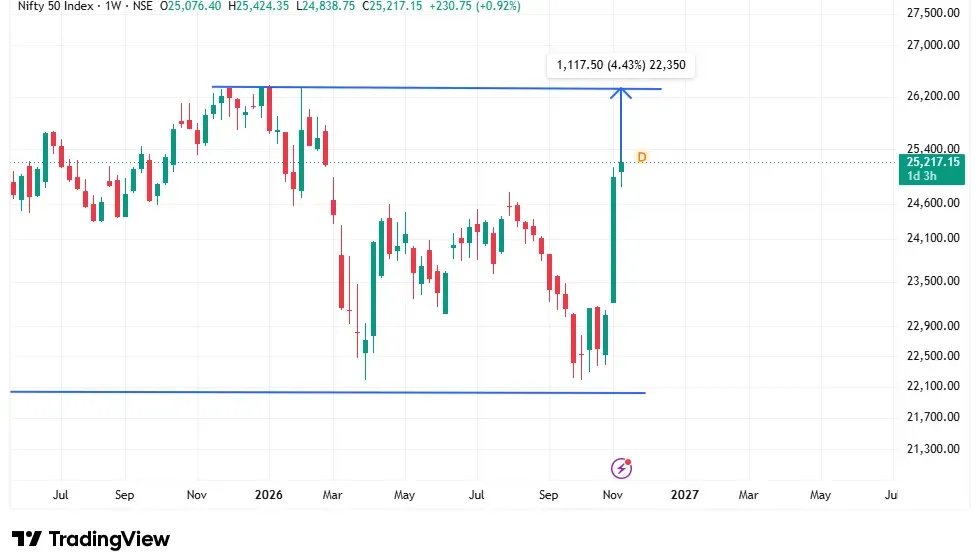
Can Dalal Street end 2026 on a high?
With nearly one and a half months left for the end of the calendar year, Indian equity markets are expected to end on a high note, with the overall sentiment of the market turning around as analysts look forward towards further gains conditional on several key factors in the markets.
“With the US Vice President personally weighing in to bring a durable peace deal between Iran and the United States, if that happens, then the crude slides further. In turn, Indian markets could witness NIFTY touching 26,000 by December-end,” Ajay Bodke told Upstox.
“I think 26,000 is eminently achievable for NIFTY50, and rolling forward, I won't be surprised if the index ranges between 27,000-28,000 by December 2027,” he said.
Global investment majors like Jefferies, Citibank, and HSBC have upgraded their NIFTY target and outlook for 2027, citing several key factors like lower crude oil prices, measured AI spending across the world in turn powering anti-AI trade in India, and strong earnings and fundamentals in domestic companies.
Jefferies expects that the potential AI trade reversal, equity tax relief, resilient domestic macroeconomic conditions, reasonable large-cap valuations and light positioning could support FPI inflows in the upcoming period.
In line with the outlook, Citibank raised its NIFTY50 end-2027 outlook to 28,000, while HSBC cited resilient earnings momentum, strong bank credit growth and policy measures to support the Indian rupee, which will in turn make the emerging market look relatively attractive to foreign investors.
5 things investors need to track
Crude oil prices
Global crude oil prices have witnessed a significant pullback from their high levels in the market, with investors focusing on an easing from a near-term peak. Escalations remain in control and on pause between Iran and the United States after the midterm election results.
Investing.com data showed that the benchmark Brent crude oil prices are down 5% in the last five days and have declined 12.6% in the last one month.
A potential moderation of crude oil prices towards the $80 per barrel (bbl) level could further reduce the elevated cost pressure for importers of crude oil in the Indian market, in turn easing the country’s overall import bill.
The lower crude oil prices will also contain the inflationary pressure in the Indian economy and, in turn, improve the macroeconomic outlook of the country in the upcoming period.
Currently, the Reserve Bank of India (RBI) estimates the consumer price index (CPI) inflation for the Indian economy to hit 6% during the third quarter of FY27 due to continued supply-side pressure, El Niño conditions, and higher oil prices in the market.
Sustained FII buying
The primary reason behind the latest rally in Indian equities is the sustained buying support from foreign investors, or FIIs, as data showed that around ₹60,698 crore of net investments have been channelled to the Indian stock market.
The continued buying support from foreign institutional investors (FIIs) could provide a significant boost to Indian equities, in turn supporting the overall market sentiment and helping benchmark indices sustain their upward momentum.
However, any trend reversal like the interest rate hike in the US economy, may also potentially trigger outflows from the Indian markets.
Experts said that the liquidity which was shifted from the Indian markets during September and October into other tech-heavy indices in Wall Street, Japan and Korea, is now returning to the domestic equities as India remains insulated from the global AI trade.
Ajay Bodke also explained that if Bloomberg finally decides to add India bonds to its global aggregate bond index, after the deferral in July earlier this year, then around $20-30 billion in foreign fund inflows are likely to happen over time into the country, which will be a positive event that could surprise the market, in turn strengthening the Indian rupee.
Geopolitical tensions
United States is currently maintaining its stance of “no need for major combat operations” in Iran, as America’s economic pressure campaign is reportedly working well for the peace deal negotiations between the two nations.
This comes at a time when the Democratic Party has taken charge of the US Congress with a majority win in the midterm election results earlier this month.
So any de-escalation in the West Asia conflict or any improvement in global trade relations could improve the risk appetite of foreign investors, encouraging further inflows in emerging markets like India.
Capital gains tax relief
Investors could also likely witness a significant change in capital gains tax in the upcoming Union Budget 2027, as industry bodies and financial researchers step up demands for relief on stock market investments.
Hence, any changes in the long-term capital gains (LTCG) or short-term capital gains (STCG) tax rates could improve investor sentiment and provide a potential trigger for domestic equities.
Industry bodies like the PHD Chamber of Commerce and Industry (PHDCCI) have urged Finance Minister Nirmala Sitharaman to abolish the existing 12.5% LTCG tax on equity investments and reduce the STCG tax rate to 10% from the current 20%.
Corporate earnings growth
In the Q2 results, the overall performance across the sectors and major corporates has been healthy and has surpassed the market estimates despite the cost overhang which emerged due to the supply chain disruption and high commodity prices in the market for raw materials.
“The Q2 earnings growth has been broad-based and robust across sectors and the market-cap spectrum,” said Ajay Bodke, a Mumbai-based independent markets analyst.
After beating down the stocks for two months, foreign investors are also conducting their buying spree, powering net flows into the large-cap stocks, which look more attractive in valuation and price, offering strong fundamentals for growth despite the near-term overhang in the market.
Hence, the healthy earnings growth, potential for margin improvement and stronger corporate fundamentals across the sectors will be crucial for investors to track, as these hold the potential for supporting further growth upside in the upcoming period.
Bottomline
All of these key factors combined hold the potential for the strong performance of the Indian stock markets in the upcoming period, as the emerging market offers key growth fundamentals and attractive valuations for global investors.
The NIFTY is largely expected to maintain its rally with key FII buying support and lower prices in the global market.
However, investors need to keep a close eye on the rapidly evolving geopolitical developments and sentiment among institutional investors in the market to gauge the way forward in the upcoming period.
Related News


About The Author
Next Story