Market News
Infosys, TCS, HCLTech: NIFTY IT is down 25% so far in 2026; what does future hold for the beaten-down sector?

6 min read | Updated on March 17, 2026, 14:38 IST


SUMMARY
IT stocks: Indian IT stocks witnessed a sharp sell-off recently amid concerns over the rapid pace of artificial intelligence advancements and continued weakness in global technology stocks following the launch of new AI tools by companies such as Anthropic and others.

HSBC recently said it expects Indian IT companies to shift away from ‘beat-and-raise’ guidance to more ‘realistic to even aggressive’ guidance. | Image: Shutterstock
And, amid the across-the-board sell-off, is the IT and tech sector, which was once the solid wealth creator and 'safe' place for investors.
Data show that the NIFTY IT index is down around 25% year-to-date (YTD), or so far in the calendar year 2026. In comparison, the benchmark NIFTY50 index is down nearly 10% during the period.
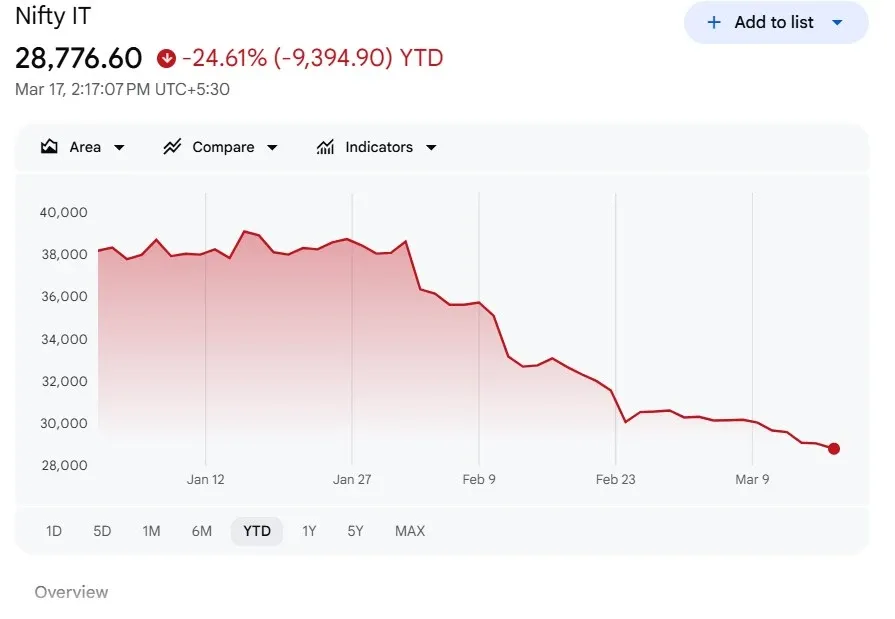
The biggest reason behind the latest sell-off in the IT space is fears of AI disrupting the business model of the traditional IT companies.
Indian IT stocks witnessed a sharp sell-off recently amid concerns over the rapid pace of artificial intelligence advancements and continued weakness in global technology stocks following the launch of new AI tools by companies such as Anthropic and others.
IT stocks: What HSBC extrapolates
Analysts at HSBC, in their recent note on the Indian IT services, said that the AI narrative and uncertainty are driving the stock valuation de-rating. Unfortunately for the sector, there is no high-frequency data to counter the AI narrative, so the most important catalyst for the sector is likely to be FY27 guidance from Infosys and HCLT in April.
"We expect companies to shift away from ‘beat-and-raise’ guidance to more ‘realistic to even aggressive’ guidance," they added.
What to expect
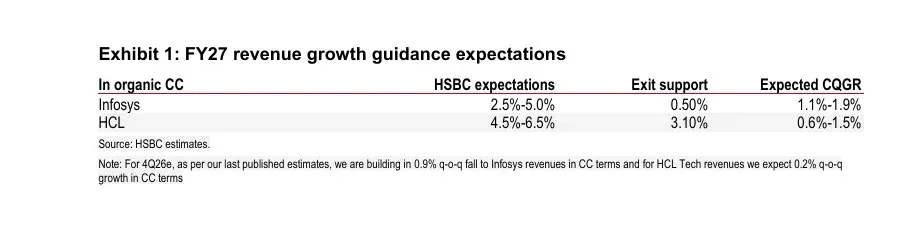
For Infosys, HSBC expects guidance to be in the range of 2.5% to 5%. The upper end may appear somewhat aggressive, but it would signal an improvement in demand versus last year. On its recent earnings call, Infosys suggested an improvement in demand in the banking and energy verticals. Together, these verticals constitute around 41% of total revenues for Infosys.
HCLT management has been quite vocal about the relative strength of the company’s business mix to manage the impact of AI. HCLT’s recent deal wins and good exit rate could result in a guidance range of 4.5-6.5%. Exhibit 1 illustrates the implied compound quarterly growth rate (CQGR) for the four quarters of FY27, alluding to the overall annual numbers.
However, the HSBC report said, "We highlight that the macro backdrop is quite favourable for the sector, as most top clients are reporting strong earnings. However, there could be a pause in spending due to the rapidly evolving frontier AI models and uncertainty around the adoption curve. This could affect near-term demand. Also, it is still a month until the end of the quarter, so the outlook could change by early April."
Indian IT outlook
The Indian IT outlook, HSBC said, is the flywheel of four interconnected forces. One is AI deflation, which is currently top of mind for investors and continues to affect stock prices. Following comprehensive analysis and industry consultations across 13 revenue sub-segments, we assume 14-16% deflation.
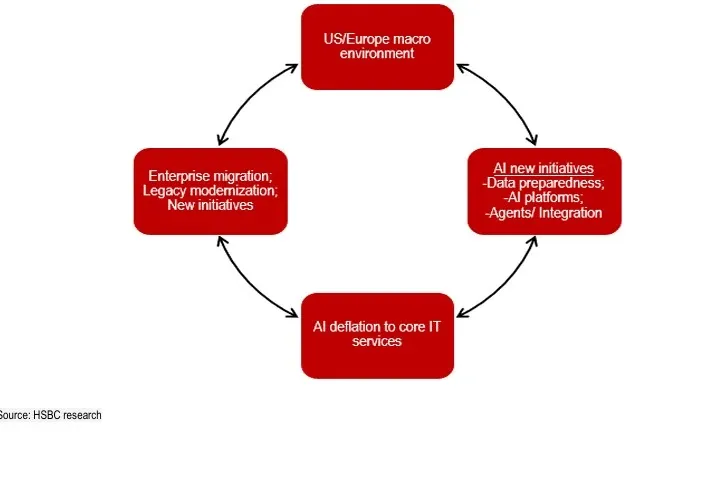
However, another key driver of IT demand (US corporate earnings) continues to surprise positively. Top US corporate results (clients of Indian IT) remain robust in 4Q25, and notably, the forward earnings expectations of the S&P 500 were upgraded further.
Improving business outlook and AI-led productivity gains should drive incremental investment in enterprise software migration, legacy tech modernisation, and AI adoption.
On a net basis, these should offset AI deflation and may still lead to mid-single-digit ‘net’ growth for some IT companies.
Industry leaders remain sanguine
Recently, HCL Tech's managing director and chief executive, C. Vijayakumar, said that investor concerns about IT stocks are "overblown". The CEO asserted that it's not the time to write an obituary for the industry, underlining that the ability to manage complex enterprise technology architectures and domain understanding will ensure its relevance.
The leader noted that amid widespread concerns about jobs and the relevance of the nearly $300 billion Indian IT services sector, the current transition will be "painful" because it involves humans.
Recounting how the industry navigated changes like the opportunities after Y2K in the past, Vijayakumar said the industry will have to reinvent itself.
"I would say this transition (brought by AI) is different from the other transitions. It's going to be painful because it really involves people," the CEO of the third-largest Indian IT services company said.
'This is the biggest inflection point for the Indian IT sector and an opportunity to completely reimagine the sector over the next 5-10 years,' Vijayakumar said.
AI provides huge opportunities to Indian firms: NASSCOM
Recently, Nasscom AI head Ankit Bose said the rapid development of artificial intelligence (AI) globally presents significant opportunities for Indian companies and will not adversely impact their businesses. Bose said instead of job cuts, India will witness job transformations as roles evolve with the growing adoption of AI.
AI is happening at a massive scale
"AI is getting developed across the world, but who will deploy that? For that, you need people... So now India is adding capacity... AI is happening at a massive scale, and Indian professionals will deploy that. So it's a big opportunity for us, but we have to be ahead of the curve, and we have to keep our skills up-to-date," Bose told PTI.
No major worry for Indian companies
Bose added that there is no major worry for Indian companies that are supplying services to domestic firms or global companies due to this fast-growing technology.
In fact, the companies will grow, Bose said.
More people are required to deploy AI globally, and India has strength in this, he said, adding that there could be some turbulence, but only in the short run.
The remarks are important, as India is a major IT and ITeS exporter.
Related News

About The Author
Next Story