
Market News
India bought 29% less gold last quarter. So how did Titan and Kalyan grow over 20%?

9 min read | Updated on November 16, 2026, 12:08 IST

SUMMARY
India's gold demand fell 29% by weight in July-September. Yet Titan's domestic jewellery revenue rose 21% and Kalyan Jewellers' revenue rose 31% in Q2 FY27. There is no obvious contradiction here. Indians bought fewer grams of gold but paid much more for each gram, and the big chains appear to have won a bigger share of that spending. Take out the one-time gains, though, and profit growth is far less dramatic.
Stock list
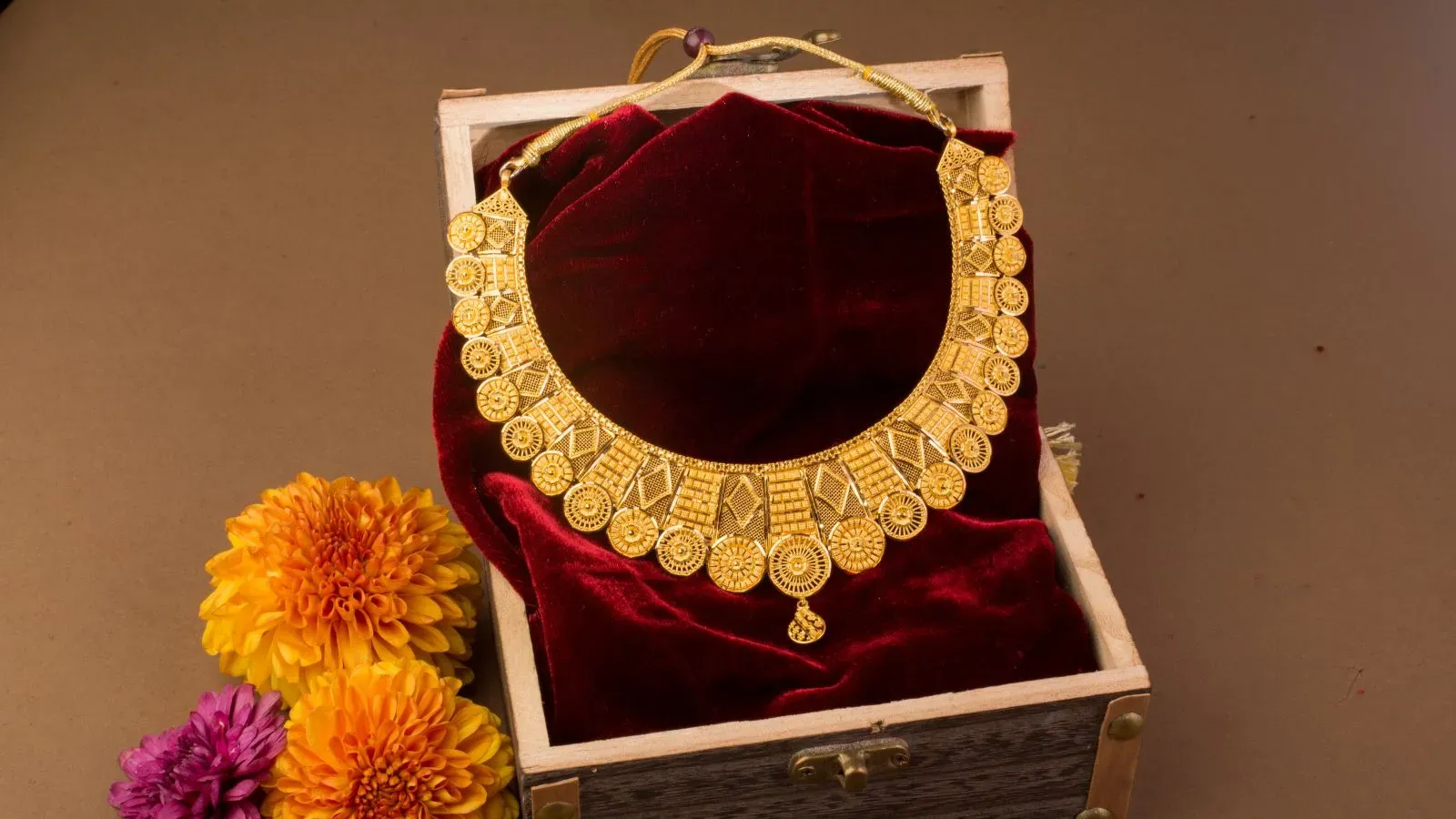
The World Gold Council says India's gold demand fell 29% YoY to 162.5 tonnes in July-September. | Image: Shutterstock
Let's imagine a family from Jaipur heading to their nearest jewellery store this festive season. They have a budget of ₹3 lakh and a pouch of grandma's old bangles. Last year, that budget would have bought about 29 grams of gold. This year, gold averaged about ₹1.49 lakh per 10 grams in July-September, so the same budget buys only about 20 grams. Making charges and GST come on top.
So they settle for a lighter necklace, maybe with a few diamonds so it doesn't look small. Grandma's bangles go in as part-payment. The bill at the counter is about the same as last year, or more.
If this plays out in several crore households, it explains the strange quarter India's jewellery market just had.
What does the 29% fall actually measure?
The World Gold Council says India's gold demand fell 29% YoY to 162.5 tonnes in July-September. Jewellery demand fell 20% to 99.9 tonnes, the weakest July-September quarter since 2020.
Now look at the rupees. Indians spent about ₹1,48,700 crore on gold jewellery in the quarter, 16% more than a year ago. Gold itself averaged about 45% more on MCX.
So, the 29% is about weight, not wallets. When the price jumps 45%, do people walk away, or do they buy smaller pieces? Indian households went for smaller pieces.
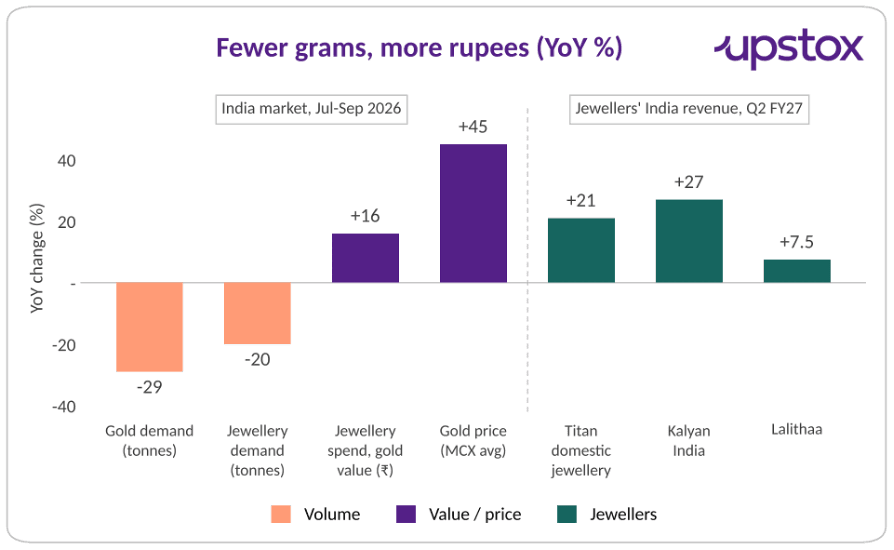
Source: World Gold Council, company filings. WGC spend is the value of gold content only; it excludes making charges and diamonds. Jewellers' figures are India revenue: Titan domestic jewellery, Kalyan India operations, Lalithaa consolidated.
Who gets the rupees?
If spending on gold jewellery grew 16%, an average jeweller might have grown about that much. The big brands grew faster.
Titan's domestic jewellery revenue rose 21% YoY to ₹16,343 crore in Q2 FY27. Tanishq, Mia, Zoya and beYon together grew 20%, and CaratLane grew 31%.
Kalyan's India revenue, excluding bullion, rose 27% to ₹8,701 crore, with same-store sales up about 20%. Its consolidated revenue from operations grew 31% to ₹10,323 crore.
Senco Gold reported its Q2 FY27 results on 13 November. Its business update already showed same-store sales growth of 19%.
These numbers are not a perfect match. The 16% only measures the value of the gold inside the jewellery. Jewellers' revenue also includes making charges and diamonds, and Titan is selling a lot more studded pieces. Still, a gap this wide points one way. The big chains are likely taking business from the thousands of small, unorganised jewellers who still hold most of this market. Organised players made up only about 37% of Indian jewellery sales in 2025.
Being big is not enough on its own. Lalithaa Jewellery, a South India-focused chain with 66 stores, grew its consolidated revenue from operations only 7.5% to ₹7,020 crore. In the same quarter, Kalyan's South India revenue grew 23%. Why did one of the largest regional chains in the country grow at less than half the pace of the market?
Same buyers, bigger bills
This is the part that often surprises people: at Titan's biggest brands, more sales did not come from more customers. At Tanishq, Mia and Zoya, the number of buyers was flat YoY. The growth came from bigger bills. Studded jewellery grew 32%, plain gold jewellery grew 20%, and coins fell 7%. Studded jewellery now makes up 35% of Titan's sales across Tanishq, Mia, Zoya and beYon, up from 32% a year ago. CaratLane was different; it did add buyers at a double-digit pace.
Senco shows the same trend from a different angle. Its diamond jewellery revenue grew 31%, but diamond jewellery volumes grew only 7%. Customers paid more for their diamond jewellery; they did not buy much more of it.
Kalyan's story is different. Its studded share stayed flat at about 31%. Growth came from same-store sales, 11 net new showrooms in India and new customers, who made up over 33% of buyers.
Jewellers are also making each piece cheaper by using less pure gold. Titan is offering 18-carat gold jewellery, 14-carat studded pieces at Tanishq and even 9-carat at Mia. Senco is focusing on lightweight and 9K collections. In a World Gold Council survey of buyers who plan to keep buying or change how they buy, 77% said they would trade down on purity or carat. Does a 14-carat necklace hold as much gold as a 22-carat one of the same weight? No. But buyers are accepting the deal.
Grandma's bangles are paying for the new necklace
Old gold is the second big lever. In Kalyan's India business, the share of recycled gold stood at 42% in Q2 FY27, up from 29% a year ago. At Senco, old gold exchange crossed 50%. At Tanishq, Mia and Zoya, exchange is now one of the most common way customers buy gold.
For families, this means an upgrade with less extra cash. For jewellers, it means gold that does not have to be imported. That matters more after the Prime Minister's appeal to cut gold purchases and the customs duty hike in May.
There is a trade-off. Senco said heavy exchange could slightly pressure its margins. And Kalyan's recycled gold share has already slipped from 46% in Q1 FY27. How long can families keep trading in their mothers' gold?
How much of the profit comes from the business?
This is where the headline numbers need a closer look.
Titan's consolidated net profit more than doubled to ₹2,393 crore, up 114% YoY. Its PAT margin rose to 11.6% from 6.0%. But two one-off items sit inside these numbers. One is a ₹671 crore accounting gain from revaluing its obligation to buy the rest of Damas, its Gulf jewellery business. The other is a ₹536 crore customs duty gain in its jewellery businesses. Titan's profit before tax rose 97% to ₹3,000 crore. Without the two items, it rose 18% to ₹1,793 crore.
Kalyan's net profit rose 64% to ₹427 crore, and its PAT margin improved to 4.1% from 3.3%. These numbers include a ₹73 crore exceptional gain from a land sale and a ₹52 crore one-off gain from the import duty hike. Kalyan's profit before tax rose 60%. Without the two items, it rose about 24%.
Lalithaa did not separately disclose any one-off items. Its net profit rose 4.5% to ₹253 crore, and its PAT margin slipped to 3.6% from 3.7%.
What is this customs duty gain? In May, import duty on gold went up to 15% from 6%. Jewellers holding gold bought at the old duty sold it at the new, higher prices and booked a windfall. Titan's management expects smaller rivals to use these gains to offer discounts for another two to three months.
Then there is grey-market gold. Unofficial gold inflows rose to about 50 tonnes in the quarter from 3 tonnes a year ago, and domestic gold traded at its widest average discount to import prices on record. That keeps pressure on selling prices.
Is the business still growing? Yes. But comparing pre-tax profit on both sides, it grew 18% to 24% without the one-offs, not the 60% to 97% that the reported numbers show.
| Company | Revenue from operations (₹ crore) | YoY (%) | Net profit (₹ crore) | YoY (%) | PAT margin (%) | PBT YoY (%): reported / ex one-offs | YTD return (%) |
|---|---|---|---|---|---|---|---|
| Titan: jewellery segment^ | 17,495 | 24.1 | 2,300 (EBIT) | 52.7 | 13.1 (EBIT) | 52.7 / 17.1 (EBIT) | 22.6 |
| Titan: consolidated | 20,614 | 10.1 | 2,393 | 113.7 | 11.6 | 97.1 / 17.8 | 22.6 |
| Kalyan Jewellers | 10,323 | 31.4 | 427 | 63.9 | 4.1 | 59.9 / 24.1 | 36.4 |
| Senco Gold | Results due 13 Nov | - | - | - | - | - | 4.2 |
| Lalithaa Jewellery | 7,020 | 7.5 | 253 | 4.5 | 3.6 | 6.0 / n.d.# | 83.9* |
PAT margin = net profit ÷ revenue from operations. One-offs: Titan ₹671 crore Damas revaluation gain and ₹536 crore customs duty gain; Kalyan ₹73 crore land sale gain and ₹52 crore duty gain. ^Segment income excluding bullion; segments report EBIT, not net profit. Titan's consolidated revenue from operations includes bullion sales, which fell to ₹226 crore from ₹2,429 crore. *Listed on 24 August 2026; return from IPO price of ₹201. YTD returns as of 11 November 2026 close on BSE. #Not disclosed: Lalithaa did not separately quantify any one-off items. Source: Company filings, BSE.
What will the festive and wedding quarter test?
Q3 FY27 brings Navratri, Dhanteras, Diwali and the start of the wedding season. It also brings three tests. First, the base. The calendar helps, since Navratri fell in Q3 this year but in Q2 last year. The base hurts, since Titan's domestic jewellery revenue grew 41% in Q3 FY26.
Second, the gold cushion is thinning. Titan's management said the YoY rise in gold prices in Q3 may be in single digits. Growth will then need more buyers, not just bigger bills.
Third, the duty windfall fades. Other one-offs may not vanish completely, though. Titan's Damas obligation can be revalued again in later quarters, which can move profit either way. Kalyan expects to sell one more land parcel, valued at about ₹16 crore, this quarter.
Early signs are mixed. Kalyan said the festive quarter started very well, especially during Navratri and Dhanteras. Titan had a strong Navratri, a few soft days when gold prices swung, and customers coming back as prices cooled. The World Gold Council expects festive and wedding demand to help, but warns that high prices and a weak rural economy could hold buying back. When gold stops doing the heavy lifting, will buyers come back?
Conclusion:
Back to the family in Jaipur. Same money, fewer grams, a little more sparkle, and grandma's bangles to help pay for it. That, in short, was India's jewellery market in Q2 FY27.
The 29% fall measures weight. Jewellers' revenues measure rupees, and the big national chains grew faster than the 16% rise in gold jewellery spending. At the same time, part of the profit jump came from one-off gains that are unlikely to repeat at the same scale. The festive and wedding quarter will show whether more buyers return as gold cools, or whether bigger bills keep doing the work.
About The Author
Next Story

