Market News
Bajaj-Finance Q1 results: Earnings preview, technical structure and options strategy ahead of results
.png)
4 min read | Updated on July 24, 2025, 09:01 IST


SUMMARY
Bajaj Finance has broken out of a symmetrical triangle pattern, which usually indicates the end of a consolidation phase and the start of a new trend. Key levels to watch for short-term trading decisions are the immediate support at ₹940 and the resistance level at around ₹979.

Bajaj Finance to announce Q3 today
Leading non-banking financial company (NBFC) Bajaj Finance is set to announce its results for the June quarter (Q1 FY26) on 24 July 2025. The earnings are expected to be announced after the market hours.
According to experts, Bajaj Finance is expected to report robust growth in net interest income (NII) and net profit during the June quarter, aided by a double-digit rise in the loan book and assets under management (AUM).
Bajaj Finance’s NII is expected to be in the range of ₹10,460–₹10,720 crore, representing a year-on-year increase of 25–28%. The company reported an NII of ₹8,365 crore in the same quarter last year. Meanwhile, net profit could rise by 17–20% to a range of ₹4,580–₹4,690 crore. In Q1 FY25, Bajaj Finance reported a net profit of ₹3,912 crore, whereas in Q4 FY25 this figure stood at ₹4,546 crore.
During its quarterly business update, Bajaj Finance reported a 23% year-on-year (YoY) growth in new loans booked, reaching 1.34 crore. Its total assets under management also grew by 25% YoY, reaching ₹4.41 lakh crore. As of 30 June 2025, total customer franchise stood at 10.6 crore.
Investors will be keen to hear management's commentary on the outlook for loan growth, net interest margin and gross and net non-performing assets (NPAs). Meanwhile, ahead of results, Bajaj Finance ended Wednesday’s session 1.6% higher at ₹968 per share on. So far this year, Bajaj Finance shares have delivered a return of over 35% to investors.
Technical view
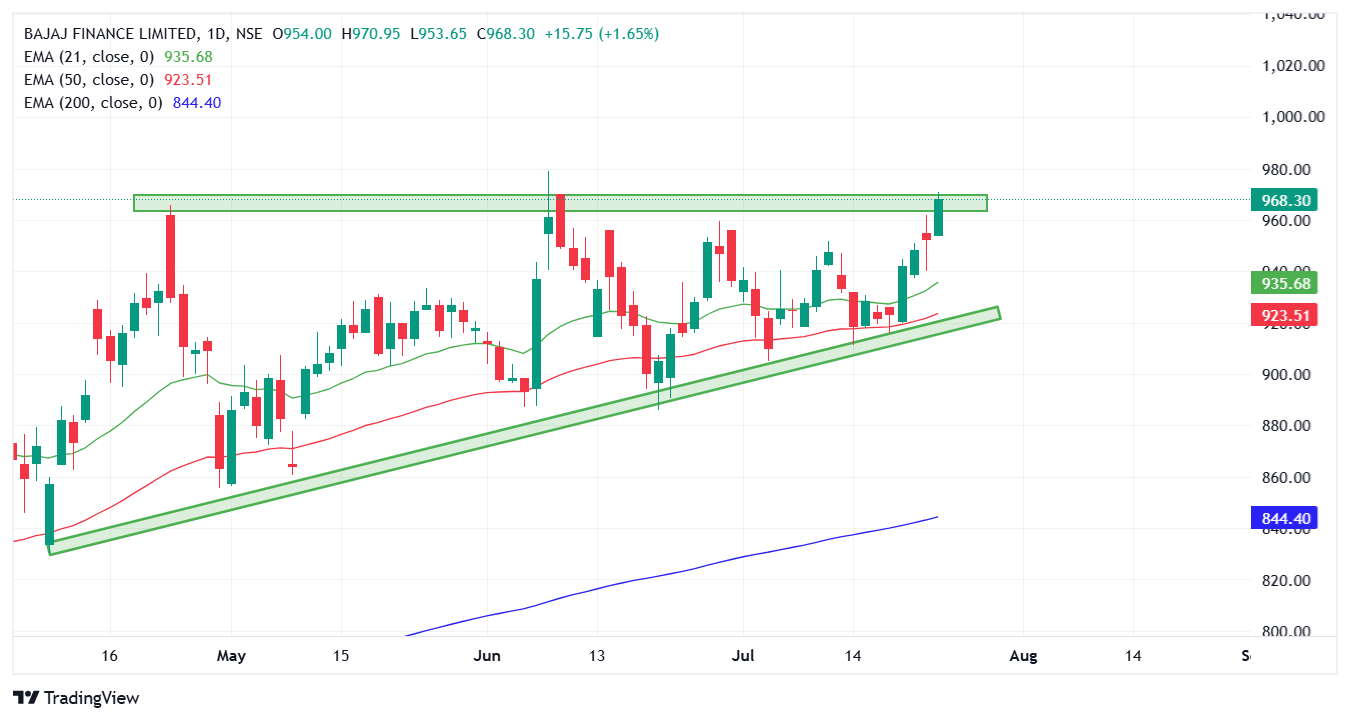
The technical structure of Bajaj Finance remains bullish as it closed at a record high level. It formed a bullish candle on the daily chart and has broken out of the symmetrical triangle pattern. This chart pattern is formed when two converging trend lines with similar slopes connect a series of lower highs and higher lows, creating a triangular shape. This usually signals a period of consolidation before a breakout in either direction. Meanwhile, for short-term clues, traders can also monitor the immediate support of ₹940 and the resistance zone of ₹979.
Options outlook
Bajaj Finance's 31 July at-the-money strike is at 970, with both the call and put options priced at ₹39 as of 24 July. This suggests that traders are expecting a price movement of ±4.1% till its July expiry.
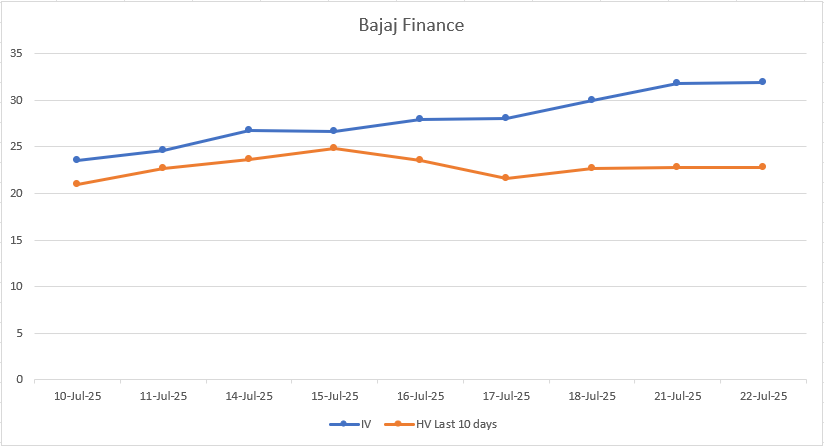
Additionally, the implied volatility (IV) for Bajaj Finance has steadily increased and has reached 34, sharply outpacing the 10-day historical volatility (HV), which has remained relatively flat after a brief spike.
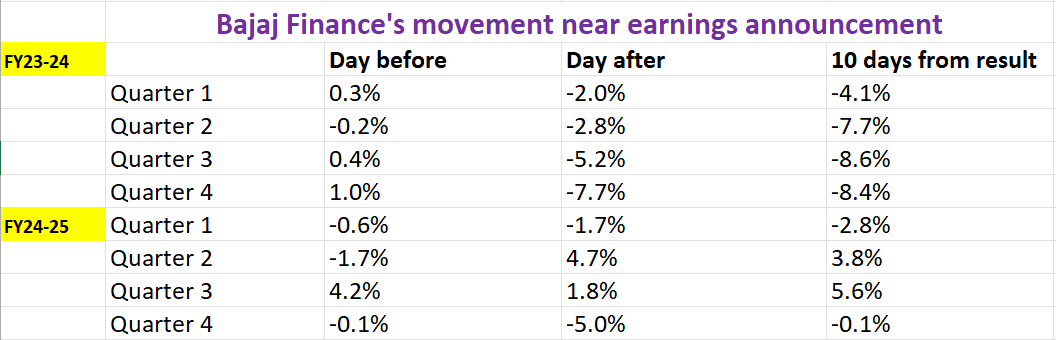
Let’s examine how Bajaj Finance stock has reacted to its quarterly earnings announcements over the past two years to gain insights into its price movements.
Options strategy for Bajaj Finance
Ahead of the 31 July expiry, the implied movement from the options market is ±4.1%. Traders can therefore consider the Long and Short Straddle strategies to take advantage of the anticipated volatility and price swings.
For those looking to capitalise on the expected volatility, the Long Straddle strategy is appropriate. This involves buying both an at-the-money (ATM) call and put option with the same strike price and expiry of Bajaj Finance, with the aim of profiting from a move of more than ±4.1% in either direction.
Conversely, the Short Straddle strategy is suitable for scenarios where volatility is expected to fall. In this approach, a trader would sell both an ATM call and put option with the same strike price and expiry, implying that the price of Bajaj Finance will remain within a range of ±4.1% after the earnings release.
Meanwhile, traders looking to implement bullish or bearish option strategies on the break of the immediate support and resistance levels can consider directional spreads. These strategies offer a slightly more advanced approach. For a bullish outlook, a bull call spread can be used by buying a call option and simultaneously selling a call option with a higher strike and the same expiry date.
Similarly, for a bearish view, traders can use a bear put spread by buying a put option and selling a put option with a lower strike and the same expiry date.
About The Author
Next Story