Market News
Maruti Suzuki Q2 results: Net profit likely to see double-digit growth aided by demand boost from GST rate cut; check details
.png)
4 min read | Updated on October 30, 2025, 19:33 IST


SUMMARY
Automobile giant Maruti Suzuki India is set to announce its results for the September quarter on 31 October 2025. Experts anticipate a consistent performance, with revenue growth in the mid-single digits and a significant increase in profitability. Technically, Maruti Suzuki has rallied over 25% since breaking out of a year-long consolidation, and the stock is now stabilising near its record high.
Stock list

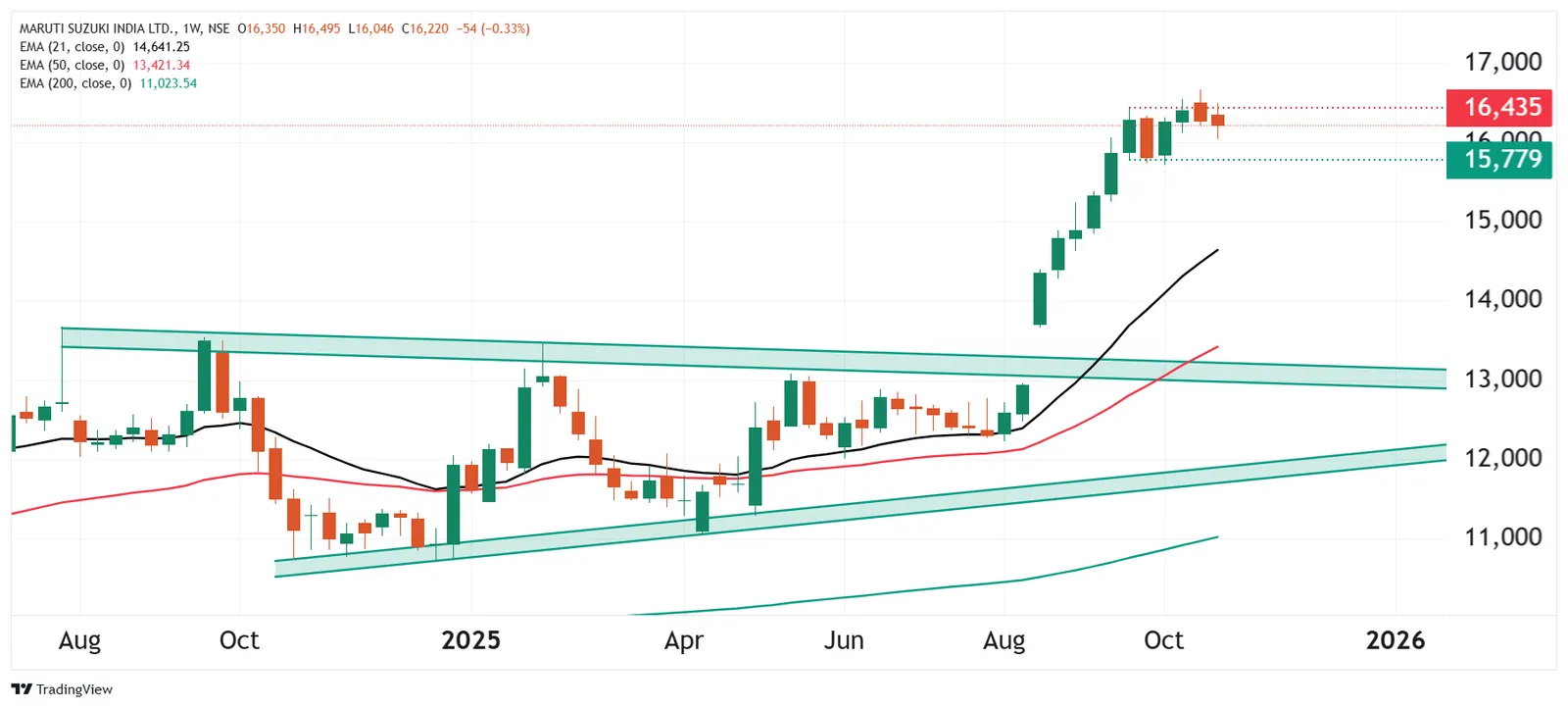
Maruti Suzuki immediate support lies near ₹15,700 zone, while the 21-week EMA at ₹14,641 offers a stronger cushion
Automobile giant Maruti Suzuki India will announce its results for the September quarter on 31 October 2025. As India's largest carmaker, it is likely to report decent quarterly earnings, with a rise in revenue and double-digit growth in net profit.
Experts believe that Maruti Suzuki's revenue could increase by 4.5–6% year-on-year (YoY) to ₹39,250–₹39,750 crore, and that its net profit could grow by 19–23% YoY to ₹3,660–₹3,730 crore. This higher profitability could be due to a rebound in sales volume, a GST rate cut leading to a recovery in demand, and a better product mix.
Maruti Suzuki’s overall quarterly sales rose by 1.4% YoY to 10.7 lakh vehicles during the September quarter, including domestic sales and exports. Meanwhile, total domestic passenger vehicle sales rose by 6.1% YoY to 7.95 lakh units during the same period.
Maruti Suzuki reported standalone revenues of ₹37,203 crore in Q2 FY25, compared to ₹38,414 crore in the previous quarter. Its net profit stood at ₹3,069 crore in the same quarter of the previous fiscal year and ₹3,712 crore in Q1 FY26. The EBITDA margin for the September quarter is expected to contract between 110 and 130 basis points due to increased input and operating costs.
Investors will be watching the management's comments on the demand trend, especially after the recent GST rate cut, export volumes, and the near-term outlook.
Ahead of the Q2 results announcement on Thursday, October 30, Maruti Suzuki shares were trading 0.4% higher at ₹16,200 per share. So far this year, Maruti Suzuki shares have risen by almost 50%.
Technical view
Maruti Suzuki has experienced a significant breakout from a long-term parallel channel that had limited the stock's potential for almost a year. This breakout, which was confirmed in late August 2025, was accompanied by a series of bullish weekly candles, which clearly indicate renewed momentum in the automotive giant.
Since then, the stock has rallied sharply from around ₹13,000 to ₹16,500, marking a vertical increase of over 25%. This sharp rally now appears to be entering a consolidation phase near its recent highs, with candles showing smaller real bodies and upper wicks, hinting at mild profit-taking.
The immediate support lies near ₹15,700 zone, while the 21-week EMA at ₹14,641 offers a stronger cushion. As long as the stock sustains above these levels, the uptrend remains intact, and any dips could attract fresh buying. A breakout above ₹16,500 on a weekly closing basis could propel Maruti Suzuki towards ₹17,200–₹17,500 in the coming weeks.
Options outlook
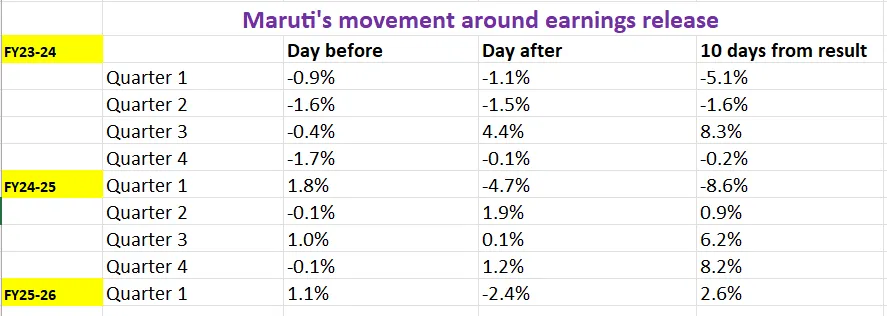
Let's take a look at how Maruti Suzuki’s stock has performed during the past two years around earnings announcement.
Options strategies for Maruti Suzuki
With the options market implying a potential move of ±4.5% for Maruti Suzuki ahead of the 25 November expiry, traders may consider both volatility-based and directional strategies.
For volatility based approach, a long straddle involves buying an at-the-money (ATM) call and put option with the same strike price and expiry date. This allows the trader to profit from large price swings in either direction. This strategy is beneficial when the actual price movement exceeds the projected range, making it ideal for those anticipating a breakout or breakdown.
Conversely, a short straddle involves selling both an ATM call and put. It suits traders anticipating muted price action. If the stock remains stable and moves by less than the expected ±4.5%, the seller keeps the premium received.
Meanwhile, for those seeking directional approach on the break of ₹16,500 and ₹15,700, bull put spreads or bear call spreads offer a more controlled risk-reward approach.
About The Author
Next Story