
Market News
Bajaj Auto Q1 results: Revenue and net profit could see double-digit growth aided by healthy volume growth

3 min read | Updated on July 21, 2026, 10:06 IST


SUMMARY
Bajaj Auto is expected to report double-digit growth in its June-quarter earnings, supported by higher volumes, improved product mix, price hikes and strong exports. Management commentary on domestic demand, exports and electric two-wheeler growth will remain in focus.
Stock list
Bajaj Auto’s at-the-money (ATM) strike of 10,500 is implying a potential price move of around ±4% ahead of the expiry.
Two-wheeler maker Bajaj Auto will announce its June quarter results on Tuesday, July 21. The Pulsar bike maker is expected to report strong earnings with double-digit growth in revenue and net profit.
According to experts, Bajaj Auto’s standalone net profit could rise by 22% to 26% YoY to ₹2,570 to ₹2,640 crore during the quarter. The company registered a net profit of ₹2,096 crore in Q1FY26. Meanwhile, the net profit may decrease by 3% to 4% sequentially compared to ₹2,746 crore profit in the previous quarter.
Its revenue is expected to increase by 26% to 29% YoY to ₹15,900 to ₹16,300 crore and remain flat sequentially. Higher revenue could come on the back of growth in sales volumes, better product mix and strong exports. Average selling prices (ASPs) are also expected to rise due to recent price hikes. The company registered a standalone revenue of ₹12,584 crore in Q1FY26, while it stood at ₹16,006 crore in the previous quarter.
Meanwhile, its EBITDA margins are likely to decline by 30 to 60 bps to range between 19.3% and 19.6% mainly due to higher raw material prices and freight expenses.
During the quarterly result announcement, investors will look forward to management commentary on the demand outlook, exports and overall volume sales growth, and volumes in the electric 2-wheeler segment.
Ahead of the Q1 result announcement, Bajaj Auto shares closed 0.6% higher at ₹10,515 on NSE. So far this year, Bajaj Auto shares have gained over 12%.
Technical outlook
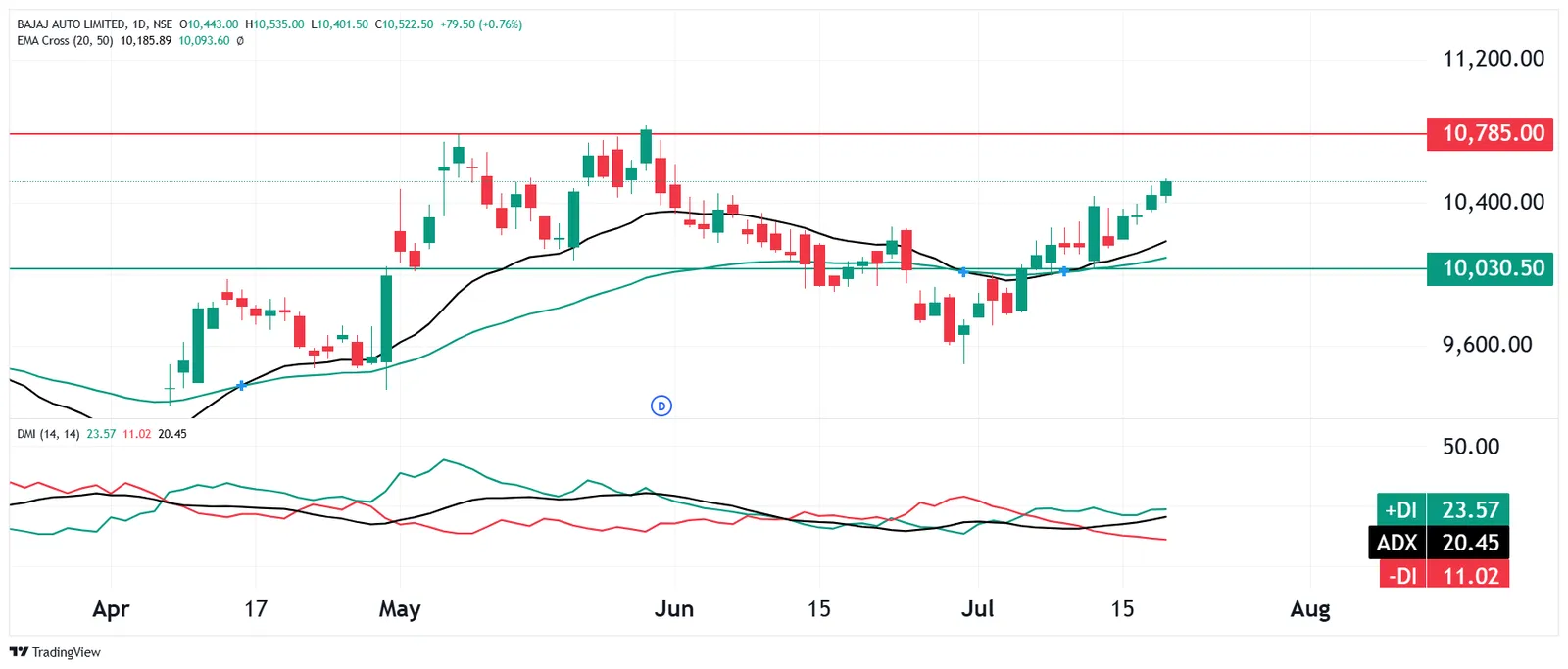
Bajaj Auto has regained bullish momentum after reclaiming its 20-day and 50-day EMAs. The stock closed at ₹10,527, with +DMI above -DMI, indicating buyers remain in control. However, ADX near 20 suggests the trend strength is still developing.
Immediate resistance is placed at ₹10,785. A sustained breakout above this level can extend the rally towards ₹11,000–₹11,200. On the downside, ₹10,400 is the immediate support, while ₹10,030 remains the crucial trend support.
Options outlook
The open interest data for the 28 July expiry indicates that Bajaj Auto’s at-the-money (ATM) strike of 10,500 is implying a potential price move of around ±4% ahead of the expiry.
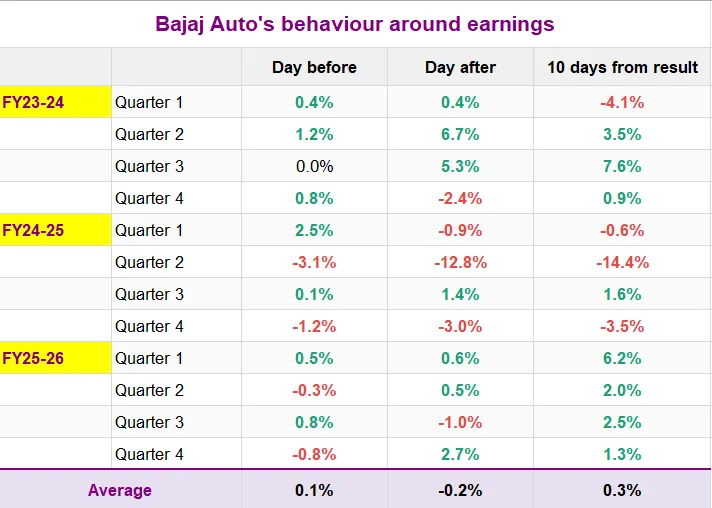
To get a clear perspective on price behaviour, let's look at how Bajaj Auto's share price has performed over the twelve quarters around its earnings announcements.
Options strategy for Bajaj Auto
With the options market pricing in a potential move of ±4%, traders can use volatility-based strategies, such as long or short straddles, to align with their market outlook.
A long straddle involves buying an at-the-money (ATM) call and put option with the same strike price and expiry date. This strategy can benefit from a sharp price movement, beyond the expected range of ±4% in either direction.
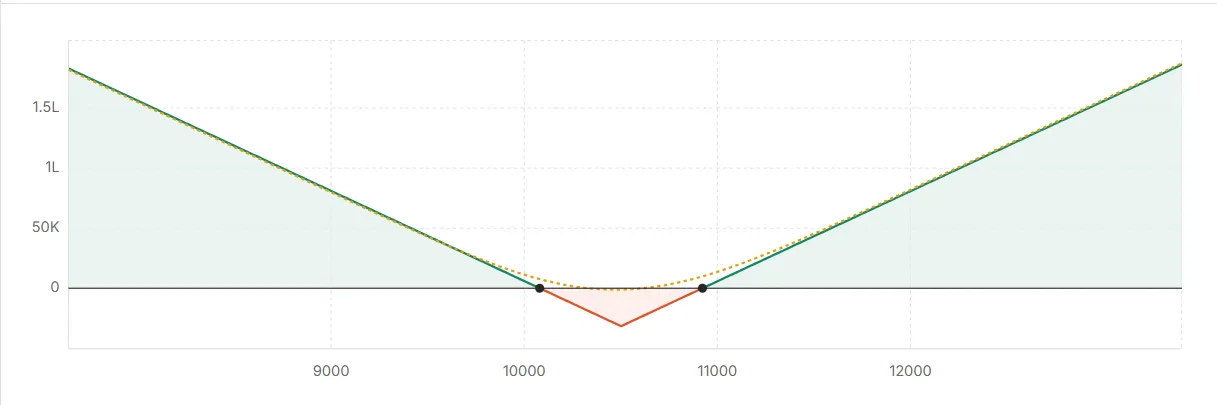
Conversely, a short straddle involves selling both an ATM call and put option with the same strike price and expiry date. This strategy aims to profit from time decay if the stock price remains within the expected range of ±4%.
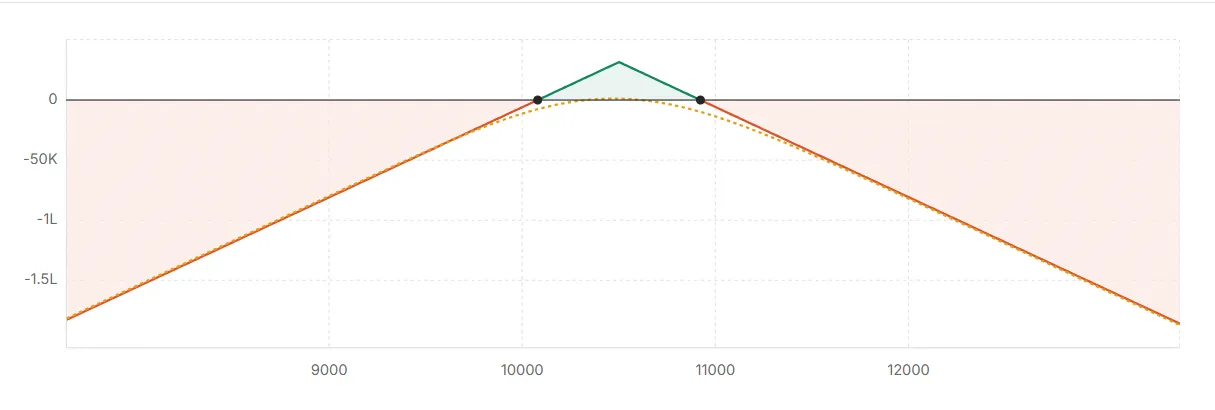
Those expecting a directional breakout or continuation may consider bull put spreads to capture further upside momentum, or bear call spreads if a breakdown from the current consolidation occurs.
Disclaimer:
Derivatives trading must be done only by traders who fully understand the risks associated with them and strictly apply risk mechanisms like stop-losses. We do not recommend any particular stock, securities, or trading strategies. The securities quoted are exemplary and not recommendatory. The stock names mentioned in this article are purely to show how to do an analysis.
Related News

About The Author
Next Story

