
Business News
VB-G RAM G Act to replace MGNREGA from July 1: What changes for rural workers
.png)
6 min read | Updated on May 11, 2026, 14:19 IST


SUMMARY
Viksit Bharat–Guarantee for Rozgar and Ajeevika Mission (Gramin) or VB-G RAM G Act, 2025, increases guaranteed rural wage employment from 100 days to 125 days annually for eligible households undertaking unskilled manual work.
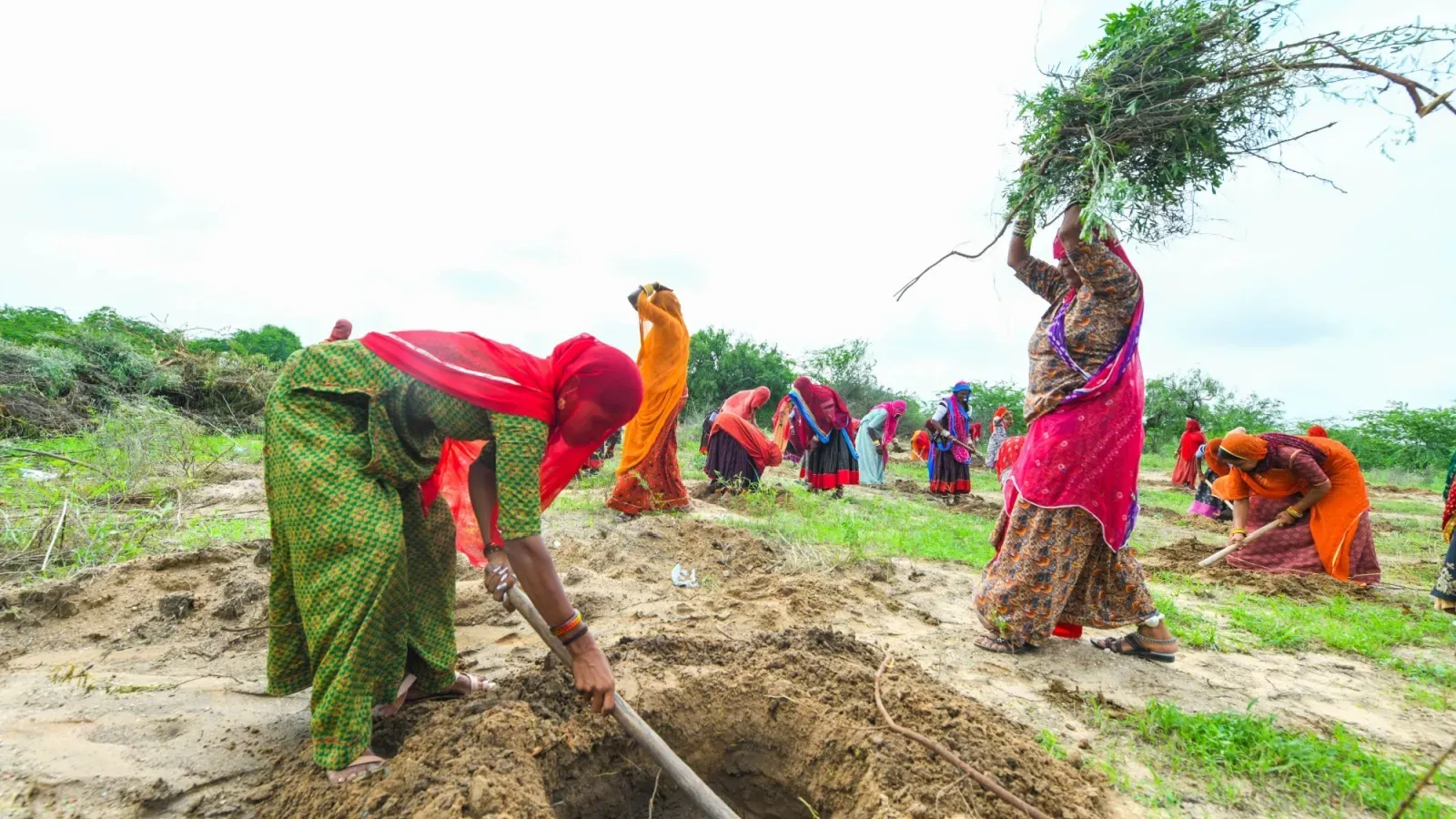
The government said ongoing MGNREGA works and existing verified job cards will continue seamlessly during the transition. Image: Shutterstock
The Centre on Monday announced that the Mahatma Gandhi National Rural Employment Guarantee Act (MGNREGA) will be replaced from July 1 by a new law that promises 125 days of guaranteed wage employment to every eligible rural household, up from the current 100 days.
The Ministry of Rural Development, in a gazette notification, said the Viksit Bharat–Guarantee for Rozgar and Ajeevika Mission (Gramin), or VB-G RAM G Act, 2025, will come into force across the country from July 1, 2026.
With the implementation of the new law, MGNREGA, enacted in 2005, will stand repealed.
Under the new framework, every rural household whose adult members volunteer to undertake unskilled manual work will be entitled to a statutory guarantee of 125 days of wage employment in a financial year.
Workers will continue to be entitled to unemployment allowance if work is not provided within the stipulated timeframe, the ministry said in a release.
Wages will be paid directly into workers' bank or post office accounts through Direct Benefit Transfer (DBT), it added.
Payments are to be made weekly or within 15 days of closure of the muster roll, failing which workers will be eligible for delay compensation as per the provisions of the Act.
VB-G RAM G will be a centrally sponsored scheme, requiring higher financial participation from states.
Under the Act, the Centre–state fund-sharing ratio will be 90:10 for North Eastern states, Himalayan states and Union territories.
The ratio will be 60:40 for all other states and Union territories with legislatures.
For 2026-27, the Centre has allocated ₹95,692.31 crore for implementation of the programme, described by the ministry as the highest-ever budget estimate for a rural employment programme.
The total outlay is estimated to exceed ₹1.51 lakh crore, which includes states’ contribution.
The ministry said ongoing works under MGNREGA will continue without interruption and will be carried over seamlessly into the new framework after June 30.
“The existing e-KYC verified MGNREGA Job Cards shall remain valid under VB–G RAM G until Gramin Rozgar Guarantee Cards are issued,” the ministry said.
“Workers without Job Cards may continue to register at the Gram Panchayat level,” it added, stressing that employment will not be denied solely because e-KYC is pending.
The ministry said the new law seeks to position Gram Panchayats at the centre of rural transformation and is expected to provide fresh momentum to employment generation, infrastructure creation and self-reliance in villages.
FAQs on Viksit Bharat–G RAM G Act, 2025
VB–G RAM G Act, 2025 will come into force across all rural areas of the country with effect from July 1, 2026.
Mahatma Gandhi NREGA will stand repealed with effect from July 1, 2026.
Yes. The Act shall be implemented across the country from July 1, 2026.
The Act guarantees 125 days of wage employment in a financial year to every eligible rural household whose adult members volunteer to undertake unskilled manual work.
Every rural household whose adult members volunteer to undertake unskilled manual work shall be eligible for employment under the Act.
Yes. Employment under Mahatma Gandhi NREGA will continue in a seamless and uninterrupted manner till the commencement of VB–G RAM G.
Ongoing works as on June 30, 2026 may continue under the provisions of the VB–G RAM G Act. These works shall be seamlessly migrated and prioritised for completion.
Yes. Existing MGNREGA Job Cards for workers whose e-KYC has been completed shall remain valid until new Gramin Rozgar Guarantee Cards are issued.
Any rural household not having an MGNREGA Job Card may apply through any adult member to the concerned Gram Panchayat by submitting the names, ages and address details of the household.
Adult members may demand employment through the Gram Panchayat. Applications can be made orally, in writing (using Form 6), or through digital platforms.
Employment must be provided within 15 days from the date of application.
The applicant shall be entitled to unemployment allowance.
The state government shall pay at least one-fourth of the notified wage rate for the first 30 days and at least one-half of the wage rate for the remaining period.
Yes. Enhanced wage rates shall be notified under Section 10 of the Act. Until then, existing Mahatma Gandhi NREGA wage rates shall continue to apply.
Wages shall be paid weekly or, in any case, not later than a fortnight after closure of the muster roll.
Wages are paid directly into workers’ bank or post office accounts through Direct Benefit Transfer (DBT).
If wages are not paid within 15 days of the closure of the muster roll, workers are entitled to delay compensation at 0.05% of unpaid wages for each day of delay.
Gram Panchayats will play a key role in registration of households, receiving applications for employment, executing works, maintaining records and preparing Viksit Gram Panchayat Plans (VGPPs).
-
Water security works
-
Core rural infrastructure
-
Livelihood-related infrastructure
-
Extreme weather mitigation works
Yes. The Act promotes a “single-plan, multi-funding” approach through convergence with central, state and local government schemes.
No. Contractors cannot be engaged for works financed under the Act, and labour-displacing machinery shall not be used as far as practicable.
About The Author
Next Story

