Business News
Trade, chips and Iran in spotlight as Trump heads to China, brings top US CEOs with him

4 min read | Updated on May 13, 2026, 12:13 IST


SUMMARY
Trump's meeting with Chinese President Xi Jinping comes amid fragile global economic conditions marked by elevated energy prices, supply chain disruptions and uncertainty linked to the Iran-Israel-US conflict.
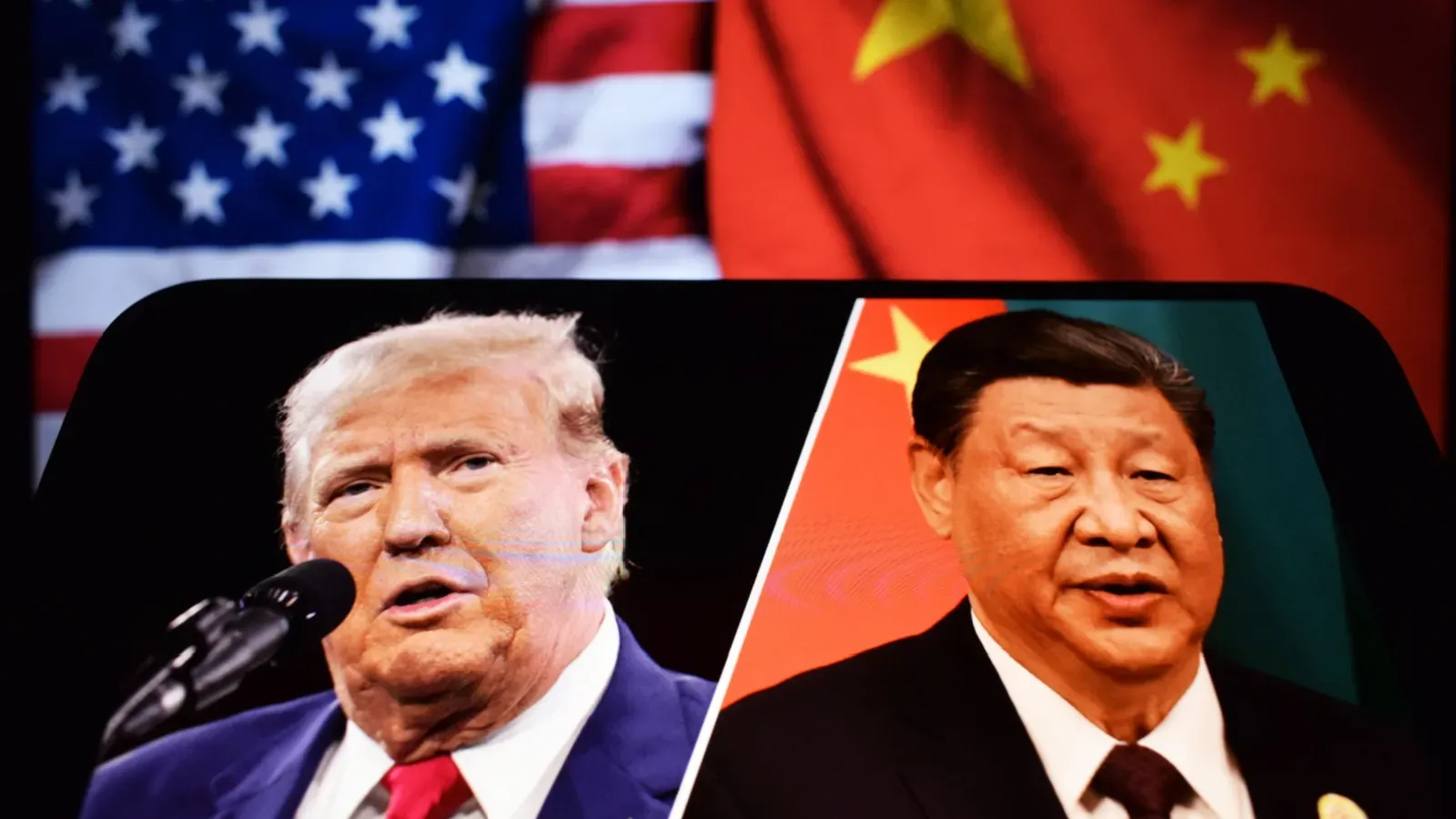
Trump, who would be accompanied by top CEOs, was the last US president to visit China in 2017, during his first term. Image: Shutterstock
US President Donald Trump is set to arrive in Beijing on Wednesday for a high-stakes summit with Chinese President Xi Jinping, with trade, artificial intelligence, rare earth supplies and geopolitical tensions expected to dominate talks between the leaders of the world’s two largest economies.
The closely watched visit comes at a fragile moment for the global economy, which is grappling with elevated energy prices, supply chain disruptions and mounting uncertainty over the conflict involving Iran, US and Israel.
“We’re the two superpowers,” Trump told reporters before departing the White House on Tuesday. “We’re the strongest nation on Earth in terms of military. China’s considered second.”
The US President is expected to attend a welcome ceremony and a bilateral meeting with Xi on Thursday.
The two leaders will meet again on Friday for a bilateral tea and working lunch, she said, adding that the US plan to host the Chinese leader for a reciprocal visit later this year.
Trump, who would be accompanied by top CEOs, was the last US president to visit China in 2017, during his first term.
The summit is widely seen as an attempt to stabilise ties after years of friction over tariffs, technology restrictions, Taiwan and military rivalry in the Indo-Pacific.
Trump said trade would be the focus of his discussions with Xi.
“We’ll be talking about trade more than anything else,” he said, adding that he wants China to increase purchases of American agricultural products and aircraft and provide greater access to US companies.
The Trump administration is also seeking to establish a formal bilateral “Board of Trade” to address disputes before they escalate into full-blown trade war, according to US officials.
The trade war intensified after Trump imposed sweeping tariffs on Chinese goods under his so-called “Liberation Day” measures.
China responded by tightening controls on exports of rare earth minerals, exposing a major vulnerability in global manufacturing and defence supply chains.
Rare earths, especially heavy elements such as dysprosium, terbium and yttrium, are essential inputs for advanced semiconductors, aerospace components, missile guidance systems, electric vehicles and powerful magnets used in electronics.
Chinese customs data show exports of these critical heavy rare earths remain about 50 per cent below levels seen in the 12 months before Beijing imposed the restrictions in April 2025.
While China’s overall rare earth exports have largely recovered, shipments of specialised materials used almost exclusively from Chinese production remain constrained.
The rare earth issue is expected to be one of the most important topics in the Trump-Xi meeting.
Trump is accompanied by a powerful delegation of US corporate leaders, including Jensen Huang of Nvidia, Elon Musk of Tesla, Tim Cook of Apple, Larry Fink of BlackRock and Stephen Schwarzman of Blackstone.
In a post on Truth Social, Trump described the delegation as the “World’s Greatest Businessmen/women” and said he would ask Xi as his “very first request” to further open China’s economy to American companies.
“Jensen is currently on Air Force One and, unless I ask him to leave, which is highly unlikely, CNBC’s reporting is incorrect or, as they say in politics, FAKE NEWS!” Trump posted on Truth Social.
“It is an Honor to have Jensen, Elon, Tim Apple, Larry Fink, Stephen Schwarzmann, Kelly Ortberg (Boeing), Brian Sikes (Cargill), Jane Fraser (Citi), Larry Culp (GE Aerospace), David Solomon (Goldman Sachs), Sanjay Mehrotra (Micron), Cristiano Amon (Qualcomm), and many others journeying to the Great Country of China where I will be asking President Xi, a Leader of extraordinary distinction, to “open up” China so that these brilliant people can work their magic, and help bring the People’s Republic to an even higher level!” he added.
The presence of Jensen Huang is particularly notable because Nvidia has been seeking approvals to expand sales of its advanced H200 artificial intelligence chips in China.
China remains one of the world’s largest markets for advanced chips, but US policymakers view cutting-edge semiconductor technology as a national security issue.
The summit also takes place against the backdrop of the ongoing Iran conflict, which has disrupted shipping through the Strait of Hormuz.
The effective closure of the strait has led to soaring crude prices and raised concerns over a hit to global economic growth and inflation.
Trump, however, downplayed Iran as a discussion point.
“We have a lot of things to discuss. I wouldn’t say Iran is one of them, to be honest with you, because we have Iran very much under control,” he told reporters.
Bert Hoffman, former World Bank country director for China, said China wants Iran war to end because it has many partners in the region, including Saudi Arabia, the UAE and Kuwait.
"So they don't like to see wars, they like to have stability," he said.
About The Author
Next Story