
Business News
Iran peace deal: Why Pak, other Muslim nations are unlikely to back Trump’s Abraham Accords push

4 min read | Updated on May 26, 2026, 13:09 IST


SUMMARY
Trump urged countries including Saudi Arabia, Pakistan, Türkiye, Egypt and Jordan to sign Abraham Accords as part of the peace framework involving Iran.
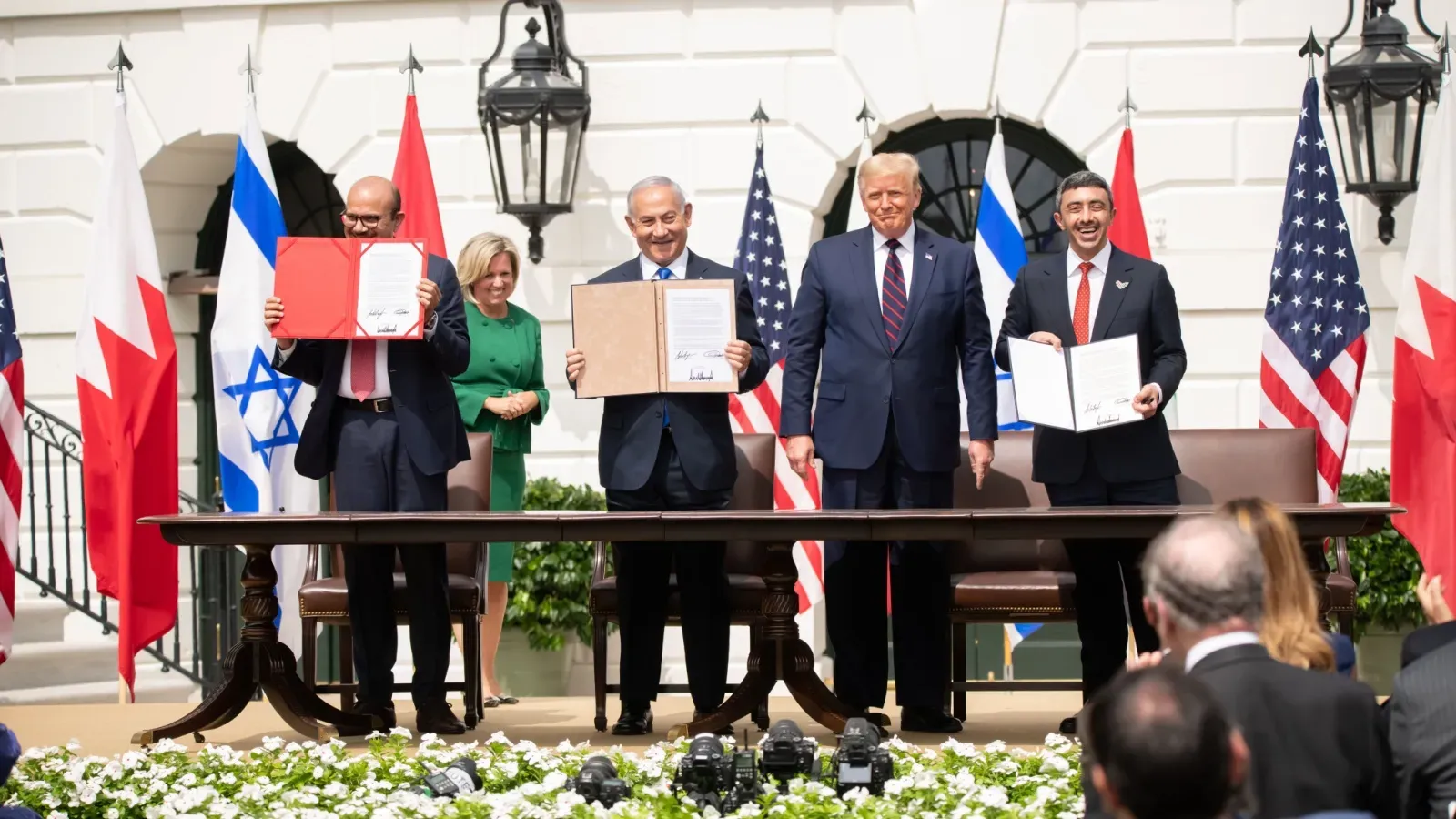
Benjamin Netanyahu, Donald Trump, Abdullatif bin Rashid Al Zayani, and Abdullah bin Zayed Al Nahyan attend the Abraham Accords ceremony at The White House on September 15, 2020. Image: Shutterstock
US President Donald Trump’s attempt to link a potential peace deal with Iran to a sweeping expansion of the Abraham Accords is unlikely to gain traction among several Muslim-majority nations, including Pakistan, analysts say.
In a lengthy post on X, Trump said negotiations with Iran were “proceeding nicely” and argued that countries including Saudi Arabia, Qatar, Pakistan, Türkiye, Egypt and Jordan should “immediately sign the Abraham Accords” as part of the peace deal.
“It will only be a Great Deal for all or, no Deal at all,” Trump wrote, warning that failure could mean a return “to the Battlefront and shooting, but bigger and stronger than ever before.”
Trump said he discussed the issue during talks Saturday with leaders from Saudi Arabia, the United Arab Emirates, Qatar, Pakistan, Turkey, Egypt, Jordan and Bahrain. He described the accords as a historic framework that could bring “Power, Strength, and Peace to the Middle East for the first time in 5,000 years.”
Trump suggested that even Iran could eventually become part of the accords if a deal with Washington is reached.
The Abraham Accords were brokered in 2020 during Trump’s first presidential term and led to normalisation agreements between Israel and the United Arab Emirates, Bahrain, Morocco and Sudan.
The Abraham Accords themselves derive symbolic significance from the shared reverence for Abraham in Judaism, Christianity and Islam. The agreements were presented as an effort to bridge historical religious divides in the Middle East.
However, such a proposal is expected to face formidable resistance, especially at a time when the war in Gaza and regional instability have hardened public opinion across the Muslim world against any overt rapprochement with Israel.
Pakistan has already publicly pushed back against the suggestion.
Pakistan Defence Minister Khawaja Asif said he was personally opposed to Islamabad joining any arrangement that conflicts with the country’s “fundamental ideologies”.
“Personally, I don’t think we should join any such accord which clashes with our fundamental ideologies,” Asif said during an interview with Samaa TV.
Reiterating Islamabad’s long-standing policy, he said Pakistan would not recognise Israel until an independent Palestinian state based on pre-1967 borders with East Jerusalem as its capital is established.
“We have a very clear stance that it is not acceptable to us,” he said.
Asif questioned Israel’s credibility as a negotiating partner, saying: “How will you sit with those people whose word cannot be trusted for even a single day?”
He also mentioned Pakistan's passports, which explicitly state that they are valid for all countries except Israel.
The domestic political cost of recognising Israel would be enormous for Islamabad, where support for the Palestinian cause cuts across political and religious lines.
The situation is similarly complicated for several Arab states.
Saudi Arabia has repeatedly maintained that normalisation with Israel would require credible progress toward Palestinian statehood.
That possibility appears increasingly distant after the Gaza conflict triggered by the October 7, 2023 Hamas attacks on Israel and the subsequent Israeli military offensive that has caused massive civilian casualties and destruction in the enclave.
The continued Israeli military operations in Gaza, tensions in the West Bank and escalating confrontations involving groups such as Hezbollah have sharply reduced political space for Arab governments to openly engage with Israel, a CNN report said.
According to a CNN analysis, Gulf states are currently more focussed on regional stability, economic security and the fallout from the Iran conflict than on expanding diplomatic ties with Israel.
The report noted that many Gulf nations fear prolonged instability, including disruptions linked to the Strait of Hormuz, which remains critical for global energy supplies and regional economies.
It also argued that Trump’s suggestion that Iran itself could join the Abraham Accords appears highly unrealistic given the decades-long hostility between Tehran and Israel.
Iran has consistently refused to recognise Israel and considers it an illegitimate state, while Israel views Iran’s regional activities and nuclear ambitions as existential threats.
CNN military analyst Cedric Leighton described Trump’s proposal as “wishful thinking”, saying current political realities make such a breakthrough unlikely.
About The Author
Next Story

