
Business News
India-New Zealand FTA: 100% Indian exports to get duty-free access from October 20
.png)
4 min read | Updated on September 21, 2026, 14:45 IST


SUMMARY
The pact is expected to benefit sectors like textiles, leather, gems and jewellery, engineering goods and processed foods.
India's exports in the textiles, apparel and made-up sector to New Zealand has shown a positive trend over the last decade.
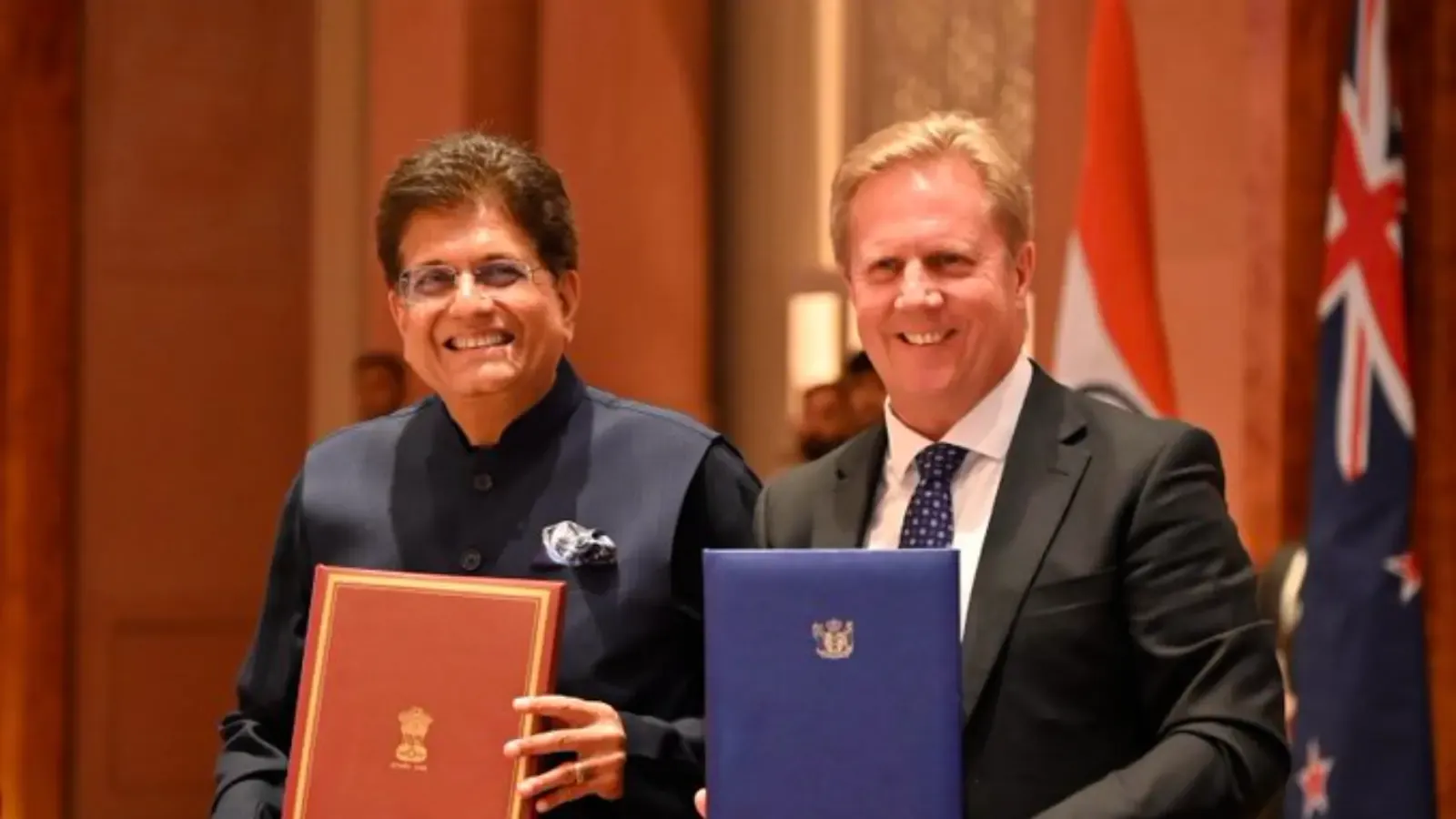
The India-New Zealand Free Trade Agreement (FTA) will come into force on October 20, Commerce and Industry Minister Piyush Goyal said on Monday, days after the deal was passed in the island country’s Parliament.
India and New Zealand had signed the trade pact on April 27 after concluding negotiations in December 2025.
"The entry into force of the India-New Zealand Free Trade Agreement ... will come into force on the auspicious occasion of Dussehra, on the 20th of October 2026," Goyal said.
The agreement provides duty-free access for 100% of India's exports to New Zealand, covering textiles, apparel, leather and footwear, gems and jewellery, engineering goods and processed foods, and other sectors.
New Zealand currently maintains peak tariffs of up to 10% on several Indian exports, including ceramics, carpets, automobiles and auto components.
Goyal said the agreement would remove the tariff disadvantage faced by Indian exporters and benefit MSMEs, farmers, handicraft and handloom artisans.
"Whatever goods are exported from India to New Zealand, import duty will no longer be levied on 100% of the goods entering New Zealand. This means all our exports will reach New Zealand duty-free," he said.
The minister said the agreement would also help create employment opportunities and attract capital and technology into India.
New Zealand has committed to invest $20 billion in India over 15 years under the pact.
"This will provide our manufacturing sectors with both capital and technology, while also attracting New Zealand companies to invest in India," Goyal said.
The minister reiterated that India had not offered market access concessions in sensitive sectors such as dairy and several agricultural products.
Dairy products, including milk, cream, whey, yoghurt and cheese, as well as onions, chickpeas, peas, maize, almonds, sugar and artificial honey, among others, have been kept outside the pact.
India has offered tariff liberalisation on about 70% of New Zealand's tariff lines, covering 95% of bilateral trade value.
India will provide duty-free access to products including wooden logs, coking coal, metal waste and scrap, wood, sheep meat and raw hides.
Tariffs on products such as petroleum oil, malt extract, vegetable oils, select electrical and mechanical machinery and peptones will be reduced in phases over three, five, seven and 10 years.
India has offered quota-based concessions with safeguards for certain products, including Manuka honey, apples, kiwi fruit and albumins,
New Zealand has offered market access commitments in around 118 sectors, including computer-related services, professional services, audiovisual, telecommunications, construction, education, environmental, financial services and tourism.
The agreement also provides a temporary employment entry visa pathway for Indian professionals in skilled occupations, with a quota of 5,000 visas at any given time and a stay of up to three years.
New Zealand has also created a dedicated pathway for student mobility and post-study work visas for Indians.
Goyal said the two countries' strategic partnership and roadmap to 2030 set an "aspirational goal" of doubling bilateral trade in goods and services to nearly Rs 35,000 crore in the next four to five years.
"The entry into force of the India-New Zealand Free Trade Agreement will translate this goal into concrete economic outcomes," he said.
New Zealand Prime Minister Christopher Luxon last Wednesday said that the country's Parliament had passed the landmark trade agreement with India.
"People told me a Free Trade Agreement with India wasn't possible. Well, today that deal passed its final vote in Parliament. It's happening," Luxon said in a social media post.
He said the agreement would mean more jobs and higher incomes for New Zealanders and open access to India's 1.4 billion consumers for New Zealand products.
The FTA is only the second trade agreement in which India has received a specific foreign direct investment commitment. The European Free Trade Association (EFTA) countries had committed to invest $100 billion in India over 15 years under their trade pact.
Total India-New Zealand trade in goods and services stood at $2.4 billion in 2024.
Bilateral merchandise trade declined by about 11% to $1.15 billion in 2025-26 from $1.3 billion in 2024-25. India's exports stood at $566.51 million, while imports were $589.1 million in 2025-26.
About The Author
Next Story

