Business News
India, EU to announce free trade deal today amid stalled negotiations with US
.png)
4 min read | Updated on January 27, 2026, 08:48 IST


SUMMARY
Commerce Secretary Rajesh Agrawal said the deal has been finalised and is undergoing legal scrubbing, with signing likely later this year and implementation possible early next year.
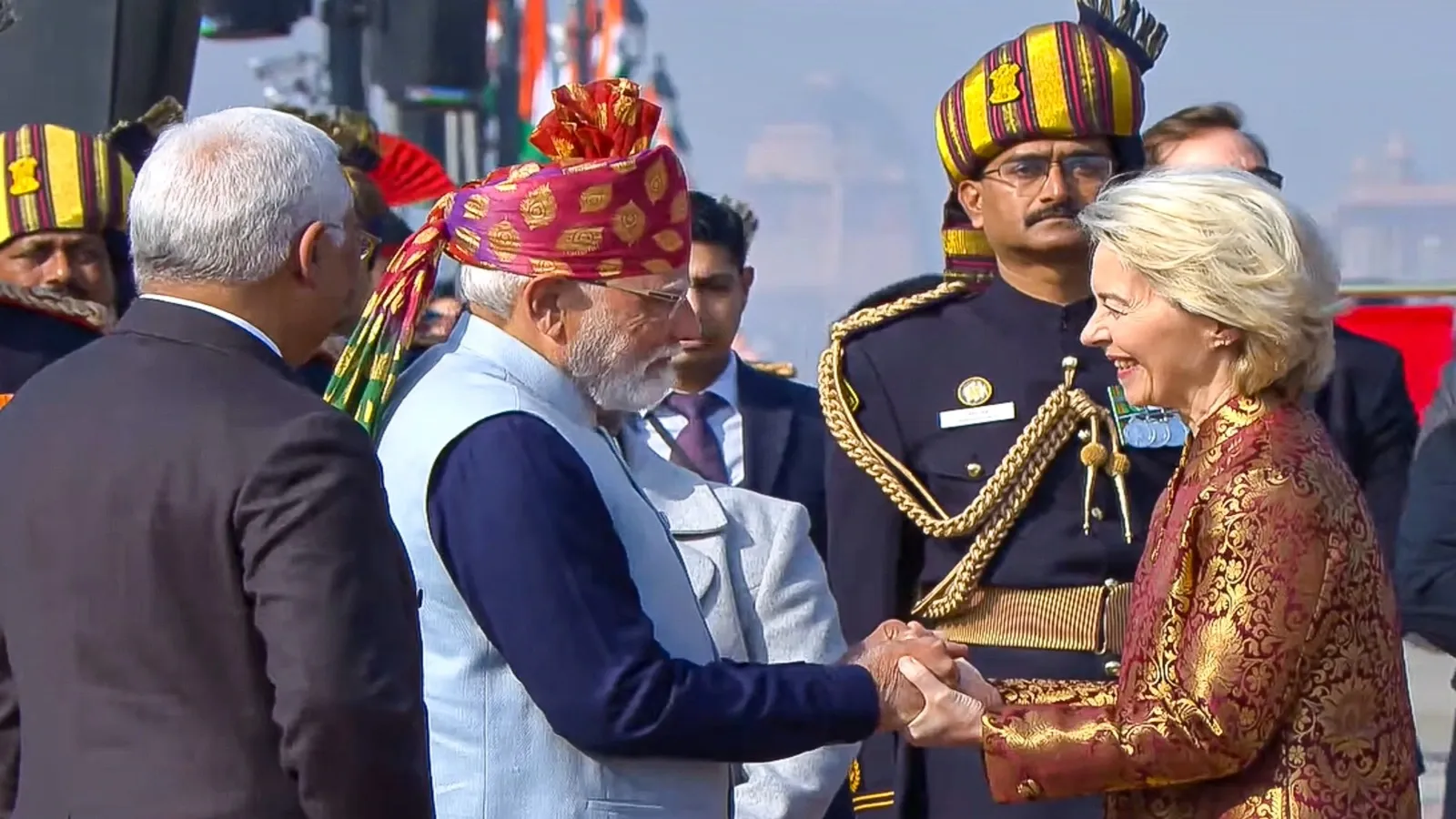
Prime Minister Narendra Modi and President of the European Commission Ursula von der Leyen during Republic Day celebrations in New Delhi, Monday, Jan. 26, 2026. (PTI Photo)
India and the European Union have concluded official-level negotiations on a long-pending free trade agreement (FTA), paving the way for a pact that officials say will boost two-way trade and investment and deepen economic ties between the two economies.
“Official-level negotiations are being concluded and both sides are all set to announce the successful conclusion of FTA talks on January 27,” Commerce Secretary Rajesh Agrawal told reporters on Monday.
“The negotiations have been successfully concluded. The deal has been finalised,” Agrawal said, noting that legal scrubbing of the text is under way.
He said the endeavour would be to complete remaining procedures and sign the pact at the earliest.
The official underlined that the agreement was “balanced and forward-looking” from India’s perspective.
The agreement, nearly two decades in the making after talks began in 2007, is expected to be signed later this year and could come into force early next year.
In the EU, the deal will require approval from the European Parliament, while in India it needs clearance from the Union Cabinet.
The formal announcement of the conclusion of talks is expected at the India-EU Summit in New Delhi on Tuesday, where Prime Minister Narendra Modi will hold discussions with European Commission President Ursula von der Leyen and European Council President Antonio Costa.
Commerce and Industry Minister Piyush Goyal has described the pact as “the mother of all deals” signed by the country.
Von der Leyen, who attended India’s Republic Day parade as chief guest, said in a post on X that Europe and India, “the world’s largest democracies”, were committed to working together to shape a new global order.
Market access and tariff cuts
The FTA is expected to provide duty-free or preferential access to a wide range of Indian goods, particularly from labour-intensive sectors such as textiles, chemicals, gems and jewellery, electrical machinery, leather and footwear.
The EU’s average tariff on Indian goods is about 3.8%, even as duties on labour-intensive products are closer to 10%.
India’s weighted average tariff on EU goods is higher, at around 9.3%, with steep levies on automobiles and auto parts (35.5%), plastics (10.4%), and chemicals and pharmaceuticals (9.9%).
Under a typical FTA framework, the two sides would reduce or eliminate import duties on more than 90% of goods traded. The agreement is also expected to liberalise services trade, including in telecommunications, transport, accounting and auditing.
Besides the FTA, India and the EU are negotiating separate agreements on investment protection and geographical indications. The trade pact itself spans 24 chapters covering goods, services and investment.
Strategic timing
The deal comes at a time of heightened global trade tensions, as the United States has imposed higher tariffs that have disrupted global trade flows. India is facing tariffs as high as 50% on certain exports to the US. The EU pact is expected to help Indian exporters diversify markets and reduce dependence on China.
A visibly miffed US treasury secretary Scott Bessent criticised the EU for finalising the trade deal with India.
“We have put 25% tariffs on India for buying Russian oil. Guess what happened last week? The Europeans signed a trade deal with India,” Bessent said in an interview.
He also claimed that European countries were “financing” a war against themselves by purchasing Russian products from India.
“Just to be clear again, the Russian oil goes into India, the refined products come out, and the Europeans buy the refined products. They are financing the war against themselves,” he said.
Trade flows
The EU is India’s largest trading partner in goods. Bilateral goods trade stood at $136.53 billion in 2024/25, with Indian exports worth $75.85 billion and imports at $60.68 billion, giving India a trade surplus of $15.17 billion. Services trade between the two reached $83.10 billion in 2024.
The EU accounts for about 17% of India’s total exports, while India absorbs roughly 9% of the bloc’s overseas shipments. The EU, with a GDP of about $20 trillion and a population exceeding 450 million, exports around $2.9 trillion of goods annually and imports more than $2.6 trillion.
India, home to about 1.4 billion people, exported $437 billion in goods and $387.5 billion in services in 2024/25, while importing goods worth $720 billion and services worth $195 billion.
India’s major exports to the EU include petroleum products, electronics, textiles and garments, machinery, organic chemicals, iron and steel, gems and jewellery, pharmaceuticals, auto components, footwear and coffee. Key imports from the bloc include machinery, electronics and components, aircraft, medical devices, gems and jewellery, organic chemicals and plastics.
About The Author
Next Story