
Business News
CBDC-based DBT for food subsidy rolled out in Chandigarh, Dadra & Nagar Haveli
.png)
4 min read | Updated on August 14, 2026, 16:47 IST


SUMMARY
The digital subsidy is purpose-bound and can be used to purchase eligible foodgrains such as wheat and rice from authorised merchants by scanning QR codes.
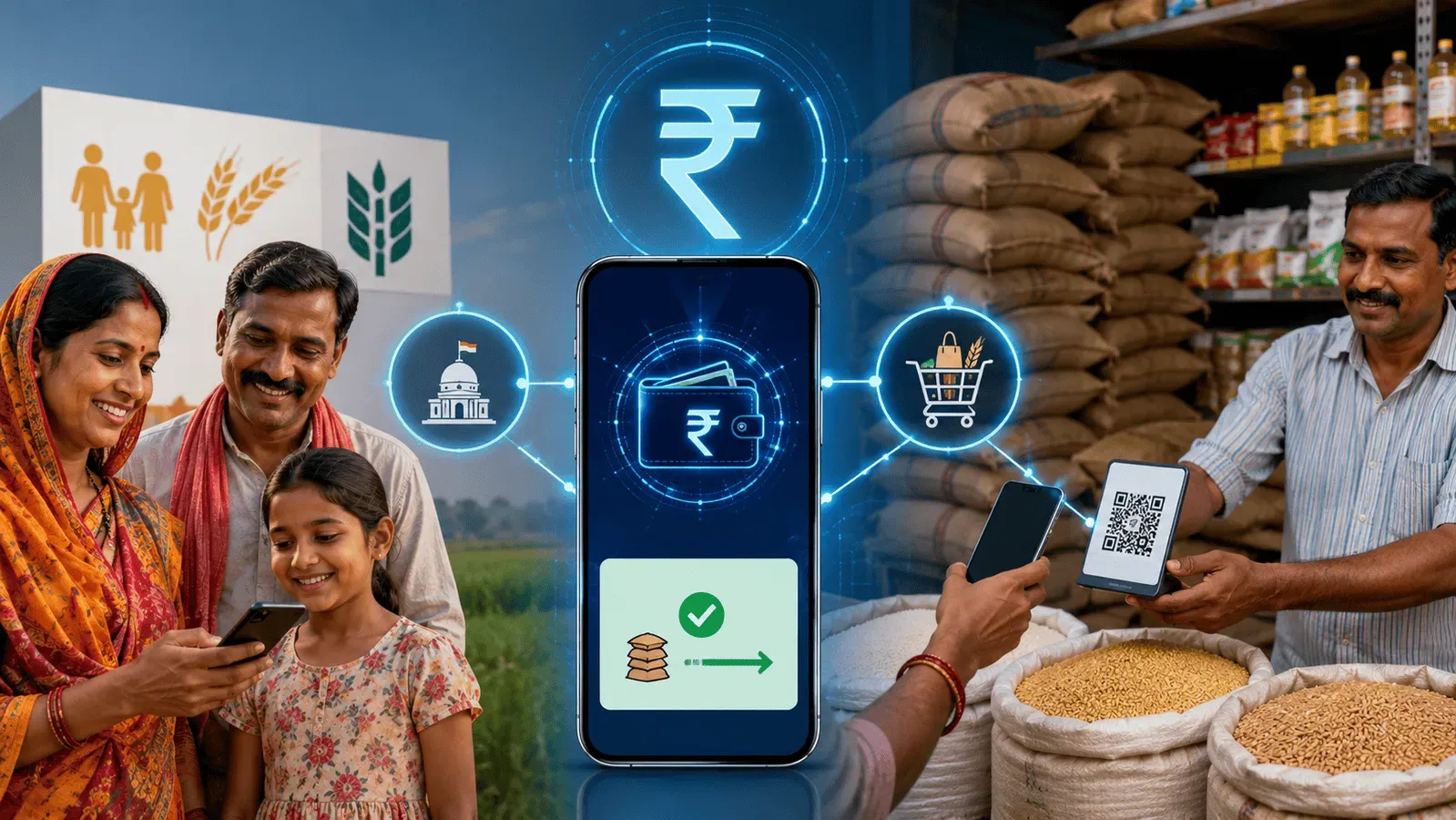
Chandigarh and Dadra & Nagar Haveli are the first Union Territories to achieve complete adoption of CBDC-based food subsidy transfers for all eligible PMGKAY beneficiaries.
The government on Friday launched a Central Bank Digital Currency (CBDC)-based Direct Benefit Transfer (DBT) system for food subsidies under the Pradhan Mantri Garib Kalyan Anna Yojana (PMGKAY) in Chandigarh and Dadra & Nagar Haveli.
Under the new system, eligible PMGKAY beneficiaries will receive food subsidy directly in their CBDC wallets in the form of programmable Digital Rupee tokens, instead of conventional bank account transfers.
The subsidy can be used to purchase foodgrains from empanelled merchants through a secure and traceable digital payment mechanism, the government said.
The rollout was attended by Union Consumer Affairs, Food and Public Distribution Minister Pralhad Joshi, Punjab Governor and Chandigarh Administrator Gulab Chand Kataria, and Union Agriculture and Farmers Welfare Minister Shivraj Singh Chouhan, among others.
Chandigarh and Dadra & Nagar Haveli are the first Union Territories in the country to achieve complete digital adoption of CBDC-based food subsidy transfers for all eligible PMGKAY beneficiaries.
The initiative builds on pilot implementations in Puducherry and Gujarat and is being positioned by the government as a proof of concept for expanding the use of CBDC in welfare schemes.
The CBDC-based DBT model is aimed at enabling end-to-end traceability of public funds, reducing leakages and diversion, and cutting down on cash handling in subsidy delivery.
It is also expected to facilitate faster transfers, real-time monitoring of subsidy utilisation and wallet-based transactions for beneficiaries.
The government said the rollout would provide operational experience in integrating CBDC with welfare schemes and could serve as a template for other states and Union Territories.
Speaking on the occasion, Joshi said digitalisation is helping deliver benefits to the eligible beneficiaries in a transparent manner while also helping detect the ineligible ones.
Joshi said when Prime Minister Narendra Modi talked about digital transactions several years ago, many in the opposition criticised.
He said they raised questions like what about internet connectivity, how can those who are illiterate do transactions and how can digitalisation become successful.
But today, if any country does the most digital transactions, that is India, Joshi said.
Under the CBDC-based DBT, Joshi assured that there is no question of excluding any eligible beneficiary. If I can say, this system is "rightful targeting", while wrongful beneficiaries will be automatically deleted, he said.
Chouhan said India's granaries were overflowing and the government was working to ensure that benefits reached eligible beneficiaries.
Chandigarh was among the pioneers in implementing the DBT model for food subsidy in September 2015, moving from physical distribution of subsidised foodgrains to direct transfer of subsidy into the Aadhaar-linked bank accounts of entitled households, officials said.
The CBDC initiative builds on this existing DBT framework and seeks to make welfare delivery more transparent, traceable, efficient and purpose-bound, they said.
Building on earlier pilot implementations in Puducherry and Gujarat, the rollout marks complete digital adoption and saturation of all eligible beneficiaries across the targeted Union Territories.
The rollout is expected to generate operational learnings on the integration of CBDC wallets, beneficiary identification and subsidy utilisation that could inform wider adoption of the model.
The digital rupee, or e-rupee, is a tokenised digital version of the Indian rupee, issued by the Reserve Bank of India (RBI) as a Central Bank Digital Currency (CBDC).
The introduction of CBDC – Digital Rupee offers an opportunity to enhance the DBT ecosystem by providing a secure, instant, traceable, and programmable digital cash mechanism for PMGKAY beneficiaries.
In the case of food subsidy, the digital benefit will be purpose-bound for the purchase of entitled foodgrains such as wheat and rice from authorised/empanelled merchants, it said.
Beneficiaries will receive the digital food subsidy, visit an empanelled merchant, scan the QR code and complete the transaction for the purchase of entitled foodgrains.
About The Author
Next Story

