
Personal Finance News
Midcap mutual fund comparison: How HDFC, Nippon, Kotak, Axis, SBI & Motilal Oswal funds stack up

5 min read | Updated on April 29, 2026, 15:38 IST


SUMMARY
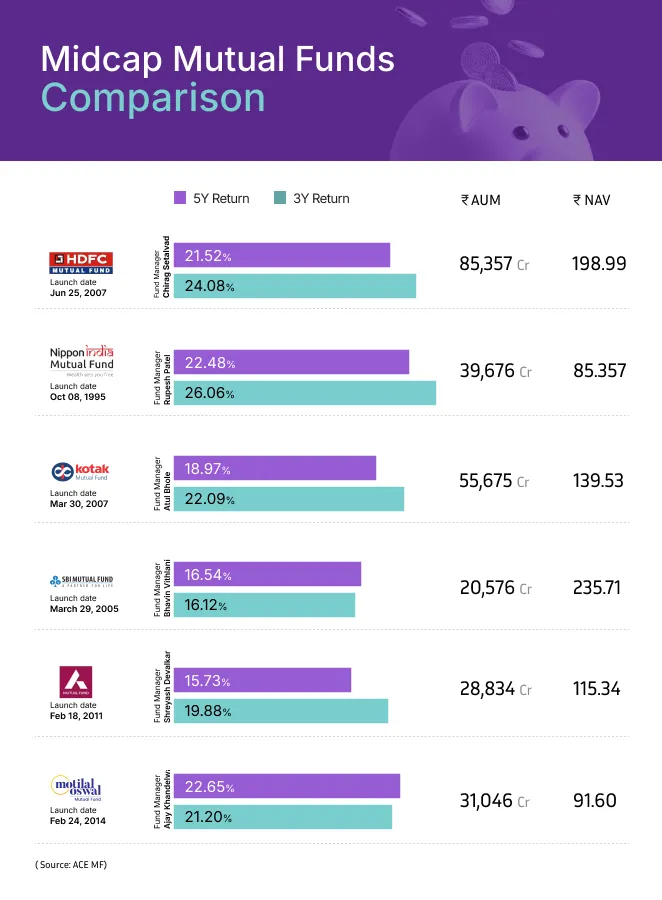
HDFC Mid Cap Fund is the largest among them with an AUM of around ₹85,000 crore, followed by Kotak at ₹55,000 crore, Nippon at ₹39,000 crore, Axis at ₹28,800 crore, and smaller but still significant ones like SBI (₹20,500 crore) and Motilal Oswal (₹31,000 crore)

The intriguing thing about all of these funds is that, although investing in the same midcap universe, they all have very different experiences. | Image: Shutterstock.
However, the index is only half the story. When you actually invest in mutual funds using SIPs, the true difference becomes apparent. Because once you begin making monthly investments, you are living through a fund's choices, sector bets, and how it responds to market fluctuations rather than merely following an index.
Before going into the funds, one important thing to keep in mind is that we are looking at some of the most widely tracked midcap funds based on size and relevance in the category.
Before reading further, please note that this is just for informational purposes only and not intended to recommend any of the schemes mentioned below.
The data has been sourced from the ACE MF website, and the returns are as of 28 April 2026.
Volatility-wise, they are all in a similar broad range, but you can still feel differences when you look closely. HDFC and SBI tend to be on the calmer side, Kotak sits in the middle, while Nippon, Axis, and Motilal Oswal feel slightly more aggressive in how they move with the market.
Now, if you actually look at SIPs over time, the differences start becoming more obvious.
HDFC Mid Cap Fund
A ₹5,000 monthly SIP with the HDFC Mid Cap Fund would have grown to about ₹2.18 lakh in 3 years, ₹4.79 lakh in 5 years, and roughly ₹16.39 lakh in 10 years.
The journey feels very close to the benchmark most of the time. If we talk about diversification, it's fairly diversified across banks, autos, healthcare, finance, and IT, so nothing dominates too aggressively.
The volatility is relatively controlled, so the SIP experience feels steady and predictable.
Nippon India Mid Cap Fund
The fund has a slightly more aggressive style compared to peers, but over time, that has translated into better compounding.
Kotak Mid Cap Fund
SBI Mid Cap Fund
Axis Mid Cap Fund
Motilal Oswal Mid Cap Fund
| Fund | Launch Date | Fund Manager | AUM (₹ Cr) | NAV (₹) | 3Y Return (%) | 5Y Return (%) | Since Inception (%) | Beta | Std. Dev. | Sharpe |
|---|---|---|---|---|---|---|---|---|---|---|
| HDFC Mid Cap | 25-Jun-2007 | Chirag Setalvad | 85,357.92 | 198.99 | 24.08 | 21.52 | 17.19 | 0.81 | 0.88 | 0.05 |
| Nippon Mid Cap | 08-Oct-1995 | Rupesh Patel | 39,676.13 | 4365.06 | 26.06 | 22.48 | 22.00 | 0.95 | 1.00 | 0.05 |
| Kotak Mid Cap | 30-Mar-2007 | Atul Bhole | 55,675.98 | 139.53 | 22.09 | 18.97 | 14.80 | 0.91 | 0.97 | 0.06 |
| SBI Mid Cap | 29-Mar-2005 | Bhavin Vithlani | 20,576.46 | 235.71 | 16.12 | 16.54 | 16.16 | 0.79 | 0.85 | 0.02 |
| Axis Mid Cap | 18-Feb-2011 | Shreyash Devalkar | 28,834.54 | 115.34 | 19.88 | 15.73 | 17.45 | 0.93 | 0.90 | 0.04 |
| Motilal Oswal Mid Cap | 24-Feb-2014 | Ajay Khandelwal | 31,046.66 | 91.60 | 21.20 | 22.65 | 19.94 | 0.96 | 1.12 | -0.01 |
The intriguing thing about all of these mutual funds is that, although investing in the same midcap universe, they all have very different experiences.
Related News


About The Author
Next Story

