
Personal Finance News
Warren Buffett's 1978 playbook: Buy when institutions flee, welcome lower prices, concentrate holdings

4 min read | Updated on October 11, 2026, 20:02 IST


SUMMARY
The willingness to acknowledge that good years will not last, and to keep buying anyway, may be the most understated lesson of the letter.
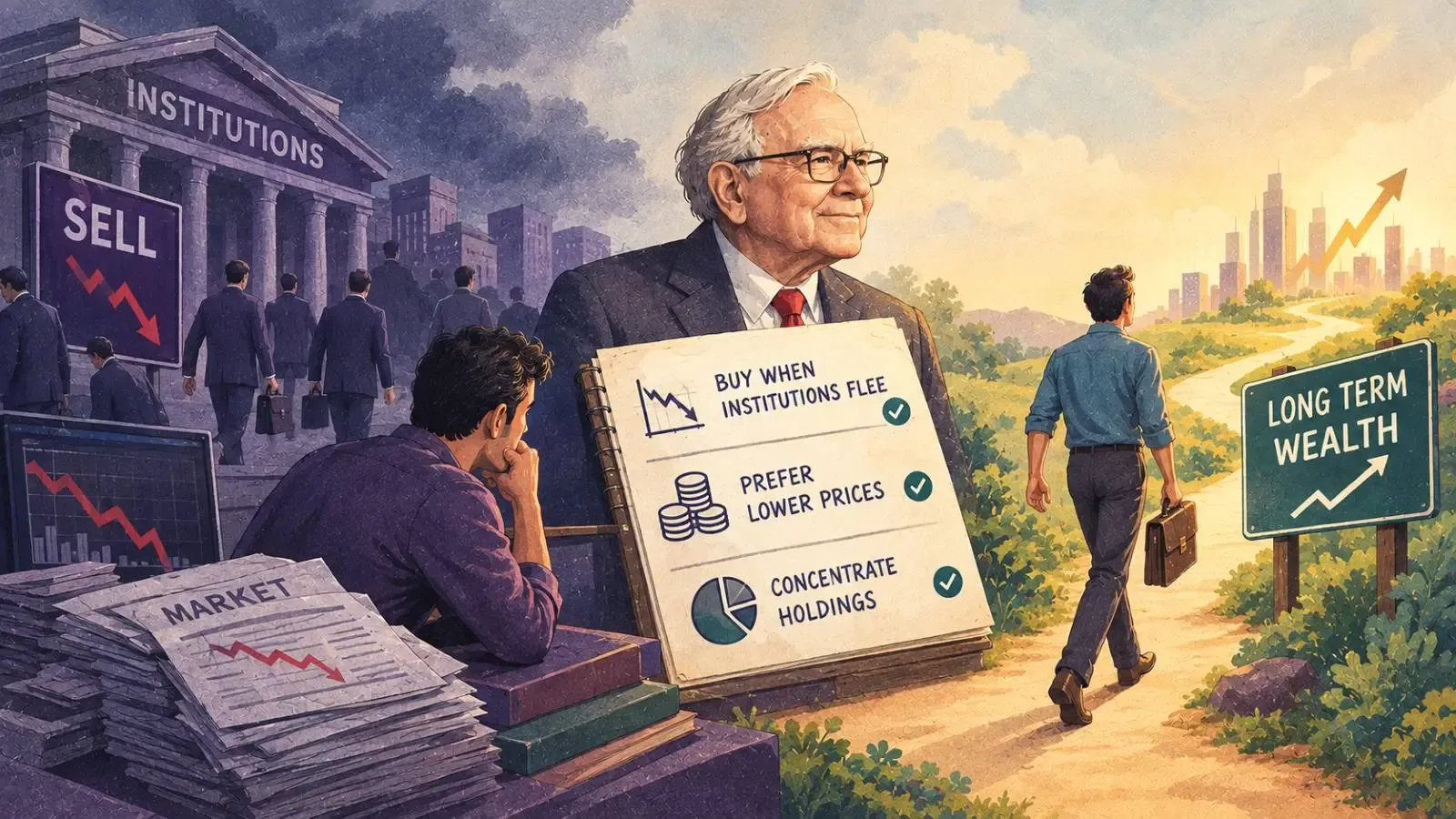
Warren Buffet's 1978 letter offers lessons that are relevant even today. | Representational image/AI Generated
In March 1979, Warren Buffett wrote his second letter to Berkshire Hathaway shareholders, covering the financial year 1978. The letter is filled with operating details about textiles, insurance, candy, banking and newspapers, but buried in it are at least five ideas that apply directly to how retail investors can think about their portfolios today.
The first is Buffett's four-point checklist for buying stocks. He wrote that he commits a big percentage of insurance company net worth to equities only when he finds "businesses we can understand, with favorable long-term prospects, operated by honest and competent people, and priced very attractively".
He added that he can usually identify a small number of companies meeting the first three conditions, but the fourth, attractive price, "often prevents action".
For Indian investors chasing initial public offerings or theme-based fund flows, Buffet's checklist is a reminder that understanding a business and finding its true valuation may matter more than participating in every opportunity.
The second idea is about how institutional investors behave at exactly the wrong time. Buffett included two footnotes that are striking:
The second idea is about how investors behave at exactly the wrong time. Buffett included two footnotes that are striking.
In 1971, when stock prices were high, pension fund managers invested a record 122% of net funds available in equities. In 1974, after the market crashed, they committed a then record low of 21% to stocks. In 1978, they put only 9% of net available funds into equities, breaking the record low set in 1974 and tied in 1977.
In contrast, Berkshire's insurance exposure grew from $10.7 million at cost in 1971 to $39.3 million at 1975 end to $129.1 million by 1978.
The pattern is that many investors even today buy aggressively at the top and retreat at the bottom. SIP investors who stop or redeem their systematic investment plans during market corrections are repeating the same mistake Buffett flagged nearly five decades ago.
The third idea turns the conventional view of falling stock prices on its head. Buffett wrote: "We are not concerned with whether the market quickly revalues upward securities that we believe are selling at bargain prices. In fact, we prefer just the opposite since, in most years, we expect to have funds available to be a net buyer of securities. And consistent attractive purchasing is likely to prove to be of more eventual benefit to us than any selling opportunities provided by a short-term run up in stock prices."
The fourth idea is concentration. Buffett wrote, "Our policy is to concentrate holdings. We try to avoid buying a little of this or that when we are only lukewarm about the business or its price. When we are convinced as to attractiveness, we believe in buying worthwhile amounts."
At the end of 1978, Berkshire's insurance companies held total equities with a cost of $133.8 million and a market value of $220.9 million. Of this, just eight holdings accounted for $94.3 million at cost and $163.9 million at market value, as per the letter.
The Washington Post Company alone was held at a cost of $10.6 million with a market value of $43.4 million.
The fifth idea concerns the textile business, which Buffett described as a textbook case of how producers of undifferentiated goods in capital-intensive businesses earn inadequate returns. Textile earnings of $1.3 million in 1978 represented a low return on $17 million of capital employed. He noted that "as long as excess productive capacity exists, prices tend to reflect direct operating costs rather than capital employed".
| Buffett idea from the 1978 letter | Application for today's investors |
|---|---|
| Four-point checklist: understandable business, good prospects, honest management, attractive price | Apply before buying individual stocks or sectoral funds |
| Pension funds bought 122% at top (1971), 9% at bottom (1978) | Do not stop SIPs when markets crash |
| Prefer lower prices as a net buyer | Treat market corrections as buying opportunities, not signals to exit |
| Concentrate holdings in high-conviction ideas | Avoid collecting too many schemes or stocks |
| Commodity businesses with excess capacity earn poor returns | Check industry structure before investing |
Buffett's 1978 return on equity from operating earnings was 19.4%, and Berkshire's per-share net worth had nearly doubled over three years, compounding at about 25% annually. Yet he called both numbers unsustainable and warned that the insurance cycle was turning downward. The willingness to acknowledge that good years will not last, and to keep buying anyway, may be the most understated lesson of the letter.
Related News


About The Author
Next Story

