Personal Finance News
Warren Buffett's 1980 letter explained real earnings, inflation, buybacks and the power of cash. 5 lessons still hold today

5 min read | Updated on November 25, 2026, 18:44 IST

SUMMARY
For Indian investors and savers reading Warren Buffet’s 1980 letter 46 years later, the five lessons from it are relevant even today:
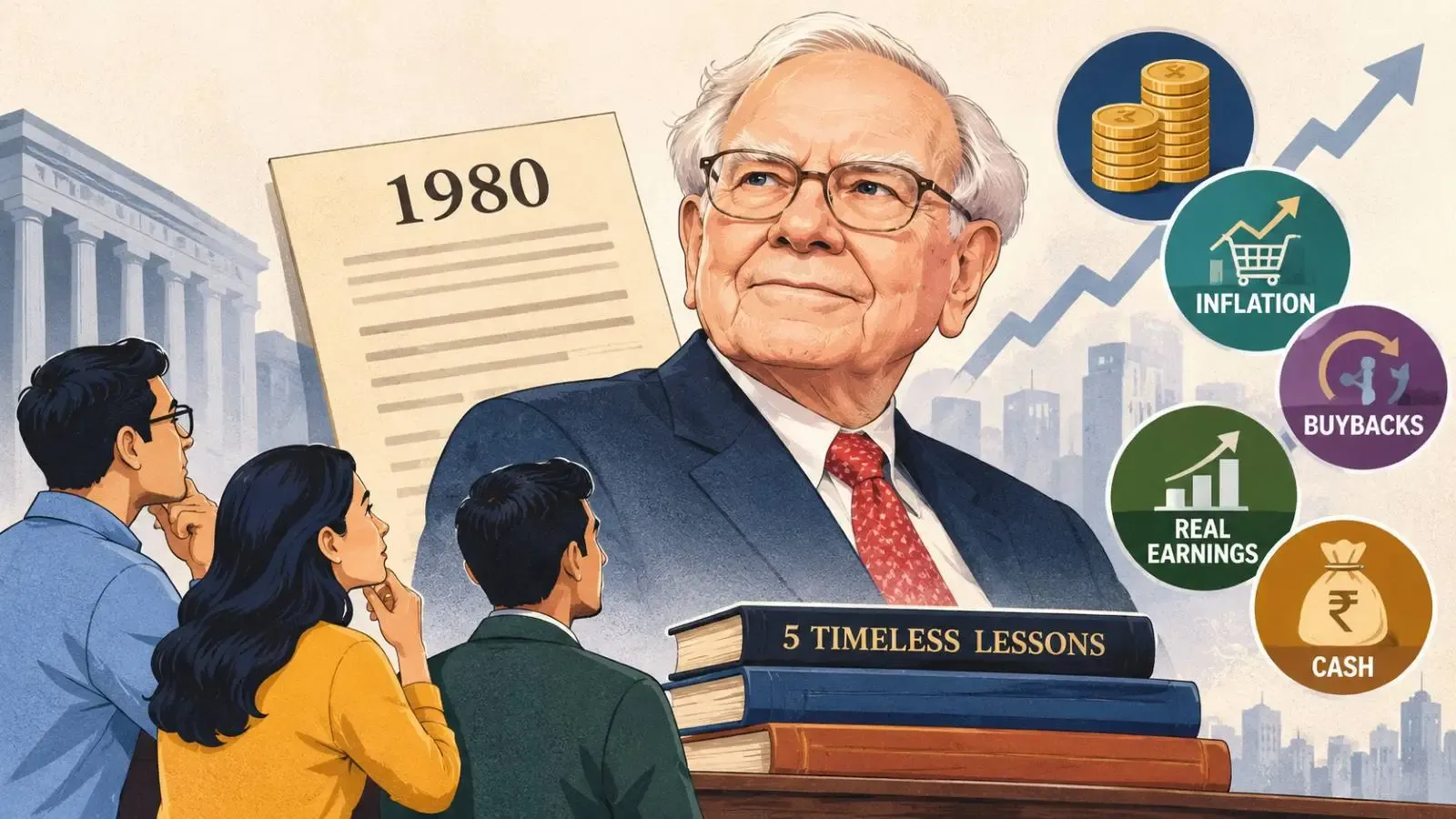
Here are five lessons from Warren Buffet's 1980 letter. | Representational image/AI generated
Warren Buffett's fourth letter to Berkshire Hathaway shareholders, written for 1980, opens with a modest number and then spends most of length explaining why the number is misleading. Operating earnings rose to $41.9 million from $36.0 million, but return on beginning equity capital fell to 17.8% from 18.6%.
He believed the return on beginning equity capital yardstick as "the most appropriate measure of single-year managerial economic performance".
Reported earnings are only the tip of the iceberg
Buffett's fourth letter takes readers through the accounting for holdings below 20%, where only dividends received show up in reported profit. Because Berkshire's insurance money sat in such companies. he wrote, "the part of 'our' earnings that these companies retained last year (the part not paid to us in dividends) exceeded the total reported annual operating earnings of Berkshire Hathaway. Thus, conventional accounting only allows less than half of our earnings 'iceberg' to appear above the surface, in plain view."
The lesson he draws is about quality of retention, not ownership size. "The value to Berkshire Hathaway of retained earnings is not determined by whether we own 100%, 50%, 20% or 1% of the businesses in which they reside. Rather, the value of those retained earnings is determined by the use to which they are put and the subsequent level of earnings produced by that usage."
And, in a line worth pinning above a desk, he wrote, "If a tree grows in a forest partially owned by us, but we don't record the growth in our financial statements, we still own part of the tree."
Buybacks are the surest use of capital
Buffett has a "special enthusiasm" for buybacks. "if a fine business is selling in the market place for far less than intrinsic value, what more certain or more profitable utilization of capital can there be than significant enlargement of the interests of all owners at that bargain price?"
He noted that the auction nature of markets often lets well-run companies buy portions of themselves at "under 50% of that needed to acquire the same earning power" through a negotiated acquisition.
Inflation is a tax that does not appear on any bill
The letter's central section is for savers. "Only gains in purchasing power represent real earnings on investment," Buffett wrote, explaining with a hamburger test: "If you (a) forego ten hamburgers to purchase an investment; (b) receive dividends which, after tax, buy two hamburgers; and (c) receive, upon sale of your holdings, after-tax proceeds that will buy eight hamburgers, then (d) you have had no real income from your investment, no matter how much it appreciated in dollars. You may feel richer, but you won’t eat richer."
Buffet explained an example that Indian savers in the 30% tax bracket will recognise even today: At 12% inflation, a business earning 20% on equity and distributing all of it to investors taxed at 50% leaves them with 98% of the purchasing power they started with - "even though they have not spent a penny of their 'earnings'". His conclusion: "At present inflation rates, we believe individual owners in medium or high tax brackets... should expect no real long-term return from the average American corporation, even though these individuals reinvest the entire after-tax proceeds from all dividends they receive."
True indexing is rare
Earnings per share rising because profits are retained is not indexation.
"For capital to be truly indexed, return on equity must rise, i.e., business earnings consistently must increase in proportion to the increase in the price level without any need for the business to add to capital - including working capital - employed," he writes. "Only a few businesses come close to exhibiting this ability. And Berkshire Hathaway isn't one of them."
Cash, firepower and the uselessness of forecasts
Berkshire borrowed $60 million of 12.75% notes in 1980 without an immediate need. He wrote, "The most attractive opportunities may present themselves at a time when credit is extremely expensive - or even unavailable. At such a time we want to have plenty of financial firepower."
His acquisition preference runs "toward businesses that generate cash, not those that consume it", and he is "leery of businesses that never seem able to convert such pretty numbers into no-strings-attached cash".
On market calls, the letter is blunt. He said, "We believe that short-term forecasts of stock or bond prices are useless. The forecasts may tell you a great deal about the forecaster; they tell you nothing about the future."
And on mistakes, having shut Waumbec Mills, Buffett conceded: "Your Chairman made a costly mistake in not facing the realities of this situation sooner" - while noting that book value per share compounded at 20.5% over 16 years despite "a lot of managerial strikeouts".
Related News
About The Author
Next Story