Market News
Week ahead: US-Israel-Iran war, crude oil spike, US Fed meet and FIIs activity among key market triggers to watch

4 min read | Updated on March 15, 2026, 12:50 IST


SUMMARY
In the week ahead, markets are likely to remain volatile as investors' focus shifts to the Federal Reserve’s policy decision amid rising inflation risks and surging crude oil prices. With the rupee hitting a record low, crude oil prices rising due to Middle East tensions, and persistent FII outflows, market sentiment remains fragile.

On the domestic front, attention will turn to India’s wholesale inflation data (WPI) due on Monday. | Image: Shutterstock
Indian markets saw one of their sharpest weekly declines in almost four years as mounting geopolitical tensions challenges sparked widespread sell-off. Benchmark indices came under heavy selling pressure throughout the week, with the NIFTY50 and SENSEX falling over 5%. Meanwhile, the Indian rupee weakened to a new record low of 92.49 against the dollar, reflecting growing worries about capital outflows and high crude oil prices.
The sell-off was severe in border markets as well with Midcap 150 and Smallcap 250 indices dropped between 3% to 4%. A key trigger behind the weakness was the escalating conflict in the Middle East, which pushed global crude oil prices higher and amplified fears of inflationary pressures for oil-importing economies like India. The combination of rising oil prices, rupee depreciation and persistent foreign institutional investor (FII) outflows created a fragile backdrop for domestic equities.
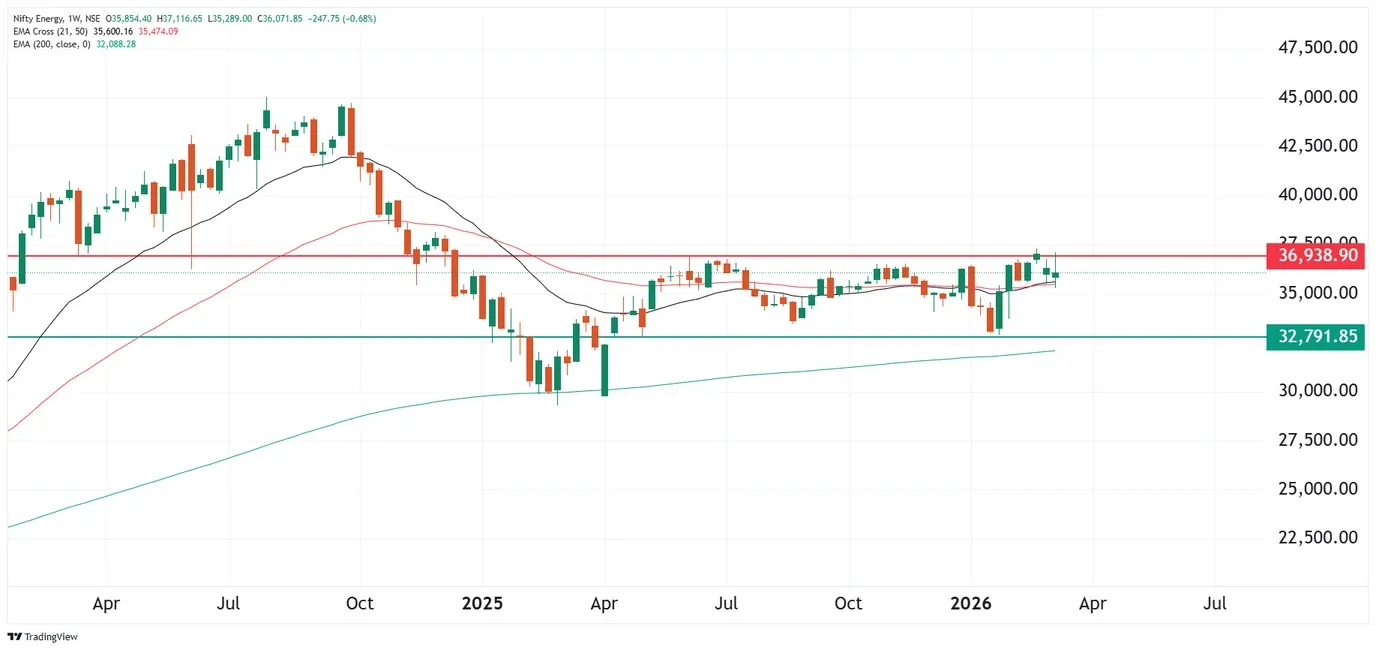
All the sectoral indices ended the week in red with Automobiles (-10%), PSU Banks (-7%) and Defence (-7%) declining the most. However, defensive sectors like Pharma (-0.6%) and Energy (-0.6%) showed relative resilience, limiting losses as investors rotated towards safer pockets amid heightened volatility.
On the domestic front, attention will turn to India’s wholesale inflation data (WPI) due on Monday. Wholesale prices had risen 1.81% year-on-year in January 2026, accelerating from 0.83% in December and exceeding expectations of 1.25%.
Market breadth
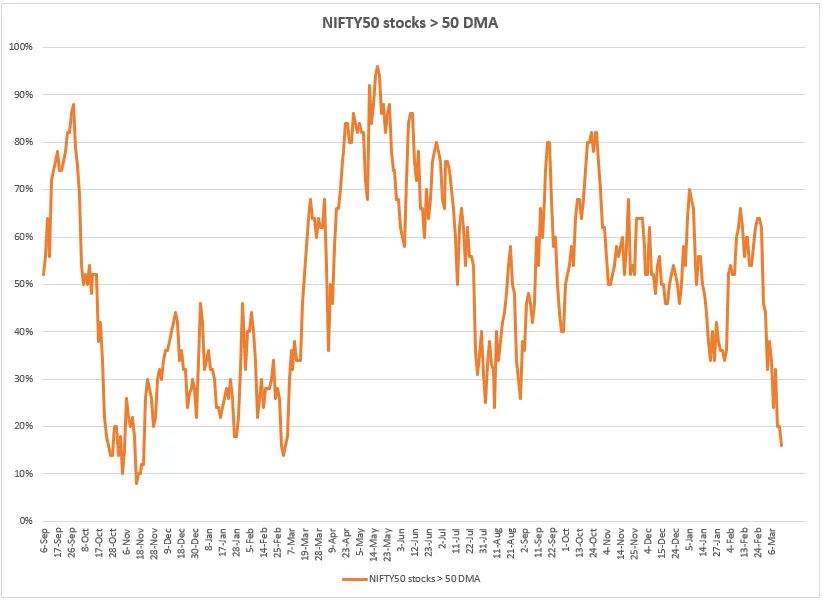
NIFTY’s market breadth deteriorated sharply this week, with the percentage of NIFTY50 stocks trading above their 50-day moving average plunging from around 35% to nearly 15%. This steep drop indicates a broad-based breakdown across the index, with a majority of stocks slipping below their key short-term trend levels.
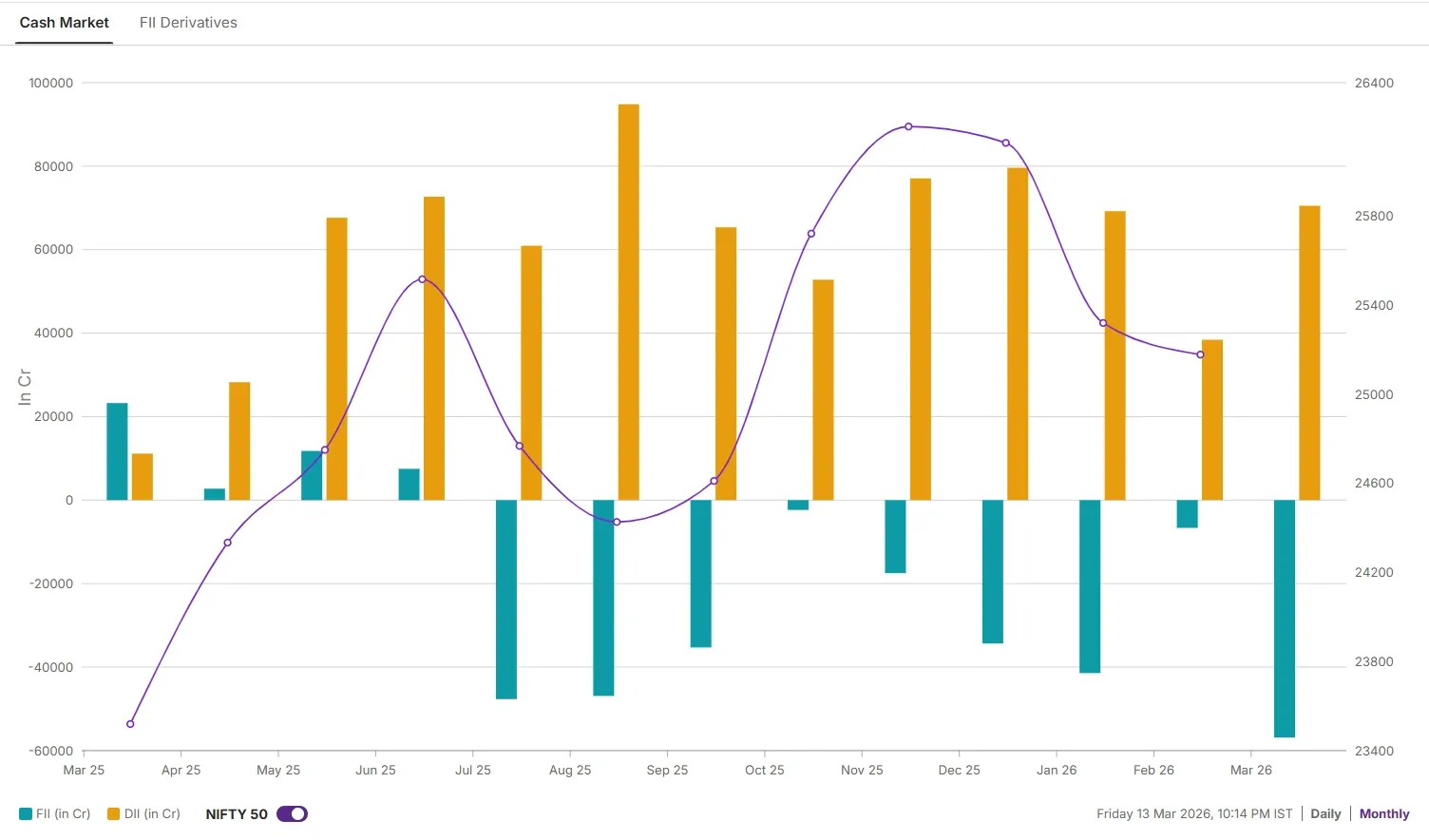
FIIs cash market and derivatives
Foreign institutional investors (FIIs) intensified their selling activity in the March so far have offloaded shares worth ₹56,883 crore. This is the highest sell figure recorded by FIIs in last one year, indicating that the FIIs are utlising the current market volatility to aggressively reduce exposure in Indian equities.
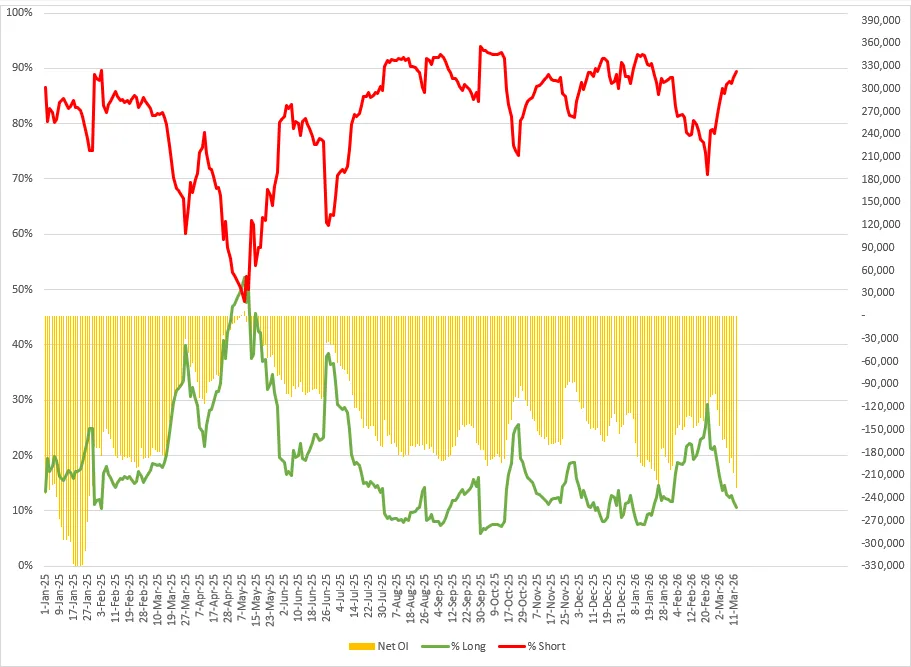
Meanwhile, in index futures the net exposure of the FIIs remain net short and they increased the long-to-short ratio to 9:91. To put this in context, the FIIs started the March series with the long-to-short ratio of 21:79 and the net open interest -1.04 lakh contracts. As of 13 March, the net open interest of FIIs in index futures stand at -2.26 lakh contracts, up 117%.
NIFTY50 outlook
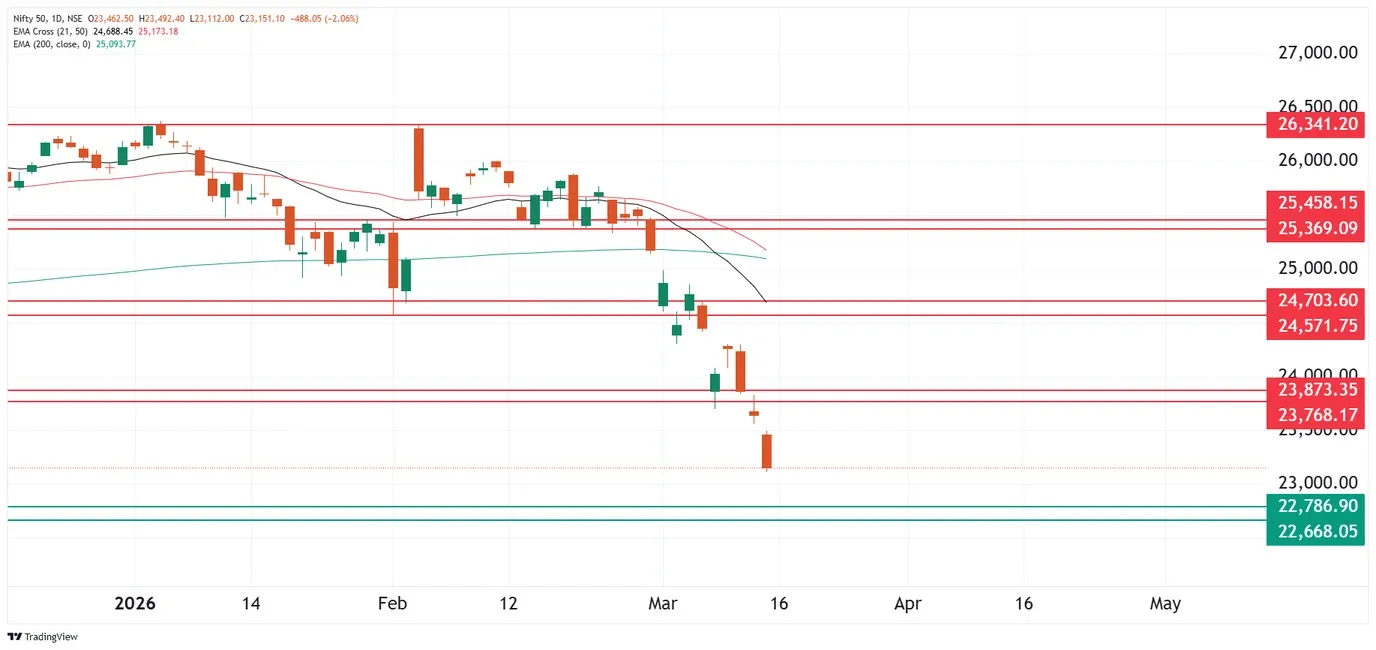
The near-term outlook for NIFTY remains weak as the index slipped below 8% from its pshyhcologically crucial level of 200-day exponential moving average (EMA). Additionally, on the daily chart the 50-day and 200-day moving averages are coming closer to form a potential “death cross”, a bearish technical formation.
Meanwhile, the next crucial support for the index is around 22,700. A break below this level will signal further weakness and index can drift lower towards 21,700 zone. On the upside, 23,800 and 24,700 will act as immediate resistance zones. Overall, the trend remains volatile and traders should take cautious approach in the near term.
Disclaimer:
Derivatives trading must be done only by traders who fully understand the risks associated with them and strictly apply risk mechanisms like stop-losses. The information is only for consumption by the client, and such material should not be redistributed. We do not recommend any particular stock, securities, or trading strategies. The securities quoted are exemplary and not recommendatory. The stock names mentioned in this article are purely to show how to do analysis. Make your own decision before investing.
Related News

About The Author
Next Story