Market News
SBI, PNB, Bank of Baroda shares rally as PSU banks report record asset quality; slippages fall below 1%

3 min read | Updated on November 27, 2026, 10:41 IST

SUMMARY
According to the Ministry's press release, PSBs have continued to record healthy credit growth while maintaining prudent underwriting standards and strengthening risk management practices.
Stock list

PSBs' advances have grown across retail, agriculture, micro, small and medium enterprises (MSMEs) and corporate segments, reflecting a broad-based expansion in lending. Image: Shutterstock
Shares of public sector banks (PSBs), including State Bank of India (SBI), Bank of Baroda (BoB), Punjab National Bank (PNB) and Canara Bank, advanced on Friday, November 27, with the NIFTY PSU Bank index gaining over 1.5%.
The gains come a day after the Ministry of Finance reported an improvement in the asset quality of state-run lenders, with all PSBs recording slippage ratios of less than 1%. Their net non-performing assets (NPAs) stood at 0.33% as of September 30, 2026, while advances grew 15.1% over the past five years to ₹127 lakh crore.
According to the Ministry's press release, PSBs have continued to record healthy credit growth while maintaining prudent underwriting standards and strengthening risk management practices.
Their advances have grown across retail, agriculture, micro, small and medium enterprises (MSMEs) and corporate segments, reflecting a broad-based expansion in lending.
The improvement in asset quality has been supported by lower slippages and stronger recoveries in stressed accounts. The Ministry said institutionalised banking reforms have also strengthened governance and risk management practices across PSBs.
PSBs' advances
PSBs' advances have grown at a compound annual growth rate (CAGR) of 15.1% over the last five years to reach ₹127 lakh crore as of September 30, 2026.
Alongside this growth, banks have reported a sharp decline in fresh slippages, indicating improved credit underwriting.
In FY22, against advances of ₹67.7 lakh crore as of March 31, 2021, fresh slippages stood at ₹1.44 lakh crore, translating into a slippage ratio of 2.35%.
This has since declined significantly. In the first half of FY27, fresh slippages stood at ₹38,780 crore against advances of ₹127 lakh crore, taking the slippage ratio down to 0.62%.
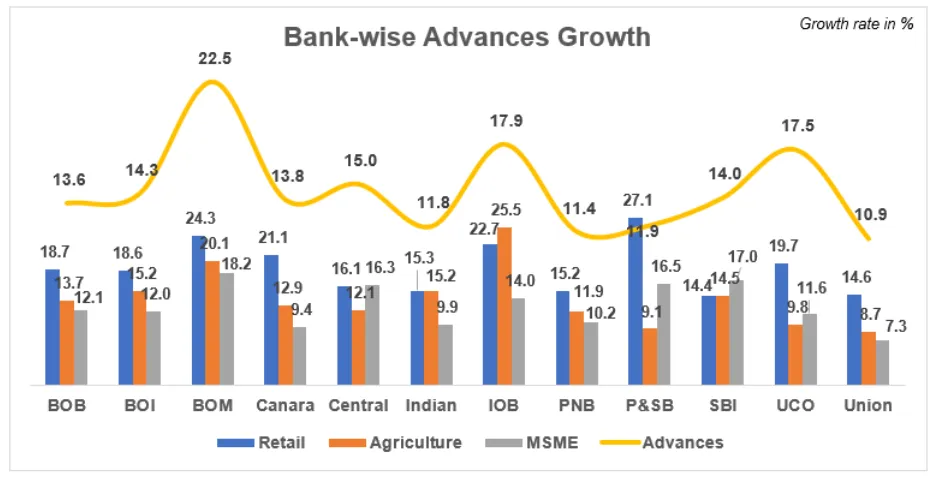
Credit growth has also remained diversified across sectors. While retail and agriculture lending have maintained healthy growth over the past five years, credit to MSMEs and corporates has picked up pace, marginally outpacing other segments.
Bank-wise performance
Among PSBs, Bank of Maharashtra has recorded the fastest credit growth, while larger lenders such as State Bank of India (SBI), Canara Bank, Bank of Baroda and Punjab National Bank (PNB) have also reported strong growth.
Despite the expansion in lending, slippage ratios have continued to improve across banks. All PSBs now have slippage ratios of less than 1%, with Punjab & Sind Bank being the only lender to report a marginal deterioration, although its ratio remains relatively low at 0.57%.
Among the larger lenders, SBI, PNB and Canara Bank have reported relatively low slippage ratios.
Net NPAs and stressed assets remain low
The decline in fresh slippages, along with adequate provisioning and recoveries, has helped PSBs maintain low levels of net NPAs.
Their aggregate net NPAs stood at just 0.33%, or ₹44,100 crore, against total advances of more than ₹127 lakh crore.
Stress levels in the form of Special Mention Accounts (SMAs) have also declined. Advances of more than ₹5 crore classified under SMA-1 and SMA-2 categories stood at ₹18,800 crore as of September 30, 2026.
The ratio of SMA-1 and SMA-2 advances above ₹5 crore to total standard advances declined to 0.14% as of September 30, 2026, compared with 0.24% a year earlier.
Related News


About The Author
Next Story