Market News
Jio Platforms shares in focus as ₹4,941 crore worth of anchor shares become eligible for trading; Check key details

7 min read | Updated on November 25, 2026, 10:32 IST

SUMMARY
Jio Platforms shares are trading lower on November 25 as the stock came under selling pressure after 3.62 crore Jio Platforms shares held by anchor investors became eligible for trading as the first 30-day anchor lock-in period expired. Check complete details
Stock list
Anchor investors are large institutions, such as mutual funds, insurance companies and foreign funds.
Jio Platforms shares made a strong stock market debut on October 28, 2026, listing at a 21.3% premium over its final issue price of ₹1,119 apiece. Jio Platforms now faces its first 30-day anchor lock-in period, which will free 50% of anchor investors' shares on November 24, available for trading from November 25 onwards. For a month after its IPO allotment, the big institutions that bought Jio Platforms shares in the anchor round could not sell a single one.
Around 3.62 crore (36,237,032) equity shares, representing half of the 7.24 crore anchor shares allotted to 212 institutional investors on October 26 under the anchor investor quota, will become free for trading. Jio Platforms shares closed at ₹1,365.9 apiece on NSE on November 23. Hence, the size of the anchor investor block being unlocked stands at ₹4941.3 crore, which is the highest among the recently listed IPOs. Will extra share supply drag Jio Platforms shares lower?
For instance, big institutions that bought National Stock Exchange (NSE) shares during its IPO, which was the second-largest IPO by issue size, saw the end of the 30-day anchor period on October 22. About 1.89 crore shares, worth roughly ₹3,225 crore at the previous day's close, became free for trading. The stock was already 4.4% below its IPO price of ₹1,785. After the 30-day anchor investor period ended, NSE shares declined, falling 2.2% in two trading sessions. But a turnaround came, and by November 19, NSE shares were 32.4% above its October 23 close.
Who are anchor investors and why are shares unlocking now?
Anchor investors are large institutions, such as mutual funds, insurance companies and foreign funds, that buy shares of the upcoming IPO one day before its open for public via anchor round.
Under SEBI rules for IPOs opening on or after April 1, 2022, half of their shares stay locked for 30 days from allotment and the other half for 90 days.
Jio Platforms allotted 7,24,74,066 (7.34 crore) shares to anchor investors at ₹1,119 apiece, raising ₹8,109.85 crore. The IPO allotment was finalised on October 26, so half of the anchor shares, about 3.62 crore, will be available for trading from November 25.
What happened to NSE shares after 30-day anchor period expired?
NSE IPO with an issue size of ₹22,562.7 crore came about a month before Jio Platforms IPO. Its anchor investors bought 3,77,93,739 shares at ₹1,785 each, putting in ₹6,746.18 crore. The first half of those shares became free to trade on October 22. Here’s what happened after that:
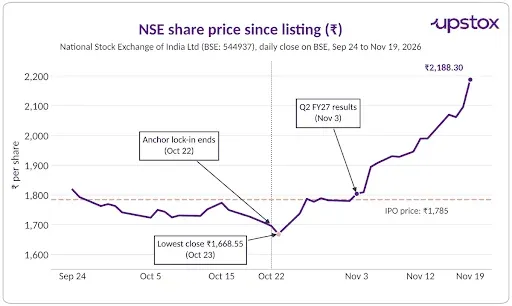
- September 24: Listed on BSE at ₹1,800, up 0.8% over the issue price of ₹1,785. Closed the first day at ₹1,818 per share.
- October 21: Slipped to ₹1,706.55, a day before the unlock.
- October 22: Closed at ₹1,695.60 on unlock day, down 0.6%.
- October 23: Closed at ₹1,668.55, its lowest close so far. It touched ₹1,640.25 during the day.
- October 26: Jumped 4.1% to ₹1,737.65.
- October 27: Rose another 2.8% to ₹1,786.95, back above the IPO price.
- November 3: Reported Q2FY27 results. Consolidated net profit rose 22.8% YoY to ₹2,577.6 crore, about 63% of its ₹4,066.8 crore revenue from operations.
- November 23: Closed at ₹2209.2, 23.7% above the IPO price.
NSE trading data show the anchor investor did not rush to exit, although volumes did pick up: 17.2 lakh shares changed hands on BSE on October 22, about 39% more than the average of the previous 10 sessions. But across the unlock day and the next session, total volume was about 31.2 lakh shares.
BSE's deal records also show no bulk or block deals in NSE shares between October 22 and November 19. However, smaller open-market sales would not appear there. Meanwhile, the broader market was also in a correction phase, with SENSEX falling 2.15% in the same week as NSE’s anchor unlock.
Lower NSE share price may be one reason for modest anchor selling after the 30 days unlocked. On October 21, NSE shares were trading 4.4% below the IPO issue price of ₹1,800 per share.
Why Jio Platforms case may be different?
In comparison to NSE, Jio Platforms' anchor investors are in profit. At ₹1,365.9 (Nov 23 closing), every Jio Platforms share is worth ₹246.9 more than the ₹1,119 they paid. On the half being freed, that is a paper profit of about ₹893.7 crore. On the full anchor book, it is roughly ₹1,787 crore, made in about a month.
A gain of ₹246.9 per share or 22.06% in about a month is not small. Will Jio's anchors book some of it, or hold on?
NSE vs Jio Platforms: First anchor unlock
| NSE | Jio Platforms | |
|---|---|---|
| IPO price | ₹1,785 | ₹1,119 |
| Anchor allotments (funds and schemes) | 189 | 212 |
| Anchor book | ₹6,746.1 crore | ₹8,109.8 crore |
| Shares freed after 30 days | 1.89 crore | 3.62 crore |
| Free to sell from | October 22, 2026 | November 25, 2026 |
| Share price before unlock | ₹1,706.5 (Oct 21) | ₹1,365.9 (Nov 23) |
| Price vs IPO price | -4.4% | +22.06% |
| Value of shares freed | ₹3,225 crore | ₹4,944.5 crore |
| Anchors' paper gain or loss on freed shares | Loss of ₹148 crore | ₹893.7 crore |
Meanwhile, Jio Platforms share price has cooled. The stock listed at ₹1,358, a 21.4% premium, and closed its first day at ₹1,417.50. Its highest close so far was ₹1,489.7 on October 29.
Jio Platforms' free float is also thin. On November 23, NSE's website showed Jio's free-float market value at about ₹27,400 crore, just over 2% of its total market value of about ₹12.8 lakh crore.
On the other hand, Jio trades far more than NSE did. Over the last 10 sessions, around 50 lakh Jio shares traded each day on NSE and BSE combined. At that pace, the freed block equals about seven sessions of recent average volume. NSE's freed block equalled about 15 sessions of its average volume on BSE.
What SEBI data shows about past IPOs?
A SEBI study released in August 2026 looked at anchor investors in 242 mainboard IPOs listed between April 2022 and October 2025. Taken together, and weighted by allotment value, anchors had sold just 3.2% of their shares shortly after the 30-day lock-in ended and about 17.3% shortly after the 90-day lock-in ended.
Bigger anchor exits went with bigger price falls. Around day 30, stocks where anchors sold up to 2.5% of their shares dipped about 0.4% on average. Where they sold more than 10%, the average fall was close to 3.5%.
Some recent big IPOs that were trading well above their issue price did feel the heat at their first anchor unlock. Swiggy fell nearly 4% on its unlock day in December 2024. Groww fell as much as 3.7% during trade in December 2025, and Meesho hit its 5% lower circuit in January 2026.
On the business side, Jio's first results since listing showed profit growth. For Q2FY27, consolidated net profit rose 13.7% YoY to ₹8,387 crore on revenue from operations of ₹40,475 crore, a PAT margin of about 20.7%.
Key dates to watch
- November 25, 2026: The first 3.62 crore anchor shares can be sold.
- January 25, 2027: The first trading day for the remaining 3.62 crore anchor shares.
- Late April 2027: The six-month lock-in on non-promoter pre-IPO shareholders ends.
Related News

About The Author
Next Story