Market News
Indian IT stocks shrug off Wall Street rout; NIFTY IT rises 2%, Infosys and TCS in the green

7 min read | Updated on November 06, 2026, 10:01 IST

SUMMARY
Shares of major IT companies, including Infosys, Tata Consultancy Services (TCS), Wipro and HCLTech, were trading higher, defying concerns stemming from the sharp decline in US technology stocks.
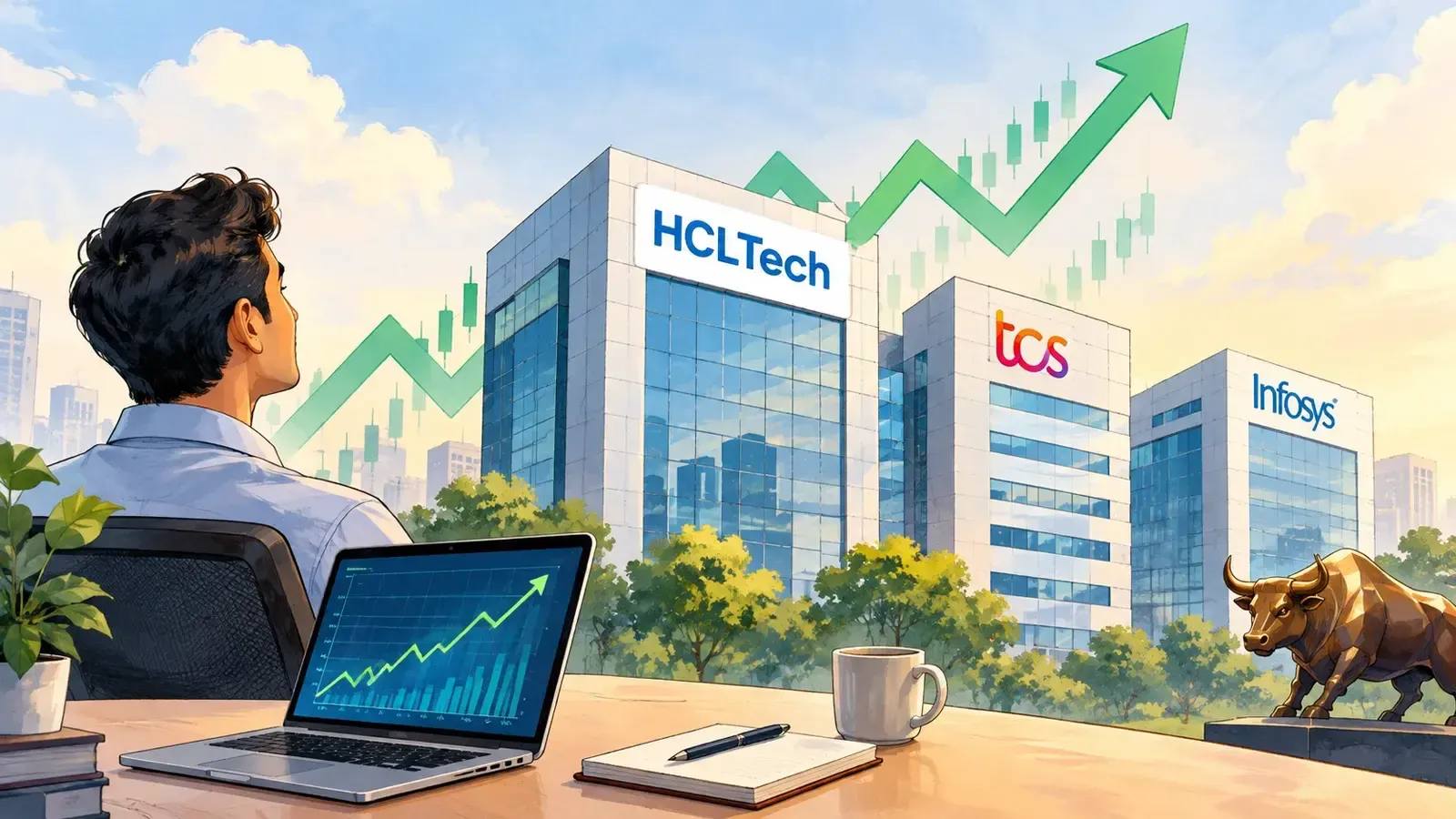
The divergence in performance comes even as the Nasdaq Composite plunged 5.5% in the previous session.
Indian IT services stocks rallied sharply in the opening deals on Friday, November 6, bucking the weak global trend, with the NIFTY IT index surging over 2% even as technology stocks on Wall Street witnessed a sharp sell-off overnight.
Shares of major IT companies, including Infosys, Tata Consultancy Services (TCS), Wipro and HCLTech, were trading higher, defying concerns stemming from the sharp decline in US technology stocks.
The divergence in performance comes amid a deepening sell-off in AI-linked stocks globally. With investors reassessing valuations and exposure to the AI trade, Indian IT companies, whose businesses are largely centred on technology services rather than AI hardware and infrastructure, appear to be attracting renewed investor interest.
How IT stocks were trading
The NIFTY IT index jumped as much as 2.37% in the opening deals to hit a high of 33,616.20, with nine of its 10 constituents trading in the green. At 9:28 AM, the index stood at 33,313.95, up 1.45% from its previous close of 32,837.85.
Among individual stocks, Mphasis gained 4.46% to ₹2,622, while Infosys advanced 1.58% to ₹1,185.90. Tata Consultancy Services (TCS) shares rose 1.79% to ₹2,540.40 apiece on the NSE, while HCLTech was up 1.73%.
| Symbol | Open | High | Low | Prev. Close | LTP | Indicative Close | Change | % Change |
|---|---|---|---|---|---|---|---|---|
| NIFTY IT | 33,270.15 | 33,616.20 | 33,150.30 | 32,837.85 | 33,306.25 | – | 468.40 | 1.43 |
| MPHASIS | 2,625.20 | 2,711.00 | 2,586.60 | 2,510.00 | 2,619.20 | – | 109.20 | 4.35 |
| INFY | 1,182.80 | 1,198.80 | 1,178.50 | 1,167.40 | 1,185.80 | – | 18.40 | 1.58 |
| TCS | 2,533.60 | 2,565.00 | 2,515.90 | 2,495.70 | 2,535.00 | – | 39.30 | 1.57 |
| HCLTECH | 1,447.60 | 1,469.00 | 1,442.00 | 1,430.50 | 1,453.00 | – | 22.50 | 1.57 |
| COFORGE | 2,100.00 | 2,127.90 | 2,090.10 | 2,079.00 | 2,096.20 | – | 17.20 | 0.83 |
| WIPRO | 199.90 | 201.70 | 199.45 | 198.40 | 200.58 | – | 2.18 | 1.10 |
| PERSISTENT | 6,175.00 | 6,240.00 | 6,135.00 | 6,109.50 | 6,223.00 | – | 113.50 | 1.86 |
| TECHM | 1,837.70 | 1,860.00 | 1,830.00 | 1,822.70 | 1,837.50 | – | 14.80 | 0.81 |
| LTM | 4,500.00 | 4,515.60 | 4,395.20 | 4,393.00 | 4,414.90 | – | 21.90 | 0.50 |
| OFSS | 10,042.00 | 10,110.00 | 9,968.00 | 10,150.00 | 9,999.00 | – | -151.00 | -1.49 |
Why are Indian IT stocks rallying? 6 key factors driving buying interest
The NIFTY IT index, which was among the worst-performing sectoral indices until September 2026, has staged a sharp comeback in October and November.
Taking current levels into account, the index has gained more than 18% over the past month, signalling a renewed interest in Indian IT stocks after months of selling pressure.
The rally is notable because it comes even as concerns over artificial intelligence (AI) disruption and its potential impact on traditional IT services businesses persist.
However, a combination of better-than-expected quarterly performances from select companies, healthy deal wins, encouraging management commentary, and a shift in global investment preferences appears to have improved sentiment towards the sector.
Q2 earnings and strong deal wins
The September quarter earnings season has provided some reassurance to investors, with several IT companies reporting better-than-expected performances, healthy deal pipelines, and improvement in certain business segments.
TCS reported a 15% year-on-year increase in net profit, while its total contract value (TCV) of new deals stood at $9.6 billion for Q2 FY27. HCLTech, meanwhile, reported record new deal bookings of $3.3 billion and raised the lower end of its FY27 revenue growth guidance. Tech Mahindra also reported a good improvement in profitability.
Healthy deal wins are particularly important because they indicate that clients continue to spend on technology transformation, cloud, cybersecurity, data, and AI-related projects despite global economic uncertainties.
The conversion of these deals into revenue over the coming quarters will be an important factor to watch.
Encouraging management commentary
Management commentary from leading IT companies has also helped improve investor confidence. Companies have indicated that client spending remains resilient in select areas, with demand for digital transformation, cloud migration, cybersecurity and AI-led services providing business opportunities.
The commentary around deal pipelines, client engagements and revenue conversion has been particularly important after several quarters of cautious spending by global clients.
However, the recovery is not uniform across the sector. Investors will continue to track discretionary spending, project ramp-ups and the pace at which large deals translate into actual revenue.
The 'anti-AI' trade: Investors look beyond AI stocks
One of the interesting factors behind the recent rally is the emerging rotation away from expensive AI-linked stocks towards traditional IT services companies.
For much of 2026, global investors preferred companies directly benefiting from the AI boom, including semiconductor manufacturers and AI infrastructure players. This left several Indian IT services companies, which were seen as vulnerable to AI-led disruption, under pressure.
Indian IT companies are increasingly attracting attention as a relatively different way to participate in enterprise technology spending. Their businesses are largely service-led, with exposure to consulting, software development, cloud migration, application management and technology transformation.
This does not mean AI is no longer a threat to the traditional IT services model. Rather, investors appear to be reassessing the balance between AI-related risks and the opportunities it could create for established IT service providers.
Attractive valuations after a prolonged correction
Valuation comfort is another factor supporting the recovery. Before the recent rally, Indian IT stocks had witnessed significant selling pressure amid concerns over sluggish revenue growth, AI-led disruption and delayed discretionary spending by clients.
The correction brought valuations of several large IT companies down from their earlier levels, making them relatively attractive for investors looking to build exposure to the sector.
This provided an opportunity for value buying, particularly in established IT services companies with strong balance sheets, global client relationships and cash-generating businesses.
Even after the October rally, the NIFTY IT index remains below its February 2026 peak. However, investors will need to assess current valuations against the pace of earnings growth rather than assume that the stocks are still cheap after their sharp recovery.
Foreign investors return to Indian IT stocks
The return of foreign investor interest has also supported the sector's recovery. According to NSDL data cited in an October 22 report, foreign portfolio investors (FPIs) bought around ₹6,463 crore worth of IT stocks during the September quarter.
The buying was selective, with companies such as Wipro and Infosys witnessing an increase in foreign institutional ownership during the quarter. This suggests that some institutional investors had started rebuilding exposure to the sector after the prolonged correction.
The October rally has also coincided with a broader global portfolio rotation away from AI-sensitive markets and towards relatively under-owned sectors, including Indian IT services.
Indian IT companies are also positioning themselves to benefit from AI
While AI disruption remains a concern, it is not necessarily a negative for every IT services company. Large Indian technology companies are investing in AI capabilities, building partnerships with global technology providers and helping enterprise clients integrate AI into their operations.
For instance, TCS reported annualised AI revenue of $3.1 billion in Q2 FY27, crossing 10% of its overall revenue. It also announced strategic partnerships involving AI capability centres and technology transformation.
As companies move from experimenting with AI to deploying it at scale, Indian IT service providers could potentially benefit from consulting, implementation, integration, and ongoing support requirements. The ability to monetise these opportunities will be an important driver of future growth.
Related News
About The Author
Next Story