
Market News
Domino's added 88 stores, but Jubilant FoodWorks' profit fell 43%. Are Indians eating out less?

6 min read | Updated on November 26, 2026, 22:48 IST

SUMMARY
Jubilant FoodWorks' consolidated net profit fell 42.7% YoY to ₹111.6 crore in Q2 FY27, even as Domino's added 88 net stores in India. A one-time gain booked a year earlier explains the entire fall. At the same time, McDonald's and Burger King are reporting double-digit same-store growth, which suggests the weakness at Domino's is company-specific rather than a sign that Indians are eating out less.
Stock list
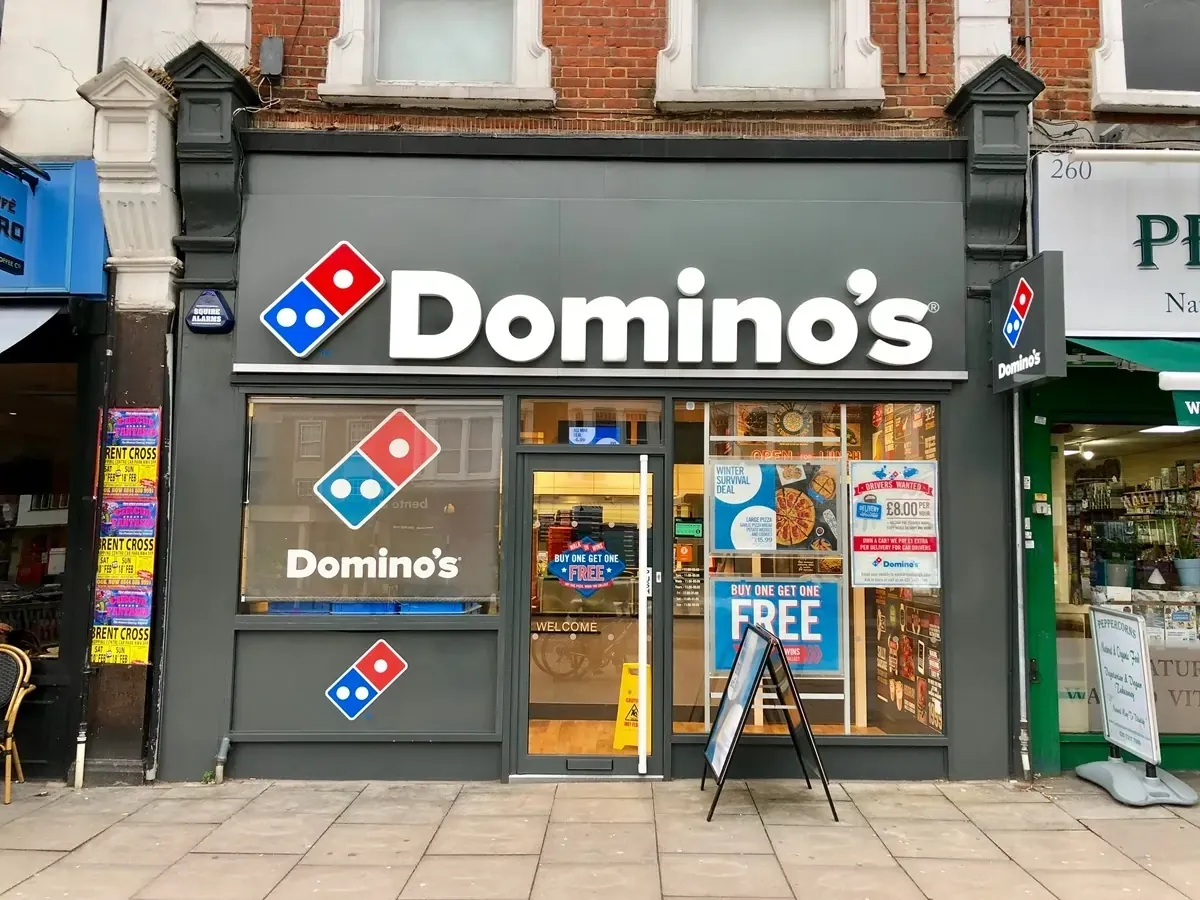
Between July and September 2026, a new Domino's opened somewhere in India almost every day | Image: Shutterstock
Between July and September, a new Domino's opened somewhere in India almost every day. The chain added 88 net outlets in 92 days and entered 47 new cities, expanding its footprint to 587 cities.
Then the results came out. Jubilant FoodWorks, which runs Domino's in India, reported a 43% YoY drop in consolidated net profit. The stock closed at ₹420.80 on November 18, about 31% below its 52-week high of ₹612.50.
So are Indians cutting back on pizza nights and burger runs, or is the profit number hiding something?
Last year's one-off did the damage
Jubilant's consolidated net profit was ₹111.6 crore in Q2 FY27, compared with ₹194.6 crore in Q2 FY26, a fall of about ₹83 crore.
The Q2 FY26 number was lifted by a one-time gain of ₹84.7 crore from exiting its Russian business, booked under discontinued operations. That gain alone is bigger than the entire fall in profit, and it will not repeat. Jubilant has since moved its small Dunkin' business into discontinued operations as well, so the discontinued operations line now shows a restated figure of ₹81.2 crore for Q2 FY26.
Excluding discontinued operations, profit from continuing operations was ₹113.9 crore in Q2 FY27, up 0.5% from ₹113.4 crore a year ago.
Revenue from operations rose 11.8% YoY to ₹2,607.9 crore, and EBITDA grew 7.3% to ₹513.1 crore. Margins did slip, though. The PAT margin from continuing operations fell to 4.4% from 4.9%, and the company said its consolidated EBITDA margin was hit mainly by hyperinflation accounting at DP Eurasia, its Turkey-based business. So did Jubilant's profit really fall 43%? On paper, yes. In the business it runs today, profit was roughly flat.
Jubilant FoodWorks: Q2 FY27 vs Q2 FY26 (consolidated)
| Particulars | Q2 FY26 | Q2 FY27 | Change |
|---|---|---|---|
| Revenue from operations (₹ crore) | 2,331.7 | 2,607.9 | +11.8% |
| EBITDA (₹ crore) | 478.0 | 513.1 | +7.3% |
| Profit from continuing operations (₹ crore) | 113.4 | 113.9 | +0.5% |
| Profit/(loss) from discontinued operations (₹ crore) | 81.2 | -2.3 | NA |
| Net profit (₹ crore) | 194.6 | 111.6 | -42.7% |
| PAT margin, reported (%) | 8.3 | 4.3 | -407 bps |
| Domino's India stores | 2,321 | 2,601 | +280 |
| Domino's India LFL growth (%) | 9.1 | 4.1 | NA |
Are Indians eating out less? Rival chains say no
If Indians were broadly cutting back, most restaurant chains would be feeling it. The listed ones are not. Westlife Foodworld, which runs McDonald's in West and South India, reported same-store sales growth of 10.1% in Q2 FY27 on the back of double-digit growth in guest count. A year earlier, same-store sales had fallen 2.8%. On-premise sales made up 59% of its system sales.
Burger King India's same-store sales rose 14%, compared with 2.8% growth a year ago. KFC, run by Devyani International, posted 4.4% same-store sales growth after a 4.2% decline a year ago, and Devyani said its on-premise sales were growing. Pizza Hut was the only Devyani brand in India that was still lagging.
Delivery apps are growing too. Zomato's food delivery net order value rose 21.5% YoY to ₹11,445 crore, faster than the 14% growth it posted a year earlier. Swiggy's food delivery gross order value grew 17.7% to ₹10,054 crore. Household surveys point the same way. In the RBI's September 2026 urban consumer confidence survey, 54.5% of respondents said the economy had worsened over the past year. Even so, more people said they were spending more on non-essential items than said they were spending less, and this gap was the widest in the last seven survey rounds.
On the earnings call, Jubilant's CEO and MD Sameer Khetarpal said the company was more worried about inflation than about demand.
Why has Domino's growth slowed?
Like-for-like (LFL) growth at Domino's India, which tracks sales at existing stores, was 4.1% in Q2 FY27. That is an improvement on 0.2% in Q4 FY26 and 2.5% in Q1 FY27, but well below 9.1% a year ago.
Part of the reason is a high base. A year ago, Domino's was growing fast while McDonald's and KFC were shrinking and Burger King was barely growing. Taking the two years together, sales at Domino's existing stores grew about 13.6%, ahead of McDonald's West and South business (about 7%) but behind Burger King India (about 17%).
The bigger gap is in dine-in. Delivery revenue at Domino's India grew 11.3% YoY and now makes up 75.8% of its sales, while dine-in and takeaway grew just 2.4%. Its burger rivals, meanwhile, are reporting more guests walking in. So if people are going to McDonald's and Burger King more often, why aren't they going to Domino's? The company is upgrading about 400 dine-in-heavy stores over roughly three quarters, has finished about 20% of them, and has rolled out its ₹119 My Meal nationally.
Then there is the cost of opening a store almost every day. Revenue at Domino's India rose 9.2% to ₹1,792.2 crore, while its store count grew 12.1% to 2,601. As a result, average revenue per store slipped by about 2.6%. Existing stores did better, with average daily sales rising from ₹78,200 to ₹81,400, which suggests newer outlets, including those in the 47 new cities, are still ramping up. Each new store also adds rent and depreciation, and consolidated depreciation rose 14.7% to ₹261.4 crore.
Costs are rising as well. Management said higher LPG prices, minimum wage hikes, and raw material costs had an impact of about 200 basis points on profitability. It has offset part of the hit with price increases of about 1.5% to 2% and says it may raise prices further if needed. How far can prices rise before value-seeking customers switch to a cheaper burger meal?
Popeyes, Jubilant's chicken brand, is still growing fast. Its revenue rose 122% YoY, LFL growth was 53%, and it had 99 stores at the end of September.
Conclusion:
The new Domino's that opened in your town this quarter will add to sales from day one. Adding to profit will take longer.
The 43% fall in Jubilant's net profit is explained by a one-time gain in the base quarter, while profit from continuing operations edged up 0.5%. Numbers from listed burger and chicken chains and the two big delivery apps do not suggest that Indians are eating out less, though they mostly reflect urban India. Jubilant's margins did narrow, and Domino's same-store growth now trails its burger rivals.
For Domino's, the questions are more specific. Can the dine-in revamp bring walk-in customers back? Can newer stores in smaller cities catch up with older ones? And can price hikes cover rising costs without losing customers? The company is targeting LFL growth of 5% to 7% for the full year, and the next two quarters will show how close it gets.
About The Author
Next Story

