Market News
Putin India visit: Pharma, chemicals, engineering, textiles among sectors to watch out for; here is what we know
.png)
4 min read | Updated on December 04, 2025, 12:52 IST


SUMMARY
Putin India visit: India and Russia are set to ink a number of agreements to enhance cooperation in an array of areas, including trade and healthcare, during the president's visit.
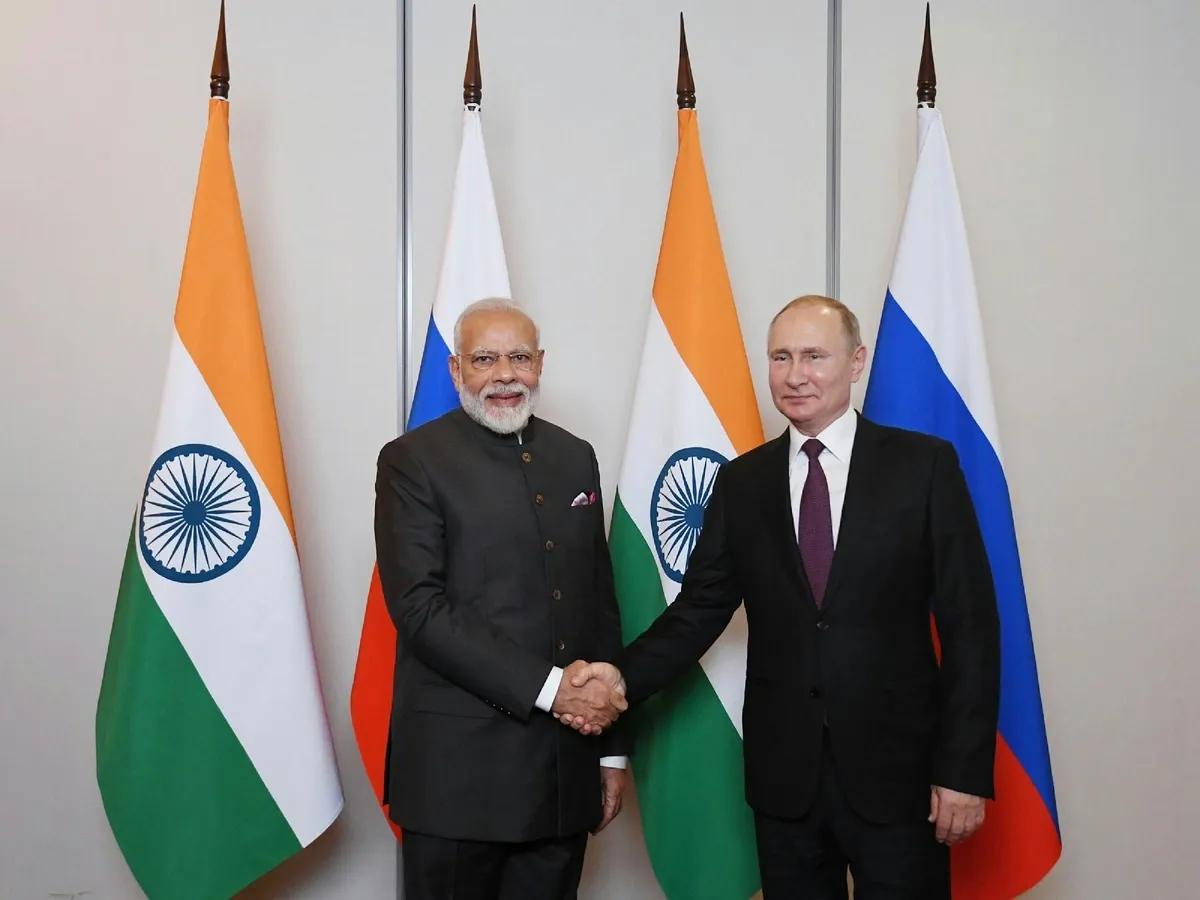
Prime Minister Narendra Modi meeting the President of the Russian Federation, Vladimir Putin, on the sidelines of the BRICS Summit in Brazil on November 13, 2020. (FILE PHOTO, Image credit: Shutterstock)
Russian President Vladimir Putin is set to arrive in New Delhi today for a state visit to India to attend the 23rd India–Russia Annual Summit. According to the official schedule, he is expected to land in the national capital at around 6:30 PM.
News reports say that Putin's visit to India aims to secure energy supplies, stabilise defence deliveries and ensure bilateral trade continues smoothly despite strong Western sanctions.
The bilateral trade between the countries will get a boost during the two-day visit of Russian President.
India and Russia are set to ink a number of agreements to enhance cooperation in an array of areas, including trade and healthcare, during the president's visit.
"It is a high-stakes working visit shaped by the necessity to lock in energy security, stabilise defence supply lines and keep bilateral trade functioning under the weight of Western sanctions," Global Trade Research Initiative (GTRI) founder Ajay Srivastava said.
Why is this meeting significant?
The bilateral trade relations are significant, as India is facing a steep 50% tariff by the Trump administration, and Russia is facing Western sanctions due to the war with Ukraine.
Sectors in focus
India's current engagement with Russia rests on three pillars – energy, defence and diplomacy, Srivastava noted.
Russia has become India's largest crude oil supplier, accounting for 30-35% of total oil imports, turning discounted crude into the foundation of the partnership, Srivastava added.
Defence forms the second pillar as Russia continues to supply and service a majority of India's frontline platforms, fighter jets, submarines, tanks and air defence systems, and talks will continue on maintenance support and future acquisitions, Srivastava said.
The two countries may formalise a new payment framework, using dirham, or integrate Russia's SPFS system with India's RuPay network, Srivastava said further.
After Russia was partially removed from SWIFT, payments shifted to a multi-currency system: the UAE's dirham (60-65 per cent), the rupee (25-30 per cent), and the Chinese yuan (5-10 per cent).
Engineering, pharma, chemicals, and agri hold huge potential
A government official, whom PTI quoted, said that India's prospects for stronger exports to Moscow lie in sectors such as engineering goods, pharmaceuticals, chemicals and agriculture, where there is a great unmet demand in Russia.
Besides these high-value sectors, labour-intensive industries such as textiles, apparel, leather goods, handicrafts, processed foods and light engineering also hold substantial promise given Russia's large consumer base and India's cost competitiveness.
Increasing exports from these sectors would help bridge the widening trade deficit with Russia, which stood at about $59 billion in the last fiscal year.
Electronics and textiles currently have a market share below 1%, yet demand is sizeable, offering space for scale if supported by stronger distribution networks.
India's next phase of export expansion to Russia hinges on a sharper alignment between India's globally competitive sectors and Russia's large, underserved import needs, the government official said.
"The most promising areas that mirror India's rising global strengths are engineering goods, pharmaceuticals, chemicals and agriculture, all of which correspond to substantial unmet demand in the Russian market," the official added.
India's exports to Russia: Current statistics
India currently exports $452 million of products to Russia against their global import demand of about $4 billion. Engineering goods present one of the widest gaps, with India exporting $90 million, while Moscow imports $2.8 billion in this segment, with growing room as Russia diversifies away from China.
Similarly, chemicals and plastics show a similar pattern, with India contributing $135 million to a demand of $4.06 billion.
Pharmaceuticals remain a strategic corridor too, as India supplies $546 million, but Russia's pharma import bill touches $9.76 billion, making generics and APIs (active pharmaceutical ingredients) significant growth levers, the PTI report added.
India's exports to Russia have expanded steadily since the COVID-19 pandemic, marking one of the fastest-growing bilateral trade lanes.
"From $2.56 billion in 2020 to $4.92 billion in 2024, exports grew at a healthy pace even as Russia's overall trade pivoted toward Asia," said a PTI report.
Russia accounts for 1.1% of India's global exports.
Related News


About The Author
Next Story