
Market News
SBI Q4 results: Net profit could see modest growth impacted by lower treasury income; focus on dividend

4 min read | Updated on May 08, 2026, 08:31 IST


SUMMARY
State Bank of India is set to announce its Q4FY26 results on May 8, 2026, with analysts expecting stable earnings despite pressure from lower treasury income. Investors will track loan and deposit growth, margins, and asset quality trends, including gross and net NPAs.
Stock list
SBI's at-the-money (ATM) options for 26 May expiry is at 1040, with both call and put options priced at ₹62. | Image: Shutterstock
India’s largest public sector bank, State Bank of India (SBI), will announce its fourth-quarter results on May 8, 2026. SBI is likely to report stable quarterly earnings with single-digit growth in net profit despite hit in treasury income.
According to experts, SBI’s standalone net profit could rise by 4 to 7% YoY to ₹19,450 and ₹20,050 crore, compared to a net profit of ₹18,643 crore in Q4FY25. Meanwhile, net profit could remain flat on a sequential basis as SBI posted net profit of ₹21,028 crore in the previous quarter mainly because of lower treasury income.
Net interest income (NII) is expected to rise 7% to 9% YoY to a range of ₹46,150 to ₹46,950 crore on back of healthy growth in loan book. SBI reported an NII of ₹42,775 in Q4FY25 and ₹45,190 crore in previous quarter.
Meanwhile, net interest margin (NIM) is likely to decline by 8 to 9 basis points to 2.7% because of an increase in the cost of funds and the recent repo rate cut by the RBI.
During the quarterly result announcement, investors will track key performance metrics, including loan growth across retail and corporate segments, deposit growth, net interest margin, gross and net non-performing assets (NPAs).
Ahead of the Q4 result announcement, SBI shares closed 0.2% lower at ₹1,092. So far this year, SBI shares have delivered 11.1% return to its shareholders.
Technical outlook
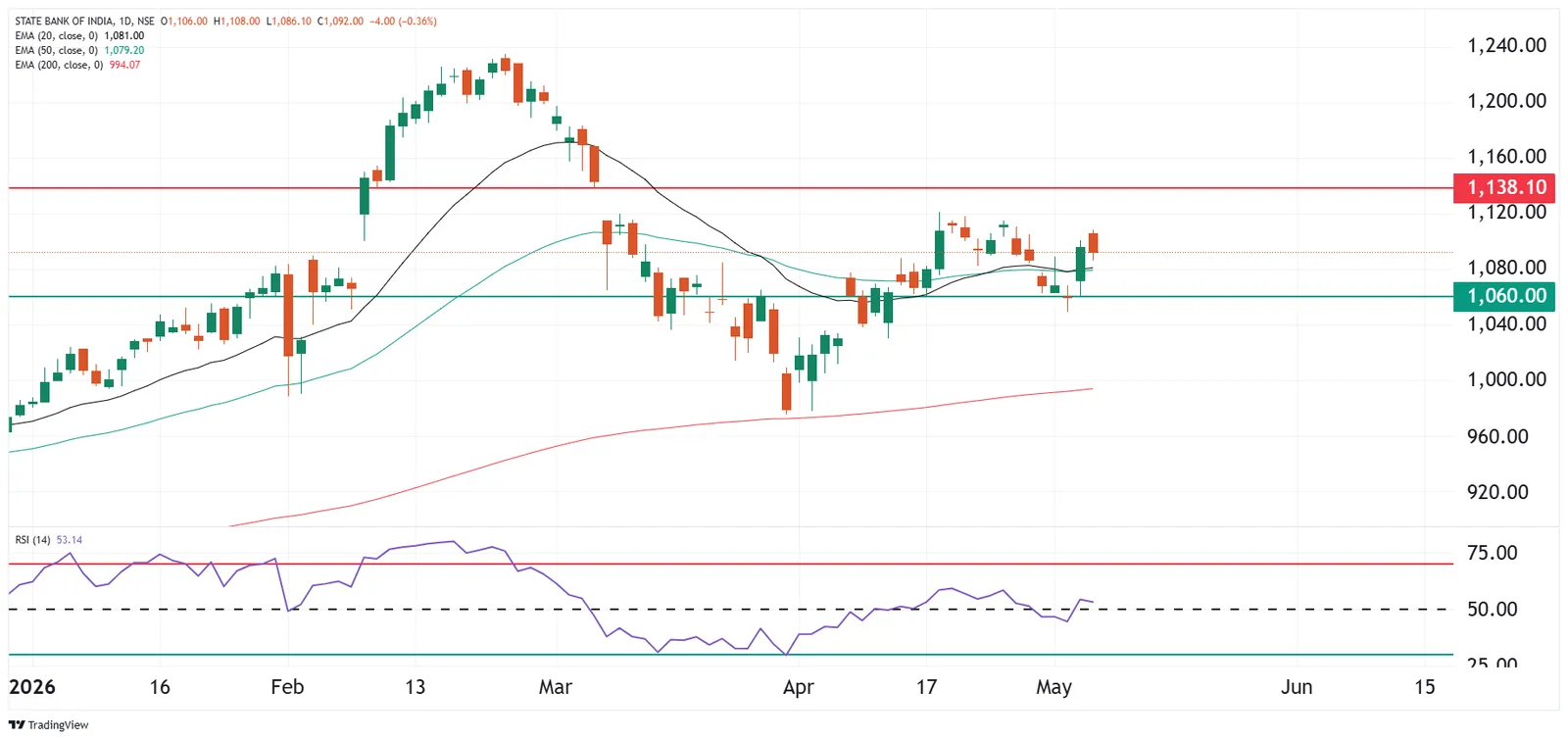
State Bank of India is showing a positive structure after reclaiming its short-term moving averages, with the stock closing near ₹1,092 and trading above the 20-day EMA around ₹1,081 and 50-day EMA around ₹1,079. The immediate support is placed near ₹1,060, which has acted as a key demand zone in recent sessions, while the 200-day EMA near ₹994 remains the broader support. On the upside, ₹1,138 is the key resistance level to watch. A decisive close above these zones could provide further clues.
Options outlook
SBI's at-the-money (ATM) options for 26 May expiry is at 1040, with both call and put options priced at ₹62. This implies a potential price swing of approximately ±5.7% based on the 7 May closing price.
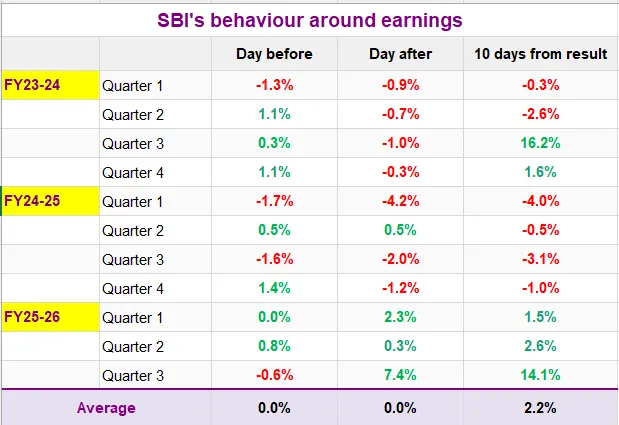
For further understanding, let’s take a look at the historical price behaviour of SBI around its earnings announcement.
Options strategy for State Bank of India
The options data for SBI's May 26 expiry shows a potential price movement of ±5.7%, providing strategic opportunities for traders based on their volatility expectations.
- Expectation of increased volatility: Traders who expect that the volatility in SBI may rise can consider a Long Straddle strategy. Strategy involves buying both an ATM call and an ATM put option with the same strike price and expiry date. This approach will benefit if the price of SBI moves significantly beyond the range of ±5.7% in either direction.
- Expectation of lower volatility: Traders who expect volatility will remain low, a Short Straddle may be more suitable. This strategy involves selling both an ATM call and an ATM put option with the same strike price and expiry, and profiting if the price of SBI stays within ±5.7%.
- Traders expecting further bullish momentum from above ₹1,138, can consider a bull call spread. This strategy involves buying a call option and simultaneously selling another call option with a higher strike price of the same expiry. This approach lowers the initial cost but also limits potential profits.
Disclaimer:
Derivatives trading must be done only by traders who fully understand the risks associated with them and strictly apply risk mechanisms like stop losses. The information is only for educational purposes. We do not recommend any particular stock, securities or strategies for trading. The securities mentioned in this article are purely illustrative and not recommendations. Investors are advised to do their own research before investing.
About The Author
Next Story

