Market News
Infosys Q4 results: Revenue and net profit could decline QoQ; key focus on dividend and FY27 guidance
.png)
4 min read | Updated on April 23, 2026, 08:45 IST


SUMMARY
Infosys will announce its March quarter results on April 23 amid a weak IT sector backdrop, with the NIFTY IT index down nearly 20% this year. The company is expected to report modest performance as revenue is likely to grow by 1 to 2% sequentially. Investors will closely track FY27 guidance, management commentary on discretionary spending, and the final dividend announcement.
Stock list
Infosys FY27 guidance and final dividend will be in focus today
IT major Infosys will announce its March quarter earnings on Thursday, April 23. Infosys earnings come amid a significant drop in IT stocks as the NIFTY IT index is down nearly 20% year-to-date. Experts believe Infosys could report low single-digit growth in revenue on a sequential basis, while net profit could decline.
Infosys' net profit may range between ₹7,490 to ₹7,510 crore, up 4 to 5% YoY, but could decline 1 to 3% compared to the previous quarter. The company reported a net profit of ₹7,625 crore in the previous quarter and ₹7,218 crore in the same quarter last year. Modest growth is mostly due to a slowdown in global IT spending and the impact of AI on pricing and demand.
As per experts, Infosys Q4 revenue could increase by 1 to 2% on a sequential basis to ₹45,950 to ₹46,550 crore. The company registered revenues of ₹45,479 crore in Q3FY26 and ₹40,925 crore in the March quarter of FY25. On a yearly basis, revenue could increase by 13 to 14%, aided by steady deal momentum.
Infosys’ EBIT margin is expected to improve marginally 8 to 10 bps in the range of 21.1% to 21.4%, aided by rupee depreciation, while total contract value (TCV) is likely to be around $2 to $3.5 billion during the quarter.
Investors will closely track FY27 revenue guidance from the management, new deal wins during the quarter, and management’s commentary on the IT discretionary spending will also be closely watched. Infosys will also announce the final dividend for FY26.
Ahead of the Q4 result announcement, Infosys shares closed 3.4% lower at ₹1,268 on April 22. Infosys stock is down over 21% so far this year amid market volatility.
Technical outlook
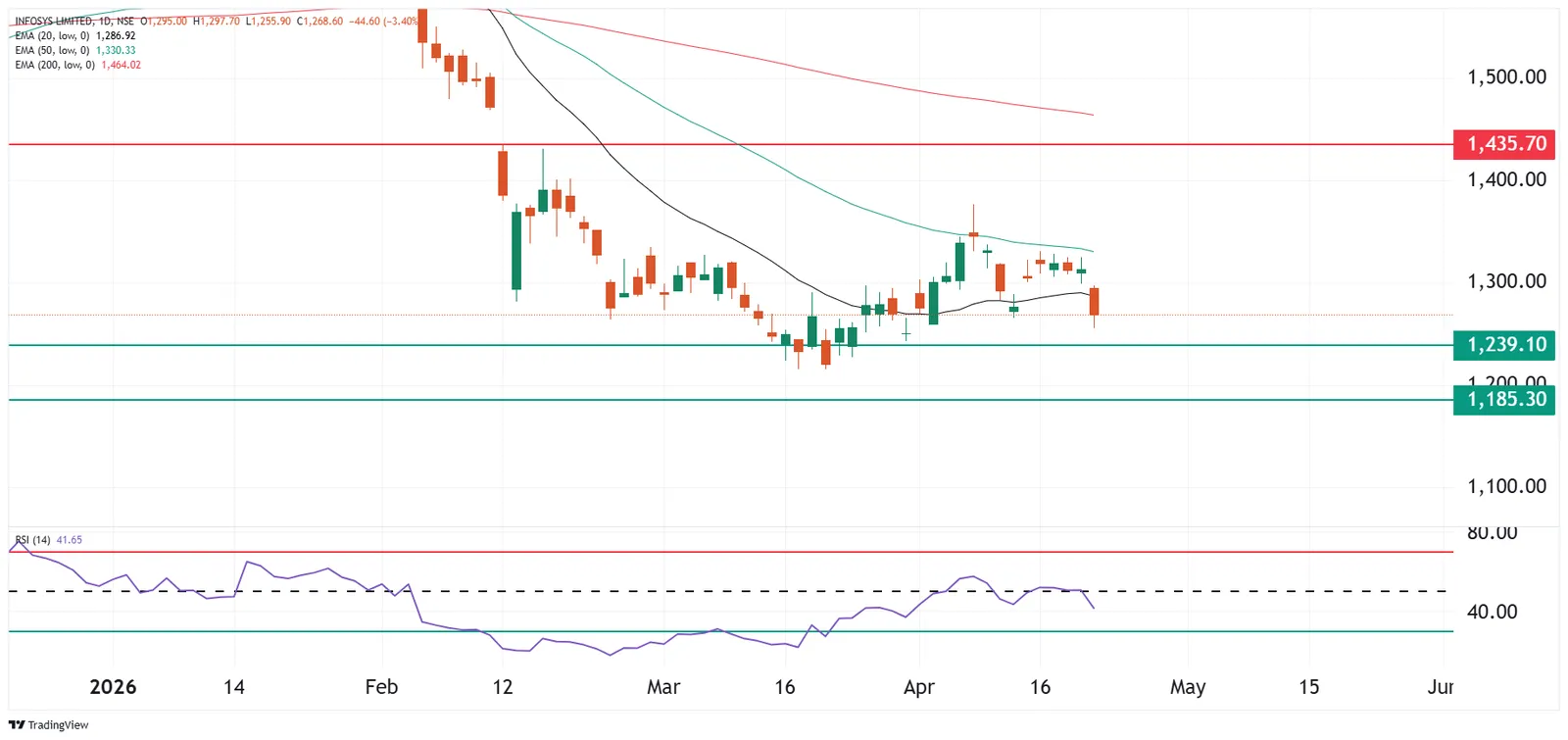
Infosys remains in a weak structure, trading below its key moving averages with the 20 EMA acting as immediate resistance and the broader trend still tilted down as long as it stays below the 50 EMA. After a brief pullback rally in April, the stock has started to lose momentum again, with rejection near the 1,330–1,350 zone.
Meanwhile, the RSI has slipped back towards the mid-40s, indicating fading strength without being oversold yet. On the downside, 1,239 remains a crucial support; a break below this could open the path towards 1,185. On the upside, only a sustained move above 1,330 would signal any meaningful recovery.
Options outlook
Options positioning for Infosys’ 28 April expiry highlights a strong call build-up at 1,300 strike, suggesting a resistance around this zone. Meanwhile, 1,280 strike also witnessed a significant build-up of call and put base, indicating consolidation around this zone.
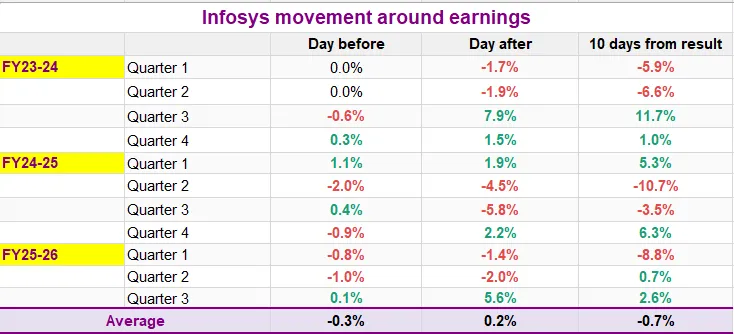
The at-the-money strike stands at 1,270, with a combined straddle premium of about ₹56, implying an expected move of roughly ±4.4% into expiry. To put this into perspective, let’s look at how Infosys has historically reacted to its quarterly earnings over the past two years.
Options strategy and approach
Ahead of the 28 April expiry, the options market is pricing in a move of roughly ±4.4% in Infosys, giving traders a clear range to plan their strategies.
If you expect a sharp move beyond this implied range, a long straddle could be a suitable approach—buying both the at-the-money call and put to benefit from a decisive breakout in either direction.
On the other hand, if you expect the stock to remain within this band, a short straddle may work better, as it allows traders to capitalise on time decay and a drop in volatility, provided the price action stays contained into expiry.
Disclaimer:
Derivatives trading must be done only by traders who fully understand the risks associated with them and strictly apply risk mechanisms like stop losses. The information is only for educational purposes. We do not recommend any particular stock, securities or strategies for trading. The stock names mentioned in this article are purely for showing how to do analysis. Take your own decision before investing.
About The Author
Next Story