Market News
ICICI Bank Q1 preview: Earnings outlook, NIM trends, technical outlook and options strategy
.png)
3 min read | Updated on July 18, 2025, 18:08 IST


SUMMARY
Ahead of its first quarter earnings, investors will closely watch the ICICI Bank’s loan and deposit growth, margin trends, and asset quality, as shares remain in a consolidation phase between support at ₹1,400 and resistance at ₹1,470.
Stock list
ICICI Bank will report its Q1FY26 earnings on Saturday, 19 July. Image source: Shutterstock.
Private sector lender ICICI Bank is set to unveil its results for the June quarter on Saturday, 19 July 2025. The bank is expected to report subdued results, primarily due to margin pressure following the repricing of loans after the Reserve Bank of India's (RBI) recent repo rate cuts.
According to experts, the bank might report a 7–9% year-on-year rise in net profit, reaching ₹12,050–12,250 crore. The private lender registered a standalone net profit of ₹11,696 crore in the same quarter last year and ₹13,502 crore in the previous quarter.
Net interest income (NII) is expected to rise by 7–9% year on year, reaching ₹20,950–21,210 crore. ICICI Bank reported an NII of ₹19,552 crore in the June quarter of FY25. Meanwhile, the net interest margin (NIM) could fall by 30–37 basis points year on year to below 4% due to the recent cut in the repo rate by the RBI.
During the quarterly result announcement, investors will closely monitor key performance metrics, including loan and deposit growth, net interest margin guidance and gross and net non-performing assets (NPAs).
Ahead of the Q1 results announcement, ICICI Bank shares ended Thursday’s session at ₹1,418, down 0.5% . So far this year, it has delivered a 10.6% return to investors.
Technical view
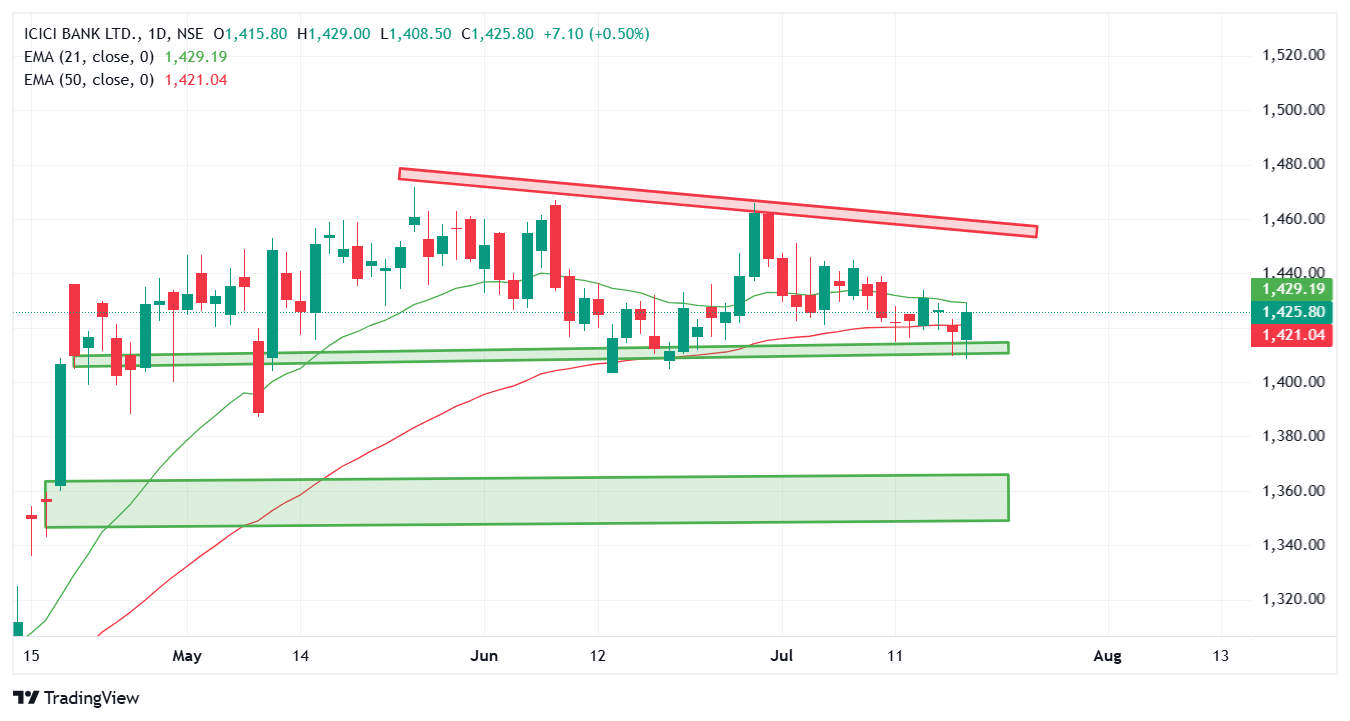
Technically, ICICI Bank shares have been in a consolidation phase for over two months. The stock is facing resistance near ₹1,470, while key support lies around ₹1,400, which is aligned with the swing lows from May and June. Traders should therefore monitor this range closely. A decisive close above or below this range will provide a clear short-term outlook.
Options outlook
Open interest (OI) data for the 31 July expiry shows a notable buildup of call options at the 1,500 and 1,450 strikes, indicating it as a key resistance level for ICICI Bank. Additionally, a significant call and put open interest base was observed at the 1,420 strike, indicating consolidation around this zone.
The at-the-money (ATM) strike of 1,420 has call and put options each priced at ₹45, suggesting the market is expecting a ±3.2% move, based on the stock’s closing price on 17 July.
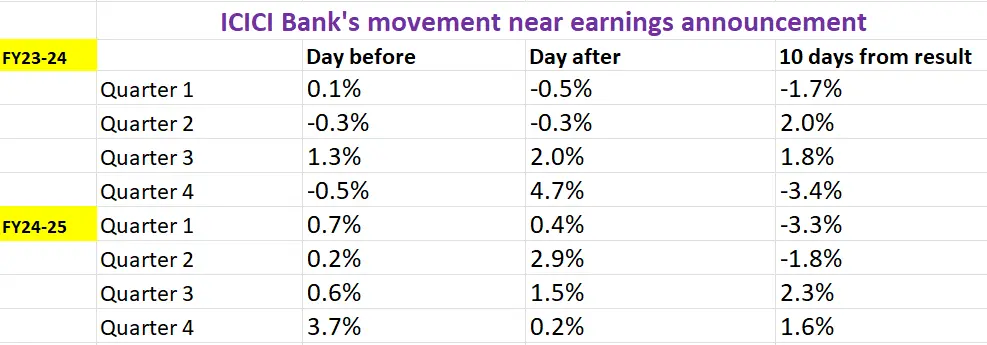
To trade this setup more effectively, it's important to review how ICICI Bank has historically reacted to past earnings announcements.
Options strategy for ICICI Bank
ICICI Bank’s options data for the 31 July expiry implies a potential price swing of ±3.2% in either direction, offering strategic opportunities based on volatility expectations.
For those anticipating increase in volatility, a Long Straddle might be a suitable strategy. This involves buying an ATM call and put option of the same strike price and expiry. This strategy profits if the price of the ICICI Bank moves significantly in either direction beyond the ±3.2% range.
However, if you believe volatility will be subdued, a Short Straddle might be a more appropriate strategy. This entails selling both ATM call and put options of same strike and expiry, profiting if the ICICI Bank stays within the ±3.2% range.
About The Author
Next Story