Market News
HDFC Bank Q2 results: Net profit likely to remain flat despite strong loan growth; key focus on NIM and leadership transition

5 min read | Updated on October 16, 2026, 12:08 IST


SUMMARY
HDFC Bank will announce its Q2FY27 results on Saturday, October 17. It will be the bank’s first results under new MD and CEO Anup Bagchi. Experts expect single-digit growth in net profit and net interest income, with margins likely to stay flat.
Stock list
The options market expects HDFC Bank to move about ±3.3% by the October 27 expiry in the expected range of ₹704 to ₹752.
India’s largest private sector lender, HDFC Bank, will announce its September quarter results on Saturday, October 17, 2026. Ahead of the results, the bank released its business update for the second quarter of FY27. This will be the bank’s first earnings announcement since Anup Bagchi was appointed as its new Managing Director and Chief Executive Officer.
HDFC Bank Q2FY27 business update
HDFC Bank reported a 16.3% YoY increase in gross advances to ₹32.19 lakh crore in the September quarter. The bank’s deposits grew 16.8% YoY to ₹31.66 lakh crore. Its current account and savings account (CASA) deposits rose 10.7% YoY to ₹9.71 lakh crore.
What to expect from HDFC Bank’s Q2 results
As per experts, HDFC Bank could report muted earnings, with single-digit growth in net profit and net interest income (NII). HDFC Bank could report 1% to 3% jump in net profit to ₹18,850 to ₹18,930 crore. The private lender reported a standalone net profit of ₹18,641 crore in Q2FY26 and ₹19,060 crore in the previous quarter.
HDFC Bank’s NII is likely to increase by 7% to 9% YoY in the range of ₹34,310 to ₹34,410 crore. The bank reported an NII of ₹33,535 crore in the previous quarter and ₹31,550 crore in Q2FY26. Net interest margin is likely to remain flat sequentially. Net interest margin (NIM) likely to remain weak during the quarter.
During the results announcement, investors will look for management commentary on credit and deposit growth and the margin outlook. They will also track key performance indicators such as net interest margin and gross and net non-performing assets (NPAs).
Ahead of the Q2 results, HDFC Bank shares are trading 0.5% higher at ₹729.3 on Friday, October 16. So far this year, HDFC Bank shares are down over 26%, amid headwinds such as post-merger margin pressure, corporate governance concerns and leadership changes.
HDFC Bank share price: technical outlook ahead of Q2 results
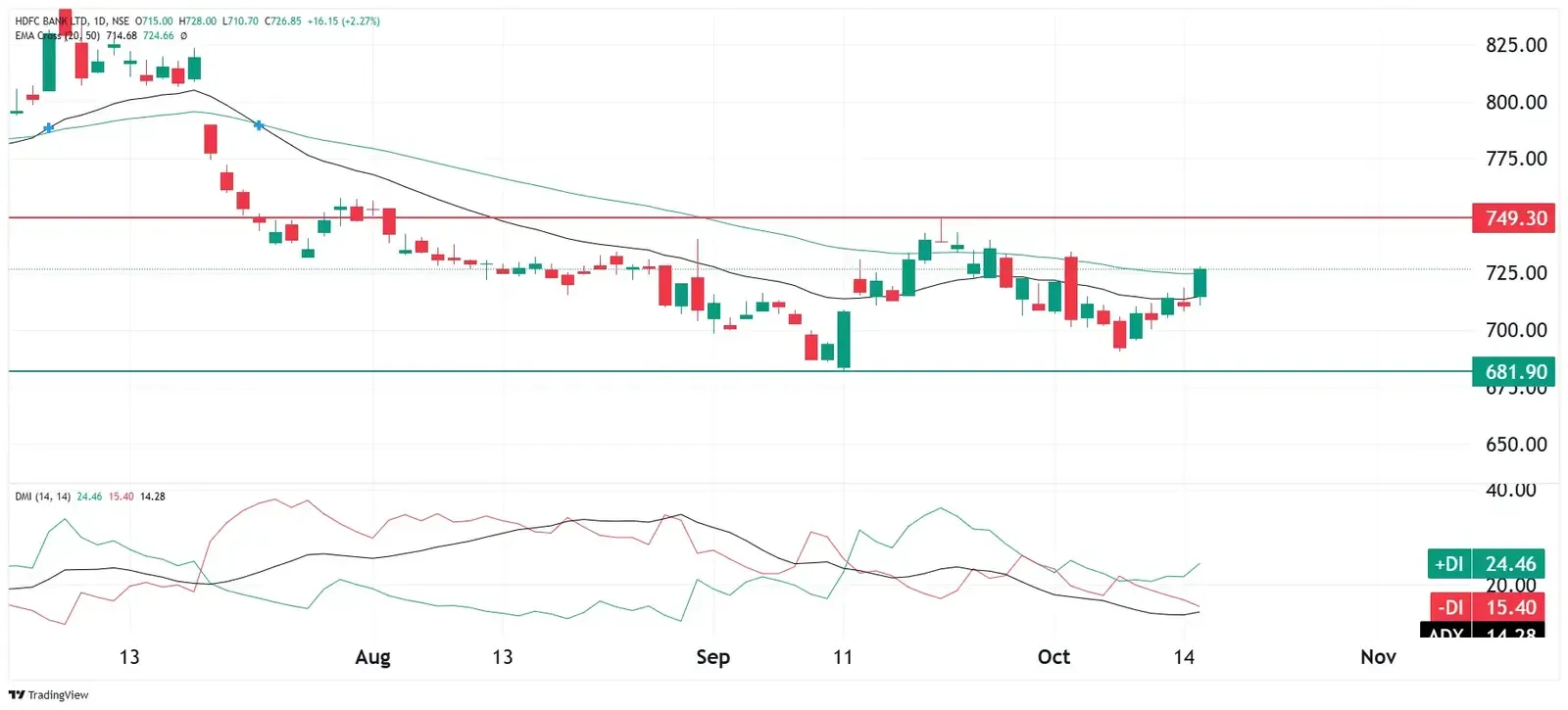
HDFC Bank is trying to recover after a long fall. The stock slid about 17%, from around ₹825 in mid-July to a low of ₹681 on September 10. Since then, it has built a base. Its most recent dip in early October stopped near ₹692, well above the September low. This higher low is the first sign that selling pressure is easing.
On Thursday, the stock rose 2.3% to close at ₹726. That took it above both its 20-day EMA and 50-day EMA for the first time since late September. The 20-day EMA is still below the 50-day EMA, where it has been since late July, but the 50-day EMA has stopped falling and is now flattening. This suggests the downtrend is losing strength. However, the ADX is low at 14.3, which shows the stock has not yet started a strong new trend.
HDFC Bank options: Expected move ahead of Q2 results
The options market expects HDFC Bank to move about ±3.3% by the October 27 expiry. That puts the expected range at roughly ₹704 to ₹752. This range lines up closely with the chart. The upper end, near ₹752, is just above the ₹749 resistance that has capped the stock since August. The lower end, near ₹704, sits below the EMA support at ₹715 to ₹725 but above the October low of ₹692.
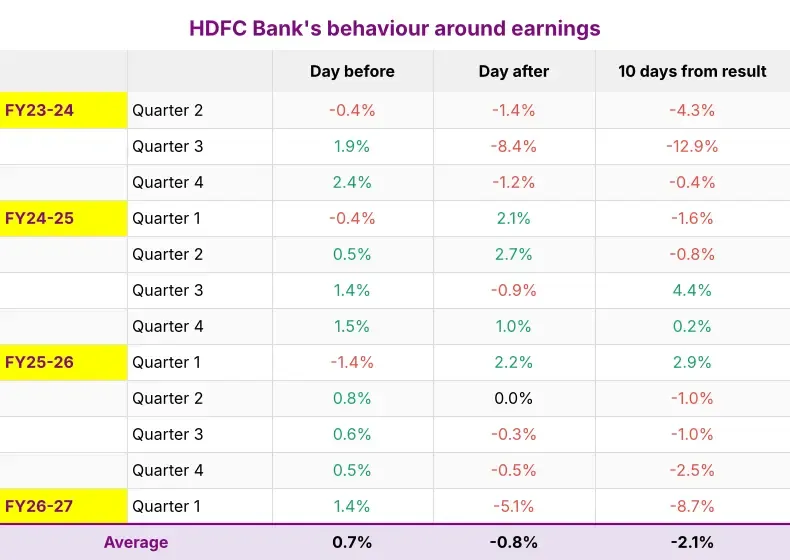
HDFC Bank usually reacts calmly to its results. In 10 of the last 12 quarters, the stock moved less than 3% on the day after the results. The two exceptions were large falls: 8.4% after the Q3FY24 results and 5.1% after the Q1FY27 results. The bigger moves have tended to come over the following days, and mostly on the downside. Over 10 days, the stock moved more than 3.3% in four of the last 12 quarters.
Options strategy for HDFC Bank Q2 results
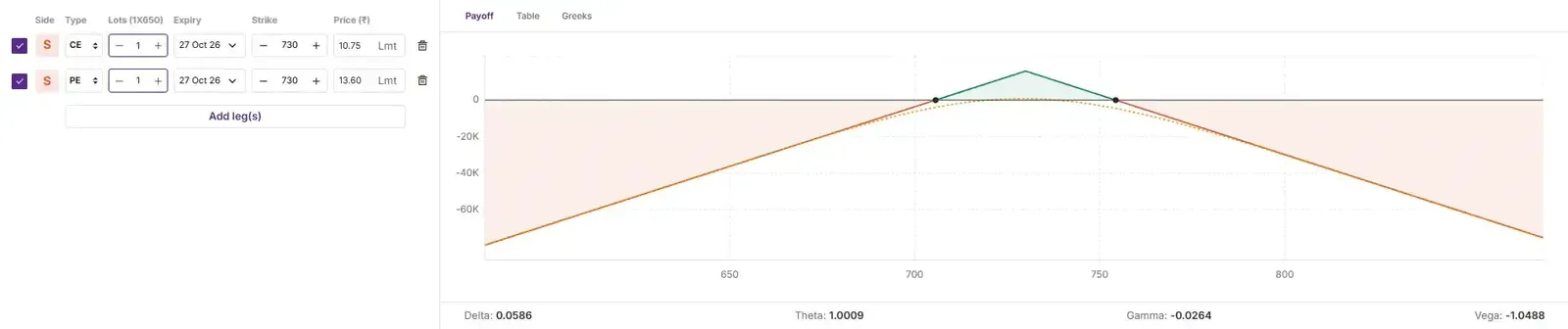
If you expect the stock to stay in a range: A short straddle, selling the 730 call and put, could be considered. The stock has traded between ₹682 and ₹749 for over a month, and the expected range sits mostly inside that band. The strategy makes profit if HDFC Bank stays between roughly ₹706 and ₹754 until expiry. The stock fell 5.1% the day after its last results, so the risk of a sharp move cannot be ruled out. The premium collected is small, so strict stop-losses are important, and traders may prefer to exit soon after volatility falls rather than hold until expiry.
If you expect a large move after the results: A long straddle, buying the 730 call and put, could be considered. At about ₹24, the cost is low. A clear break above ₹749 or below ₹692 after the results could carry the stock beyond the expected range. The strategy makes profit if HDFC Bank moves below ₹706 or above ₹754 by expiry. However, option premiums usually fall after the results, so the stock needs to move quickly for this trade to work.

If you want to trade a move in one direction: Traders can wait for the stock to break out of its range before taking a position. If HDFC Bank closes above ₹749, a bull put spread could be considered. If it slips back below the ₹715 to ₹725 support zone, a bear call spread may be more suitable. Both spreads limit the risk and cost less than buying options outright.
About The Author
Next Story