
Business News
Trump, Iran's Pezeshkian sign 14-point framework to reopen Hormuz, pursue sanctions relief
5 min read | Updated on June 18, 2026, 09:12 IST


SUMMARY
The 14-point framework calls for an immediate halt to military operations, the reopening of the Strait of Hormuz to commercial shipping, negotiations on sanctions relief and Iran's nuclear programme, and a proposed $300 billion reconstruction and economic development plan.
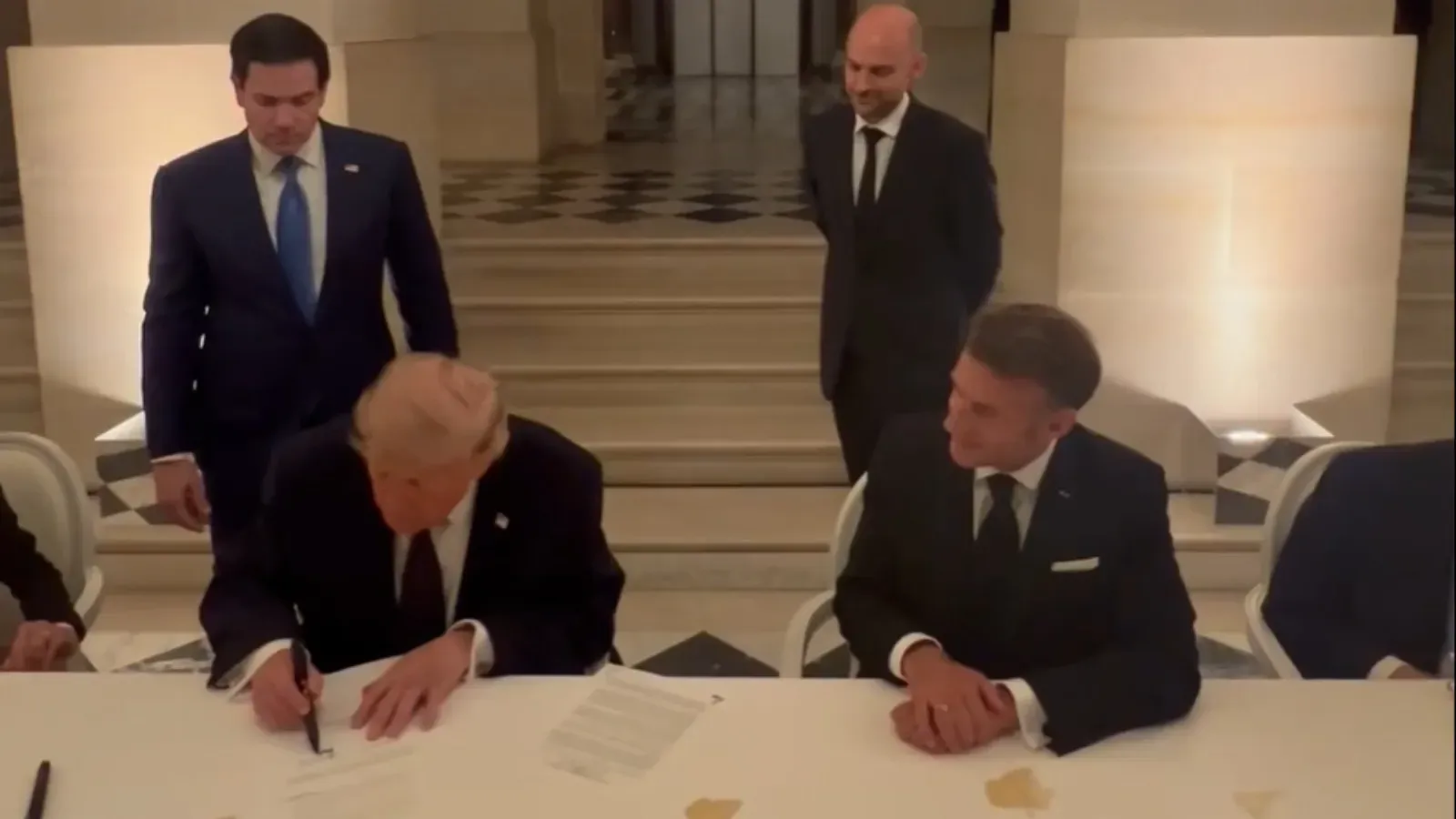
US President Donald Trump signed a copy of the US-Iran agreement on ending the conflict as he departed the Palace of Versailles on Wednesday night.
The memorandum of understanding aims to end hostilities between the two countries, reopen the Strait of Hormuz to commercial shipping and launch negotiations toward an agreement that would include sanctions relief and restrictions on Tehran's nuclear program.
Trump signed the document shortly before attending a dinner hosted by French President Emmanuel Macron at the Palace of Versailles outside Paris.
Video of the signing, posted on social media by White House Deputy Chief of Staff Dan Scavino and later shared by Macron, showed Secretary of State Marco Rubio standing behind Trump as he signed the agreement.
"It's signed," Trump told reporters as he departed Versailles. "Signed it in Versailles, I just signed it."
"This was not easy," Trump said while signing the document, according to the video shared by the French president.
Iranian President Masoud Pezeshkian also signed the agreement, according to photographs published by Iran's state-run IRNA news agency.
The images showed Pezeshkian holding a Farsi-language version of the document bearing what appeared to be both leaders' signatures.
Macron welcomed the agreement, saying it "paves the way for lasting peace" and would allow the reopening of the Strait of Hormuz.
"It is an important step in the right direction for our compatriots that will soon enable a decrease in energy prices," Macron wrote on social media.
14-point framework for peace and negotiations
The memorandum outlines a 14-point framework intended to expand an existing ceasefire and establish conditions for a comprehensive agreement within 60 days.
Under the terms of the document, the United States and Iran agreed to immediately and permanently halt military operations against one another and commit to respecting each other's sovereignty and territorial integrity.
The agreement also calls for negotiations on a final deal that could be extended beyond the initial 60-day deadline by mutual consent.
Strait of Hormuz reopening and sanctions relief
One of the most consequential provisions would require the United States to begin removing the naval blockade of Iran and to end it completely within 30 days.
Iran, in return, would facilitate the safe passage of commercial vessels through the Strait of Hormuz and work to restore shipping traffic to pre-war levels.
The memorandum also includes sweeping economic commitments.
The United States agreed to pursue the termination of sanctions against Iran and to issue waivers allowing Iranian oil exports and related financial transactions.
The document further envisions a reconstruction and economic development plan worth at least $300 billion, to be developed with regional partners. The implementation details will be finalised during negotiations on the final accord.
Nuclear commitments and asset access
Iran reaffirmed that it would not procure or develop nuclear weapons.
Both sides agreed to negotiate arrangements for Iran's stockpile of enriched nuclear material under the supervision of the International Atomic Energy Agency and to discuss future enrichment activities as part of a final agreement.
The memorandum states that frozen or restricted Iranian assets would be made available for use under procedures to be negotiated by both governments.
The agreement also provides for the establishment of a joint monitoring mechanism and says that any final accord would ultimately be endorsed through a binding resolution of the United Nations Security Council.
Mohammad Bagher Ghalibaf, Iran's parliament speaker and a key negotiator, warned that Tehran's compliance would depend on Washington fulfilling its commitments.
"If the United States does not honor its commitments, there is no way Iran will honor its own commitments," Ghalibaf said, according to media affiliated with Iran's Islamic Revolutionary Guard Corps.
Pakistan, which played a mediation role in the negotiations along with Qatar, endorsed the agreement.
Prime Minister Shehbaz Sharif said the memorandum had been signed by both presidents and endorsed by him as mediator.
"The signing of this agreement at the highest level of the respective governments demonstrates the commitment of both sides to a diplomatic resolution of the conflict," Sharif said.
Sharif said Iran would immediately reopen the Strait of Hormuz while the United States would begin lifting naval blockade.
He said that Pakistan and Qatar would host an official ceremony in Switzerland on Friday to mark the agreement and begin technical-level discussions on implementation.
Signing moved ahead of schedule
The memorandum had originally been scheduled for signing on June 19 in Switzerland.
The MoU was scheduled to be signed on June 19 in Switzerland but the timetable was moved ahead to open the strait of Hormuz sooner than Friday.
Another factor could be the political pressure on the White House to release the text of the MoU, reported Axios.
According to the sources cited by Axios, it was Iran that demanded the text not be published until the formal signing, and denied the White House was responding to political pressure.
About The Author
Next Story

