Business News
Piyush Goyal meets US counterpart Lutnick, discusses trade amid tariff uncertainty
.png)
3 min read | Updated on February 26, 2026, 15:26 IST


SUMMARY
The discussions come amid shifting trade dynamics following a Supreme Court of the United States ruling that blocked former US President Donald Trump from imposing sweeping reciprocal tariffs without congressional approval.
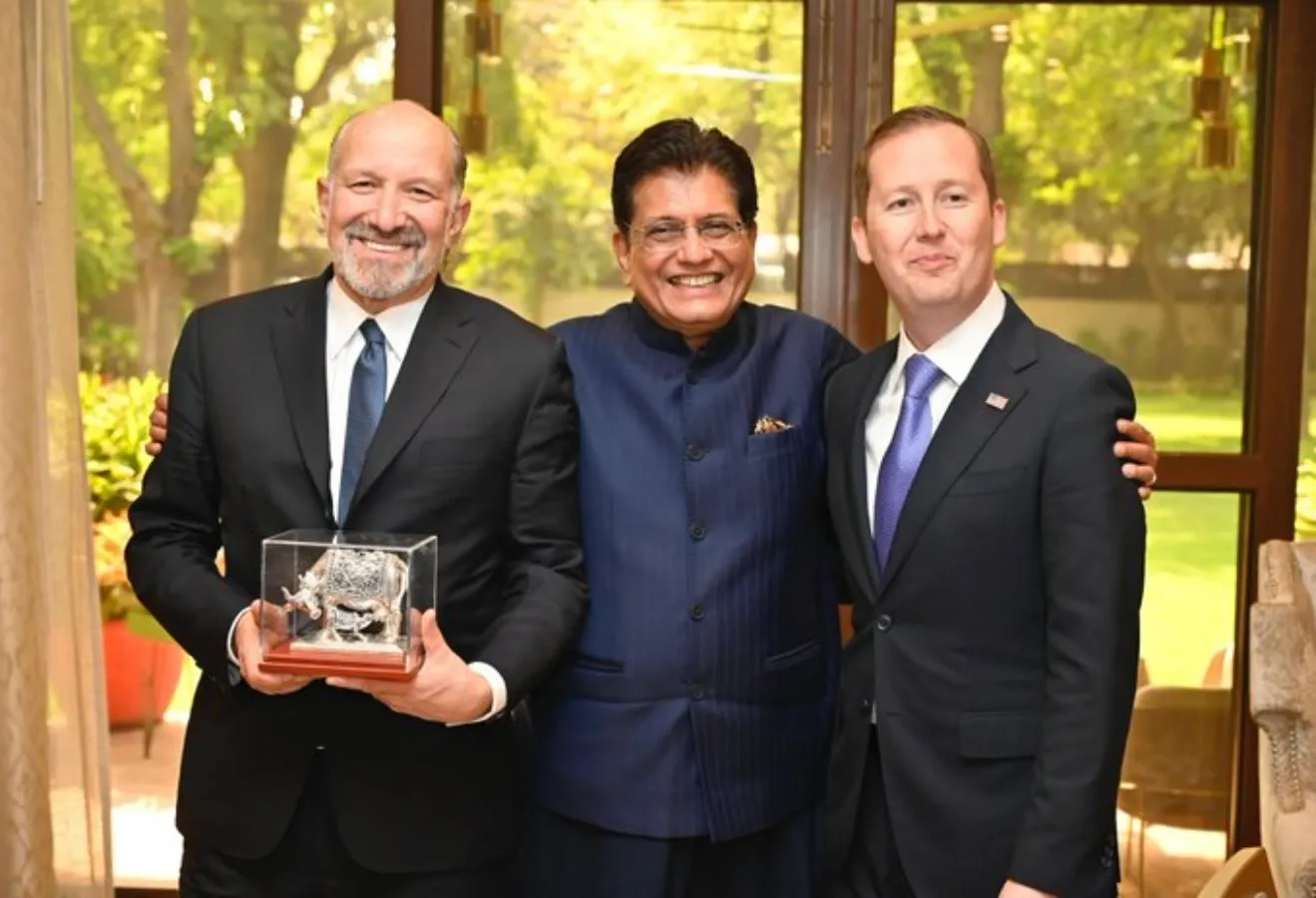
Union Minister of Commerce & Industry Piyush Goyal with US Secretary of Commerce Howard Lutnick and US Ambassador to India Sergio Gor.
Commerce and Industry Minister Piyush Goyal on Thursday held a meeting with US Secretary of Commerce Howard Lutnick and US Ambassador to India Sergio Gor, during which they discussed ways to further expand the trade and economic partnership between the two countries.
“Hosted US Secretary of Commerce @HowardLutnick & @USAmbIndia Sergio Gor. Engaged in very fruitful discussions to expand our trade and economic partnership,” Goyal posted on X.
The meeting assumes significance as India and the United States are in the process of finalising the legal text for the first phase of a proposed bilateral trade agreement (BTA).
The two countries had recently postponed a scheduled meeting of their chief negotiators in Washington to conclude the interim trade pact, amid uncertainty following a ruling by the US Supreme Court against President Donald Trump’s sweeping tariff measures.
In a 6–3 verdict, the top US court held that Trump had violated federal law by unilaterally imposing “reciprocal” tariffs without clear authorisation from Congress.
Chief Justice John Roberts said the president had asserted “the extraordinary power to unilaterally impose tariffs of unlimited amount, duration, and scope” and must identify explicit congressional approval to exercise such authority.
The court observed that the emergency powers statute relied upon by the administration “falls short”.
Justices Samuel Alito, Clarence Thomas and Brett Kavanaugh dissented.
Kavanaugh noted that the ruling did not clarify how the government would return billions of dollars already collected from importers, cautioning that the process could become a “mess”.
Following the ruling, the US administration imposed a 10% tariff on imports from all countries for 150 days.
In a proclamation titled “Imposing a Temporary Import Surcharge to Address Fundamental International Payments Problems”, Trump said he was invoking Section 122 of the Trade Act of 1974 to levy a temporary 10% ad valorem surcharge for 150 days.
A White House fact sheet stated that certain goods would be exempted due to US economic needs, including some critical minerals, energy products, select agricultural items such as beef and oranges, pharmaceuticals, certain electronics, and some categories of vehicles and aerospace products.
The Commerce Ministry said it was examining the implications of the developments.
“We have noted the US Supreme Court judgement on tariffs yesterday (Friday). US President Donald Trump has also addressed a press conference in this regard. Some steps have been announced by the US administration. We are studying all these developments for their implications,” it said.
The US had imposed a 25% reciprocal tariff on India in August 2025, followed by an additional 25% levy linked to India’s purchases of Russian crude oil, taking the total duties to 50%.
Earlier this month, the two sides had agreed in principle to an interim arrangement under which Washington would reduce tariffs to 18%, and the punitive 25% surcharge was removed.
By signing up you agree to Upstox’s Terms & Conditions

About The Author
Next Story