
Business News
NITI Aayog identifies 4 key sectors that could position India as global manufacturing hub
.png)
4 min read | Updated on August 14, 2026, 14:34 IST


SUMMARY
The assessment considered factors such as market potential, infrastructure, policy support, raw materials, technology readiness, employment and India's integration into global value chains.
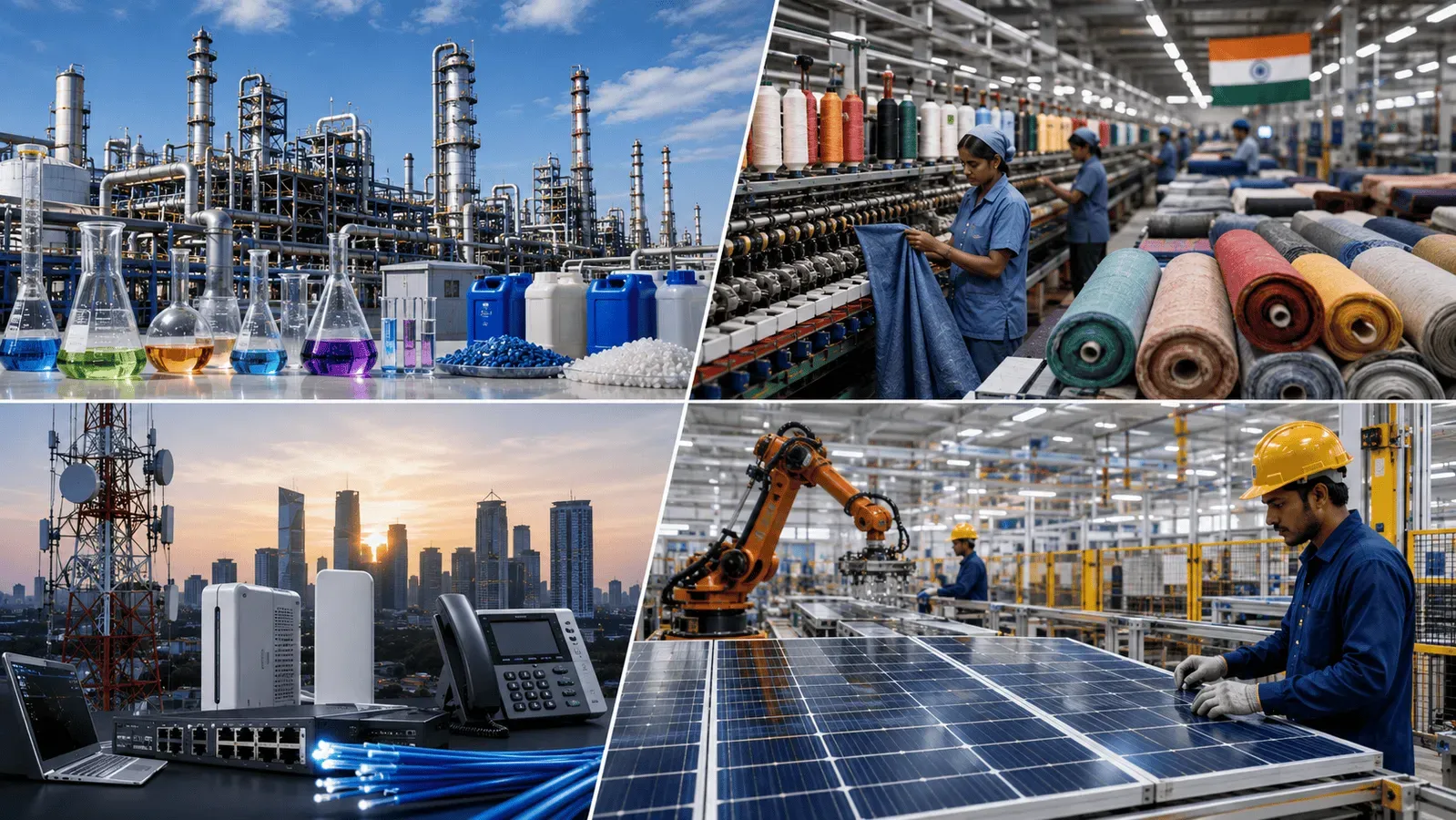
NITI Aayog has identified four high-potential sectors that can help India strengthen its position as a global manufacturing hub.
NITI Aayog has identified chemicals, textiles, telecom and networking equipment, and solar photovoltaic manufacturing as four high-potential sectors that can help India strengthen its position as a global manufacturing hub.
In a report titled “Key Sectors to Position India as a Global Manufacturing Hub”, the government think tank has examined the sectors against factors including market potential, infrastructure readiness, policy support, availability of raw materials, technology readiness, employment potential and India's position in global value chains.
The report seeks to identify areas where targeted interventions can boost domestic capabilities, increase value addition and accelerate export-oriented manufacturing growth.
The assessment was carried out in four phases: shortlisting sectors based on their domestic and global growth prospects; detailed assessment of their market potential and competitiveness; benchmarking international best practices; and formulation of sector-specific recommendations.
On chemicals, the report said India has scope to increase domestic value addition by expanding downstream production and making better use of feedstock.
The chemicals industry is mainly driven by petrochemicals and organic chemicals, specialty chemicals and inorganic chemicals, with petrochemicals and organic chemicals forming the largest segment.
“Promoting domestic manufacturing, investments in competitiveness, and strategic use of FTAs can help reduce import dependence, strengthen downstream capabilities, and support sustainable industry growth,” NITI Aayog said.
The textile and apparel sector, meanwhile, contributes about 2% to India's GDP, 11% to manufacturing gross value added and 9% of merchandise exports, according to the report.
The sector provides livelihoods to more than 45 million people and is the country's second-largest employer after agriculture.
India exported textile products worth $37.7 billion in fiscal 2025 and accounted for 4.1% of global textile and apparel exports, making it the world's sixth-largest textile exporter.
The report said India can improve competitiveness by ensuring raw material availability, scaling up manufacturing through infrastructure support and expanding market access through deeper trade integration.
It also called for greater skilling, technology adoption and productivity, while identifying technical textiles, man-made fibre-based products, sustainable textiles and premium Indian weaves as areas with potential for higher value addition.
NITI Aayog noted that India is the world's second-largest telecommunications market, with more than 1.2 billion subscribers, around 85% telecom penetration and nearly 75% internet usage.
The report cited the National Telecom Policy 2025, which targets doubling the sector's contribution to GDP and telecom product and service exports by 2030, besides creating one million new jobs and raising investment and R&D spending.
It said India's competitiveness in telecom and electronics can be strengthened by deeper localisation and development of domestic component manufacturing.
“Key priorities include promoting joint ventures and technology transfer, developing integrated industrial clusters, expanding high-potential export segments, and strengthening testing, certification and skill development to support scale, innovation and productivity,” the report said.
The solar photovoltaic sector also offers considerable scope for expanding manufacturing, according to the report.
India had 106 GW of installed solar capacity as of March 2025 and needs to add about 174 GW to meet its 2030 target of 280 GW.
The domestic photovoltaic market, estimated at ₹32,400 crore or USD 3.7 billion, is projected to grow at 17-20% annually between fiscal 2023 and fiscal 2030, supported by utility-scale and rooftop solar, open-access projects and demand linked to green hydrogen.
NITI Aayog said India can deepen domestic value addition in solar manufacturing by developing upstream capabilities and reducing import dependence.
It recommended technology partnerships and joint ventures, greater R&D, performance-linked support, integrated clean-tech clusters and industry-led skilling.
The report said the identified sectors can benefit from interventions tailored to their specific challenges.
“Industry and Government can collaborate to enhance India’s manufacturing prowess through specific interventions customized to overcome the existing challenges,” NITI Aayog said.
A coordinated effort, it added, can help India move to a higher growth trajectory in manufacturing and advance the broader goal of a Viksit Bharat.
About The Author
Next Story

