Business News
Nirmala Sitharaman tables Economic Survey 2025-26 in Lok Sabha; Key takeaways

7 min read | Updated on January 29, 2026, 15:17 IST


SUMMARY
The Economic Survey 2025-26 projected India’s economy to grow in the range of 6.8% to 7.2% in the financial year 2026-27.
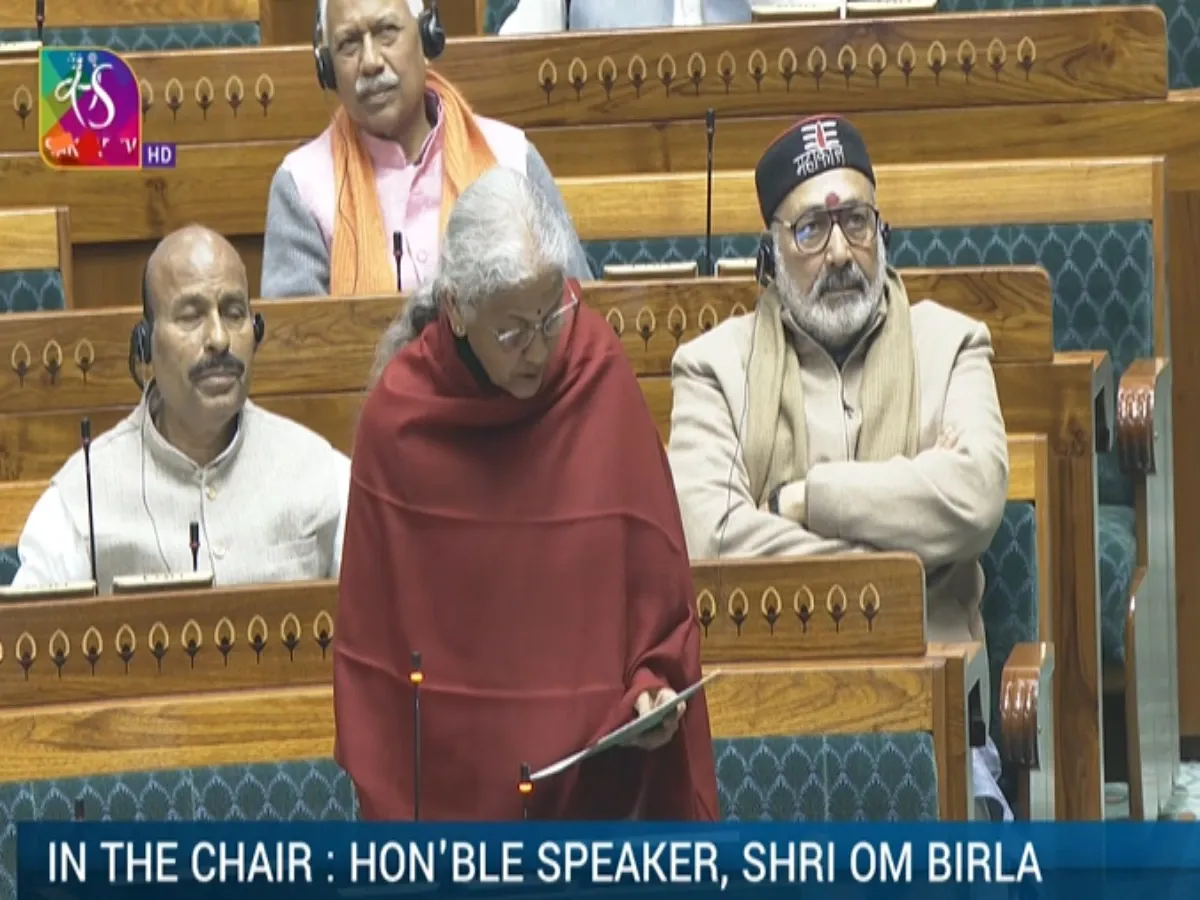
Union Finance Minister Nirmala Sitharaman on Thursday tabled the Economic Survey 2025-26 in the Lok Sabha
Union Finance Minister Nirmala Sitharaman on Thursday tabled the Economic Survey 2025-26 in the Lok Sabha ahead of the presentation of the Union Budget.
The annual document, prepared by the Economic Division of the Department of Economic Affairs, comprises 16 chapters and includes a separate chapter on artificial intelligence.
The Economic Survey projected India’s economy to grow in the range of 6.8% to 7.2% in the financial year 2026-27.
"The outlook, therefore, is one of steady growth amid global uncertainty, requiring caution, but not pessimism," said the pre-Budget document tabled in the Lok Sabha.
"With domestic drivers playing a dominant role and macroeconomic stability well anchored, the balance of risks around growth remains broadly even," it added.
Fiscal consolidation
In its preface, the Survey said 2025 unfolded very differently from initial expectations for the world, but one key continuity was India’s “strong macroeconomic performance” in the post-Covid period.
The Survey said the government announced “significant tax breaks for households” in the Budget for FY26 and achieved a fiscal deficit of 4.8% of GDP in FY25, better than the budgeted 4.9%.
It also reaffirmed the target of reducing the deficit to 4.4% in FY26, fulfilling a commitment made in 2021 to sharply consolidate public finances.
India also received credit rating upgrades from three agencies in 2025, including S&P’s upgrade from BBB- to BBB, which the Survey described as the country’s “first credit rating upgrade from a major agency in nearly two decades”.
India is now anticipating “a full-year real growth rate of over 7%, with another year of real growth at or near 7%”, Chief Economic Advisor V. Anantha Nageswaran said.
Inflation 'tamed and anchored'
The Economic Survey highlighted that India has achieved a sharp and sustained moderation in inflation, with price pressures now “tamed and anchored” amid easing global commodity prices, favourable agricultural conditions and effective monetary and fiscal interventions.
Domestically, retail inflation, as measured by the Consumer Price Index (CPI), has followed a “clear downward trajectory”, declining from 6.7% in 2022–23 to 1.7% in 2025–26 (up to December).
“April–December 2025 marked the lowest average inflation rate in the current CPI series,” it said.
Headline inflation fell sharply from 3.2% in April 2025 to 1.4% in September 2025 and eased further to 0.3% in October 2025, the lowest reading in the current CPI series.
While core inflation appeared sticky, the Survey said this was largely due to sharp increases in precious metals prices amid global uncertainty.
The Survey said the base effect played a dominant role in FY26, with its downward influence outweighing month-on-month price pressures in most months, thereby exerting “significant disinflationary pressure”.
A favourable agricultural outlook has also created a benign inflation environment, it said, noting normal or excess rainfall across most states, record cereal production in 2024–25, and strong output growth in oilseeds.
The Survey cautioned that risks from currency depreciation, base metal price surges and global uncertainties persist and warrant continued policy vigilance.
However, it said soft global commodity prices, adequate foodgrain stocks and policy responsiveness are likely to limit inflationary pressures.
“In conclusion, India’s inflation rate – headline and core excluding precious metals – will likely be higher in FY27 than in FY26. However, we believe it is unlikely to be a concern,” the Survey said.
Rupee 'punching below its weight'
However, the CEA noted that India’s strongest macroeconomic performance in decades coincided with a global environment that “no longer rewards macroeconomic success with currency stability, capital inflows, or strategic insulation”.
“The rupee’s valuation does not accurately reflect India’s stellar economic fundamentals,” it said, adding that the currency is “punching below its weight” amid volatile capital flows and geopolitical tensions.
US tariffs and trade deal
The Survey said the announcement of an additional 25% tariff by the United States on Indian exports in August “surprised many”, as India was expected to be an early beneficiary of the new US tariff regime.
“Growth forecasts were revised downward. But in reality, growth accelerated due to a slew of structural reforms and policy measures,” the Survey said, referring to a major overhaul of the GST, reforms in nuclear power and insurance, notification of labour codes and easing of regulatory norms for industry.
According to the document, the ongoing negotiations for a bilateral trade agreement with the United States are expected to conclude this year, which would help reduce uncertainty on the external front.
India and the US are negotiating a trade agreement since March last year. So far, six rounds of negotiations have been held.
The imposition of additional 25% tariff on Indian goods over Russian crude purchase stalled the trade talks.
3 global scenarios for 2026
The Economic Survey outlined three possible global scenarios for 2026, warning that rising geopolitical rivalry, financial fragility and policy uncertainty have made the global system “less coordinated, more risk-averse, and more exposed to non-linear outcomes with a narrower margin of safety”.
The first and best-case scenario for 2026, according to the Survey, is “business as in 2025”, but in a more fragile global setting.
“In this setting, with the margin of safety being thinner, minor shocks can escalate into larger reverberations,” it said.
The report added that the scenario would involve “managed disorder” rather than stability, with governments intervening more frequently to stabilise expectations.
The Survey attached “a subjective probability of around 40% to 45%” to this outcome.
The second scenario envisages a sharper deterioration in global coordination, where “the probability of a disorderly multipolar breakdown rises materially and cannot be treated as a tail risk”.
“Strategic rivalry intensifies, the Russia–Ukraine conflict remains unresolved in a destabilising form, and collective security arrangements unravel,” it said.
In such a scenario, trade could become “increasingly explicitly coercive” and financial stress transmitted across borders “with fewer buffers and weaker institutional shock absorbers”.
This scenario was also assigned a probability of “around 40% to 45%”.
The third scenario, with a residual probability of “10% to 20%”, involves “the risk of a systemic shock cascade in which financial, technological, and geopolitical stresses amplify one another rather than unfolding independently”.
“If such developments were to coincide with geopolitical escalation or trade disruption, the resulting interaction could produce a sharper contraction in liquidity, a sudden weakening of capital flows, and a shift toward defensive economic responses across regions,” it said.
The Survey warned the macroeconomic consequences “could be worse than those of the 2008 global financial crisis”.
External sector
A surplus in services trade has helped stabilise India’s external sector but cannot substitute for a strong manufacturing export base if the country is to achieve durable currency stability, the Economic Survey said.
It reiterated that “currency strength, in general, or currency stability during crises, has always eluded countries that could not become successful and significant exporters of manufactured goods”.
“Countries with strong, stable currencies are known for their manufacturing excellence,” it said.
The Survey noted that India’s export performance since the start of the millennium shows services consistently outpacing goods exports.
“Over the five years since 2020, the compounded annual growth rate of total exports has been 9.4%, while that of merchandise exports has been only 6.4%,” it said.
However, it cautioned that services are “not a substitute for the goods-based export ecosystems that ultimately underpin durable external and currency stability”.
Gig Economy
The Survey called for significant policy interventions in the gig economy, suggesting the setting of "minimum per-hour or per-task earnings" for the workers.
“About 40 per cent of gig workers report earnings below ₹15,000 per month,” the Survey said.
The Survey flagged concerns over the increasing role of platform algorithms in determining work allocation, performance monitoring and wages, warning of “algorithmic biases and burnout”.
"Policy should address this through competition rules, data access, and algorithmic transparency, while reorganising the social contract so that gig work benefits workers more fairly," it said.
The Lok Sabha was adjourned for the day after the tabling of the Survey and will reconvene on February 1, 2026.
Related News


About The Author
Next Story