
Business News
India to flag off first hydrogen fuel cell train with 10 coaches; Check route, capacity and more
.png)
3 min read | Updated on July 17, 2026, 14:17 IST


SUMMARY
The 10-coach train, capable of carrying around 2,600 passengers, will initially operate on the 89-km Jind-Sonipat route in Haryana under Northern Railway.
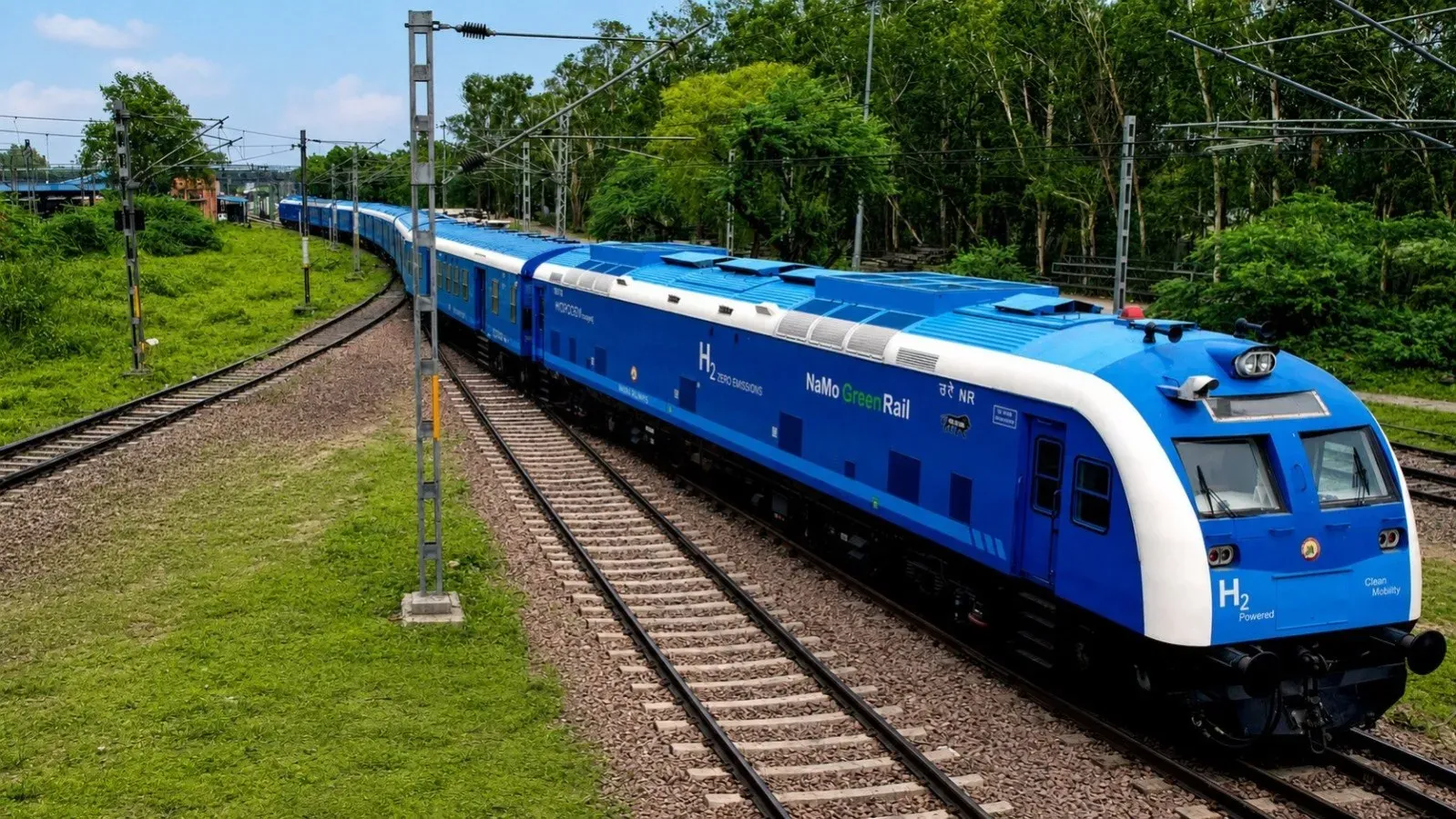
The train consists of two hydrogen-powered driving cars and eight trailer coaches, with a combined power output of 2,400 kW. Image: PIB
India is set to flag off its first hydrogen fuel cell-powered train, marking its entry into hydrogen-based rail transport, the government said on Thursday.
The train generates electricity onboard using hydrogen fuel cells instead of drawing power from overhead lines.
The 10-coach train, designed to carry around 2,600 passengers, will initially operate on the 89-km Jind-Sonipat section of Northern Railway in Haryana.
Proposed halts include Jind City, Pandu Pindara Junction, Lalit Khera Halt, Bhambhewa, Isapur Kheri Halt, Butane Halt, Khandrai Halt, Rabrah Halt, Lath Halt, Mohana, Barwasni Halt and Sonipat New.
According to the Railways, the hydrogen-powered train is expected to run at an operational speed of 75 kmph, with a design speed of 110 kmph.
Unlike diesel locomotives, the train uses Proton Exchange Membrane (PEM) fuel cells, where hydrogen combines with oxygen from the air to produce electricity.
The only direct by-products of the process are water vapour and heat, resulting in near-zero emissions at the point of use.
The train consists of two hydrogen driving power cars and eight trailer coaches. Each power car produces 1,200 kW of power, taking the combined output to 2,400 kW to propel the train.
The Railways said the train has been equipped with multiple safety systems to address concerns around the use of hydrogen, a highly flammable gas.
The sensors will continuously monitor hydrogen leaks, heat, flames and smoke.
Automatic shutdown mechanisms have been incorporated to cut off hydrogen supply in case of any abnormality, while continuous ventilation systems prevent the accumulation of leaked hydrogen.
The loco pilot's cabin has also been provided with dedicated safety features and real-time system monitoring.
The hydrogen storage, production and refuelling facility at Jind has also been fitted with leak detectors, flame detection systems, automatic shutdown mechanisms, water spray systems and fire alarms, the statement said.
The government said the hydrogen ecosystem has been designed in line with international standards and complies with the requirements of the Petroleum and Explosives Safety Organisation (PESO).
It added that the project also underwent an independent third-party safety assessment by Germany-based TÜV SÜD before operational clearance.
Indian Railways has established a hydrogen production and refuelling facility at Jind, where hydrogen is produced through electrolysis, compressed and dispensed to the train. The facility can store nearly 3,000 kg of hydrogen and allows simultaneous refuelling of both power cars.
“Hydrogen-powered trains are still at a nascent stage globally,” the government said.
Germany became the first country to introduce commercial hydrogen passenger trains, while France, Italy, China, Japan and a few other countries are pursuing pilot projects or limited deployments.
“However, these trains typically comprise two to four coaches and are intended primarily for regional passenger services,” it added.
Indian Railways said it also plans to explore the deployment of hydrogen-powered trains on heritage routes, including the Kalka-Shimla railway, based on the experience gained from the Jind-Sonipat project.
About The Author
Next Story

