Business News
India's power sector needs $700 billion investment to achieve net-zero pledge: Moody's
.png)
4 min read | Updated on February 19, 2025, 18:39 IST


SUMMARY
Investments in the power sector include capital spending for electricity generation (including renewable energy, coal and nuclear power), electricity transmission and distribution and energy storage.
Moody’s expects India’s economy to grow at a rate of nearly 6.5% per annum over the next 10 years with a compound annual growth rate (CAGR) for power demand of around 6%
India’s power sector, which is the country’s biggest carbon emitter, would need an investment of $700 billion over the next 10 years to help the country achieve its net-zero by 2070 pledge, Moody’s Ratings said on Wednesday, February 19.
As the power sector accounts for nearly 37% of the total carbon emissions of the country, Moody’s said that the sector’s investments during 2026-51 must be 1.5% to 2% of the GDP (around 2% for the next 10 years), adding that the target is manageable for India.
India’s power sector is currently highly dependent on coal-fired generation, which means it has to make significant investments in decarbonisation for the country to meet its emission goals.
"Our expectation of strong economic growth over the next 10 years implies an expansion of India's coal-based power generation capacity in that period, hindering carbon transition," it said.
Moody’s in a note said that the investment requirement for the sector is estimated to be between ₹4.5 lakh crore to ₹6.4 lakh crore ($53 billion to $76 billion) until fiscal 2034-35 and nearly ₹6 lakh crore to ₹9 lakh crore annually over fiscal 2026-51.
"We estimate India's power sector investments would be in the range of ₹4.5 lakh crore to ₹6.4 lakh crore ($53 billion to $76 billion) until fiscal 2034-35 (total investment of around $700 billion over the next 10 years), and ₹6.0 lakh crore to ₹9.5 lakh crore annually over fiscal 2025-51," it said.
Investments in the power sector include capital spending for electricity generation (including renewable energy, coal and nuclear power), electricity transmission and distribution and energy storage.
"Annually, this represents 2% of real GDP over the next 10 years, and 1.5-2% of GDP over fiscal 2026-51," it said. "These investments are significant and will be funded jointly by the public and private sectors and foreign and domestic capital."
GDP growth and electricity consumption
Moody’s expects India’s economy to grow at a rate of nearly 6.5% per annum over the next 10 years with a compound annual growth rate (CAGR) for power demand of around 6%.
According to the International Energy Agency (IEA), the per capita consumption of electricity in India (1,255 kilowatt-hours (KWH) in fiscal 2022) is around one-third of the world average. Consumption is expected to increase with the growth of the Indian economy and improved living standards among the population.
"Our projection of an increase of around 450 GW of renewable energy capacity over this period would be insufficient to meet such demand, implying that India's coal-based power generation capacity will continue to expand by 35% (from 218 GW to around 295 GW) over the next 10 years," it said.
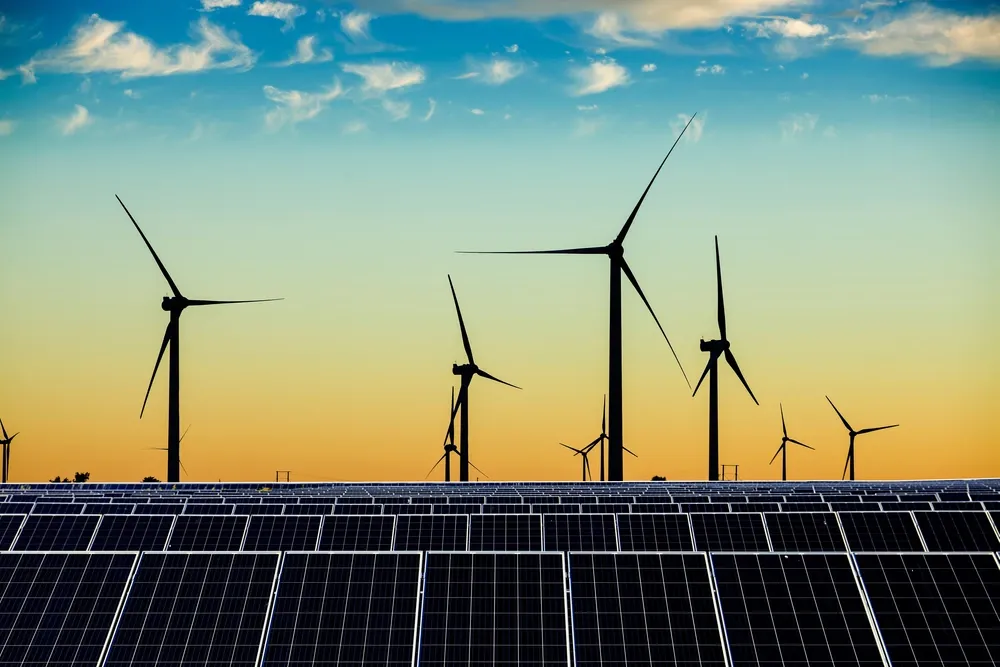
Thus, the investments in order to meet the net-zero target will have to be focused on renewable energy, grid networks and energy storage. It added that solar and wind power will dominate the new generation capacity additions over the next 20-25 years while the nuclear and hydropower additions will be smaller.
"We expect installed generation capacity to increase by 2.0x-2.2x by fiscal 2034-35 to meet India's power demand growth of 1.7x-1.8x in the same period. Non-fossil fuel power will account for 45-50% of total output by fiscal 2034-35, from 23.5% in fiscal 2023-24," it said.
Moody’s also said that the private sector in the country is essential for the transition and foreign capital is necessary for funding the gap. It expects the private sector to play an active role in the country’s renewable energy sector and an increased participation from government-owned companies.
For financial assistance, conventional banks and non-bank financial institutions will be the primary source of debt capital for under-construction projects, Moreover, debt capital markets, both domestic and international, will be crucial for refinancing debt for the operational projects.
By signing up you agree to Upstox’s Terms & Conditions

About The Author
Next Story