Business News
India, New Zealand sign FTA with 100% duty-free access for Indian exports
.png)
4 min read | Updated on April 27, 2026, 16:29 IST


SUMMARY
The agreement includes a commitment to facilitate $20 billion in investment into India and is expected to deepen economic ties, expand market access and support MSMEs, farmers and professionals.
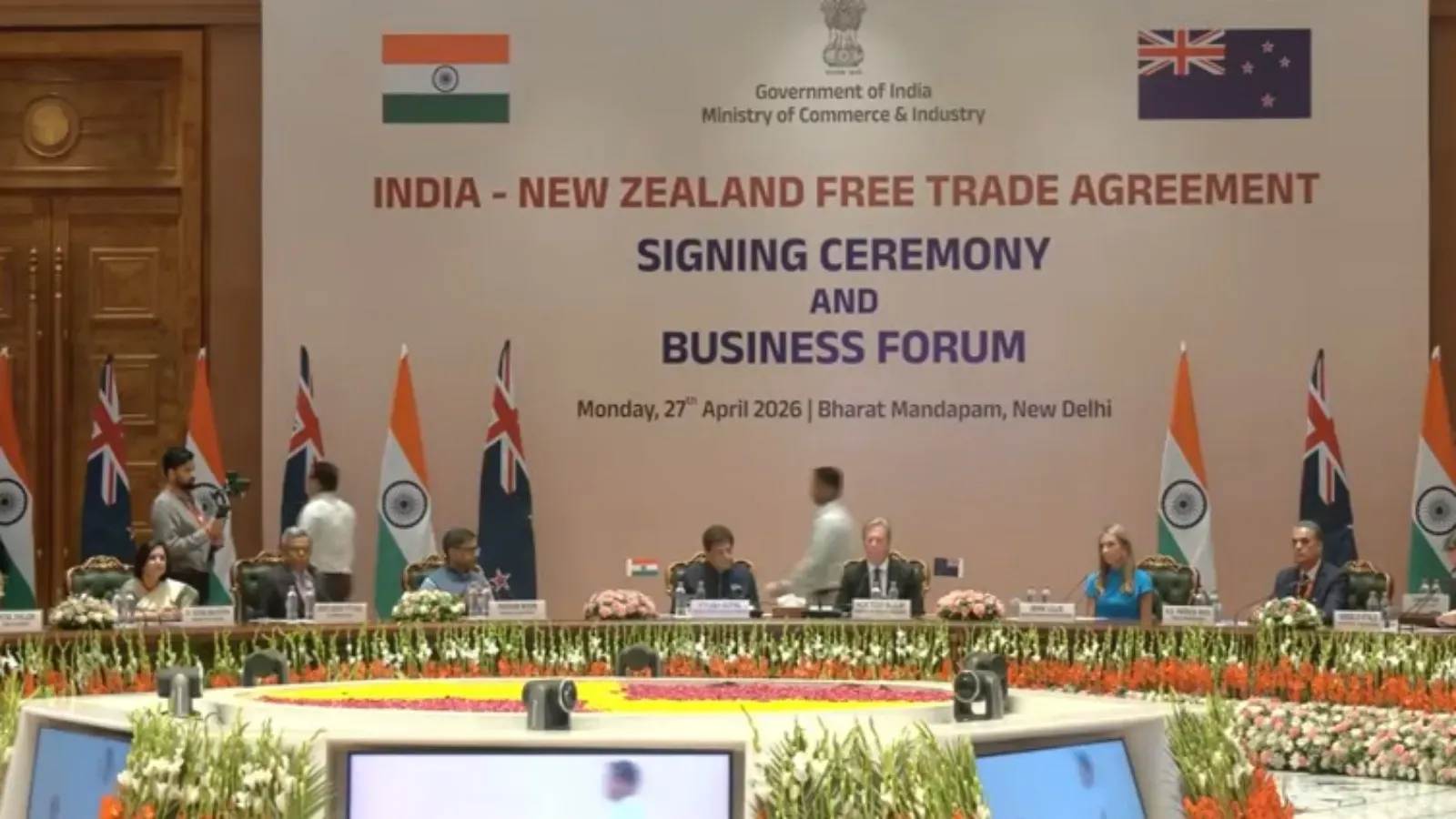
The pact was signed by Commerce and Industry Minister Piyush Goyal and visiting New Zealand's Trade and Investment Minister Todd McClay.
India and New Zealand on Monday signed a free trade agreement (FTA) that will grant duty-free access to 100% of Indian exports to the Pacific nation.
Announcing the pact, Union Commerce and Industry Minister Piyush Goyal said the agreement, concluded in a record nine months, marks a “defining milestone” in the bilateral economic ties.
Describing it as India’s first “women-led” FTA, Goyal said the pact reflects “deep mutual trust” and opens opportunities for MSMEs, farmers, women, youth and professionals, while safeguarding sensitive domestic sectors through a “balanced and calibrated framework”.
In a post on X, New Zealand Prime Minister Christopher Luxon termed the agreement a “historic milestone” and said it would unlock significant opportunities for both countries.
Luxon said the FTA, negotiations for which were launched during his visit to India last year, would help diversify New Zealand’s export markets and support its goal of doubling export value over the next decade, while giving its exporters a level playing field in India.
“For India, this deal means growth, innovation and new opportunities,” he said.
He added that Indian exporters would get tariff-free access to New Zealand from day one, while Indian consumers would benefit from improved access to high-quality New Zealand goods.
Luxon also highlighted cooperation in agriculture and technology, saying the pact would enable India to benefit from New Zealand’s expertise in agri-tech and food production, and described the agreement as a commitment to “stable, predictable, and rules-based trade” amid global uncertainty.
Zero-duty access
The FTA provides duty-free access for 100% of India's exports to New Zealand, covering all tariff lines or product categories. This is expected to enhance competitiveness in sectors such as textiles, apparel, leather, footwear, gems and jewellery, engineering goods and processed foods.
Earlier, New Zealand imposed tariffs of up to 10% on several Indian products, including ceramics, carpets, automobiles and auto components.
With the elimination of duties, Indian exporters will now operate on a level playing field with competitors from countries that already have trade agreements with New Zealand.
India has also secured duty-free access to key inputs such as wooden logs, coking coal, and metal scrap, which is likely to reduce production costs and improve global competitiveness for domestic manufacturers.
About 30% of tariff lines will see immediate duty elimination, while 35.6% will undergo phased cuts over three to ten years.
A small share of goods, including apples, kiwi fruit and Manuka honey, will be governed by tariff rate quotas with safeguards such as minimum import prices.
Services, mobility and talent pathways
New Zealand has offered market access in around 118 services sectors, including IT, professional services, telecom, education, financial services and tourism, along with most-favoured-nation commitments in about 139 sub-sectors.
The agreement creates new mobility pathways for Indian professionals and students. A Temporary Employment Entry visa route will allow up to 5,000 Indian professionals at a time to work in New Zealand for up to three years in sectors such as IT, healthcare, engineering and education.
It also removes numerical caps on Indian students, allows part-time work during study, and offers post-study work visas of up to three years for graduates and up to four years for doctoral candidates.
Calibrated tariff cuts, sensitive sectors protected
Under the pact, India has offered tariff liberalisation on 70.03% of tariff lines, covering 95% of bilateral trade value, while excluding 29.97% to shield sensitive sectors.
Items kept out of tariff concessions include dairy products, most animal products, key agricultural goods such as onions, pulses and corn, sugar, certain oils, and select metals and defence-related items.
New Zealand is one of the world's largest dairy exporters, while India is home to millions of small dairy farmers for whom market protection is a red-line issue. In practice, however, current trade is minimal.
India has always resisted opening the door to bulk dairy imports in all of its previous pacts.
Duty elimination will be immediate on about 30% of New Zealand tariff lines, covering products such as wood, wool, sheep meat and raw hides.
Another 35.6% of tariff lines will see phased reductions over periods ranging from three to ten years, including petroleum products, vegetable oils, machinery and select industrial inputs.
New Zealand exports such as wine, pharmaceuticals, polymers, aluminium, iron and steel products will see tariff reductions, while a small share of goods will be subject to tariff rate quotas.
$20 billion investment commitment
The FTA also includes a commitment to facilitate USD 20 billion in investment into India.
A rebalancing clause is incorporated into the Agreement to provide a framework for addressing any shortfall in investment delivery.
Bilateral trade in goods and services between the two countries stood at about USD 2.4 billion in 2024.
About The Author
Next Story